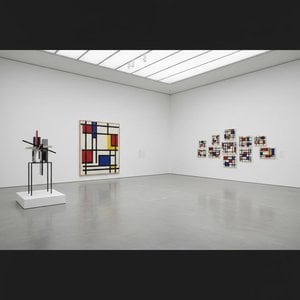
Composition III blue and yellow
Piet Mondrian’s Composition III blue and yellow isn't merely a painting; it’s a declaration of artistic intent, distilled from the turbulent currents of early 20th-century abstraction into a visual emblem of harmonious equilibrium. Emerging from the vanguard of Neoplasticism – a style Mondrian championed as a pathway toward universal beauty – this canvas presents a rigorously structured grid of black lines dividing space into rectangles filled with primary colors: bold reds, serene blues, and luminous yellows punctuated by areas of pure white. It’s deceptively simple in appearance but harbors a profound intellectual quest rooted in geometric abstraction.
From Impressionism to Neo-Plasticism: A Journey Towards Pure Form
To truly appreciate Composition III blue and yellow, one must understand Mondrian's artistic evolution from his initial foray into landscape painting—characterized by Impressionistic brushstrokes capturing the fleeting beauty of Dutch scenery—to his decisive embrace of Cubism. This pivotal shift propelled him toward deconstructing forms, dismantling traditional perspective, and gradually reducing his palette. This transformative process culminated in the birth of Neo-Plasticism around 1917, a stylistic manifesto driven by philosophical convictions about expressing underlying spiritual truths through the purest possible visual language.
The Language of Geometry: Balance and Dynamic Harmony
Neo-Plasticism wasn’t simply an aesthetic preference; it was a systematic approach to art informed by Mondrian's belief in opposing forces – masculine and feminine, static and dynamic – achieving equilibrium when perfectly balanced. The horizontal and vertical lines represent these antithetical principles, creating a rhythmic interplay that governs the composition. Simultaneously, the primary colors—red, blue, and yellow—were chosen for their inherent energy and clarity, devoid of emotional connotations. White serves as a crucial element, allowing the colors to breathe and resonating with their fundamental purity.
A Microcosm of Universal Harmony: Analyzing the Composition
Consider the arrangement itself. The black lines delineate a square grid, dividing the canvas into nine rectangles—four horizontal and five vertical—each filled with one of the primary colors. This seemingly austere structure belies a meticulous calculation designed to achieve dynamic equilibrium. As Stephanie Chadwick eloquently observes, “Mondrian’s *Composition III blue and yellow* demonstrates his commitment to relational opposites, asymmetry, and pure planes of color.” The careful placement of colored rectangles isn't random; it reflects Mondrian’s conviction that visual art could embody universal harmony.
A Legacy Enduring: Influence on Modern Design
The impact of Piet Mondrian extends far beyond the confines of painting. His geometric aesthetic principles have profoundly influenced architects, designers, and artists throughout the 20th century—and continue to inspire contemporary creations. From furniture design to fashion, the clean lines, bold colors, and simplified forms characteristic of Neo-Plasticism embody a timeless elegance that transcends stylistic trends. Owning a reproduction of Composition III blue and yellow isn’t merely acquiring an artwork; it's embracing a legacy of artistic innovation—a testament to Mondrian’s unwavering belief in the transformative power of abstraction.



 Aperçu en situation
 Commander la reproduction peinte à la main
 Envoyer
 Partager
 Détails de l'œuvre

 Télécharger
 Articles similaires
 Radiographie
 Diaporama
 Statistiques

 Lire la suite






































 L'option verre n'est disponible que pour les dimensions inférieures à 110 cm.