Aperçu en situation Aperçu en RA Acheter la peinture faite à la main Passer au format image numérique Partager
Détails Ajouter aux favoris Télécharger Articles similaires Radiographie Voir le diaporama Statistiques

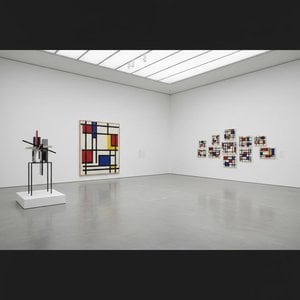
Composition avec rouge, jaune et bleu

Découvrez « Composition avec rouge, jaune et bleu » (1922) de Piet Mondrian. Un chef-d'œuvre néoplasticiste révolutionnaire aux couleurs primaires – un pilier de l'art moderne. Achetez des reproductions de haute qualité !

Explorez l'art de Piet Mondrian (1872-1944), un pionnier de l'art abstrait et du mouvement De Stijl. Découvrez ses peintures géométriques emblématiques, son style néoplasticiste et son influence durable sur le design moderne, l'architecture et l'art du 20e siècle.

Giclées et impressions d'art

Impressions giclées ou sur toile de qualité musée, avec une production rapide et des finitions au choix. ( Acheter la peinture faite à la main Passer au format image numérique)

P118B $10
P118H $10
P118W $10
P438Z $10
P508JH $12
P508YH $12
P805H $10
P805Z $10
P919BZ $10
P919G $10
P919XJ $10
P959ZH $10
P968JZ $12
W106C $8
W218G $10
W218JH $8
W218Y $10
W307PJ $10
W316G $10
W316PJ $8
W316Y $10
W398PJ $8
W4111J $10
W500HY $15
W500JH $15
W692G $12
W849H $8
W940BG $15
W953PJ $8

Format standard
personnalisé
CM
INCH

Choisissez parmi nos formats prédéfinis qui respectent les proportions originales de l’œuvre.

largeur
hauteur

Vous pouvez saisir vos propres dimensions pour vous adapter à un cadre ou à un espace spécifique. Si la taille sélectionnée ne correspond pas aux proportions de l'image originale, nous recadrerons l'œuvre ou étendrons l'image avec une bordure en miroir ou une couleur unie. Une maquette numérique vous sera envoyée pour approbation avant le début de la production.
Veuillez noter que l'aperçu à l'écran ne reflète pas le recadrage ou l'extension réelle. Seule la maquette montrera avec précision la composition finale.
Bien que des tailles personnalisées soient disponibles, nous vous recommandons de choisir une dimension dans la liste prédéfinie afin de préserver les proportions originales.

Livraison dans le monde entier () en 2 semaines au lieu des 4/5 semaines habituelles. (17 septembre)

why_choose_icon
Livraison express gratuite dans le monde entier
why_choose_icon
Toile de lin de haute qualité
why_choose_icon
Assurance transport complète
why_choose_icon
Garantie de remboursement des droits de douane
why_choose_icon
Garantie de fidélité des couleurs
why_choose_icon
Garantie de retour de 100 jours (uniquement en cas de défaut)
why_choose_icon
Garantie de remboursement à 100%
why_choose_icon
Tarifs dégressifs sur quantité

Prix total

$ 68

reproduction

Composition avec rouge, jaune et bleu

Giclées et impressions d'art

Format de la reproduction

-

Prix total final

$ 68

L'essentiel de l'œuvre

  • Movement: Neoplasticism
  • Title: Composition with Red, Blue & Yellow
  • Notable elements or techniques: Geometric abstraction; Primary colors
  • Dimensions: 16 x 19 cm
  • Year: 1922
  • Medium: Oil on Canvas
  • Influences: Theosophy

Quiz d'art

Chaque question ne comporte qu'une seule bonne réponse.

Question 1:
What art movement is Piet Mondrian’s ‘Composition with Red, Yellow and Blue’ associated with?
Question 2:
In what year was ‘Composition with Red, Yellow and Blue’ created?
Question 3:
What are the primary colors prominently featured in this painting?
Question 4:
The painting utilizes geometric shapes. Which of these shapes are most evident?
Question 5:
What philosophical influence is suggested by Mondrian's exploration of universal language through art?

The Essence of Pure Form: A Journey into Mondrian’s Geometric Revelation

In the quiet evolution of modernism, few works possess the radical clarity of Piet Mondrian’s Composition with Red, Yellow and Blue. Created in 1922, this masterpiece serves as a profound window into the soul of Neoplasticism, a movement that sought to strip away the distractions of the physical world to reveal a deeper, universal truth. While many artists of his era were still tethered to the representational beauty of landscapes and figures, Mondrian embarked on a daring intellectual voyage. He moved beyond the lush textures of Dutch Impressionism toward a visual language composed of nothing but the most fundamental elements: straight lines, primary colors, and a rigorous sense of equilibrium.

To gaze upon this canvas is to witness a deliberate distillation of reality. The painting does not attempt to mimic the organic chaos of nature; instead, it constructs an architectural meditation on order. Through a masterful use of horizontal and vertical black lines, Mondrian establishes a structural grid that anchors the viewer’s eye. Within this framework, the vibrant pulses of red, yellow, and blue emerge not as mere decorations, but as elemental forces. There is a rhythmic tension at play here—a silent dialogue between the weight of the bold color blocks and the airy lightness of the white spaces, creating a sense of dynamic stability that feels both ancient and avant-garde.

A Symphony of Primary Truths

The technical brilliance of this work lies in its deceptive simplicity. Though the palette is strictly limited to the primary triad, the emotional resonance is vast. For the discerning collector or interior designer, this piece offers a timeless sophistication that transcends fleeting trends. The use of primary colors—red for energy, yellow for light, and blue for depth—mirrors the philosophical pursuits of Theosophy, which heavily influenced Mondrian’s search for spiritual harmony through geometric purity. Every intersection of line and color is calculated to achieve a state of "relational opposites," where asymmetry provides a much more complex and engaging balance than traditional symmetry ever could.

For those looking to infuse a contemporary space with intellectual depth, a high-quality reproduction of this composition acts as a focal point of clarity. It brings an atmosphere of structured calm and modern elegance to any room, whether it be a minimalist gallery setting or a vibrant, eclectic living area. The painting does not merely occupy space; it organizes it. By introducing such a disciplined aesthetic, the artwork invites contemplation, encouraging the viewer to find beauty in the essential and strength in the simple.

The Legacy of Neoplasticist Vision

Understanding this work requires acknowledging the transformative era from which it emerged. Mondrian’s transition from the soft, atmospheric studies of his youth to this uncompromising abstraction represents one of the most significant shifts in art history. This 1922 composition stands as a pivotal moment where the artist successfully translated complex philosophical inquiries into a visual shorthand that remains legible and powerful over a century later. It is an invitation to look past the surface of things and appreciate the underlying geometry of existence.

Owning or displaying such a piece is more than a decorative choice; it is an engagement with the very foundations of 20th-century modernism. As a cornerstone of the De Stijl spirit, this artwork continues to inspire architects, designers, and art lovers alike, proving that true innovation does not require complexity, but rather the courage to find perfection in the most basic building blocks of our visual world.


Biographie de l'artiste

**Je jeunesse et sa carrière aux Pays-Bas (1872-1911)**

pieter cornelis mondriaan, connu depuis 1911 sous le nom de piet mondrian, était un peintre et théoriciens de l'art néerlandais né le 7 mars 1872 à Amersfoort, aux Pays-Bas. Il a commencé sa carrière comme enseignant dans l'enseignement primaire tout en pratiquant la peinture, initialement dans le style impressionniste néerlandais de l'École de La Haye.
  • Ses premières œuvres, caractérisées par des paysages naturalistes, peuvent être vues dans des peintures telles que The Red Mill et Trees in Moonrise, exposées au Kunstmuseum Den Haag.
  • La recherche de Mondrian d'un style personnel l'a conduit à explorer divers mouvements artistiques, notamment le pointillisme et le fauvisme.
  • Sa première exposition en 1893 a marqué le début de sa carrière prolifique.

**L’évolution du style de Mondrian**

De la figure à l'abstraction La direction artistique de Mondrian s'est orientée vers un style de plus en plus abstrait, culminant dans une forme non-représentative qu'il a appelée néoplasticisme. Cette « art plastique pur » visait à créer « une beauté universelle », limitant son vocabulaire formel aux couleurs primaires (rouge, bleu et jaune), aux valeurs (noir, blanc et gris) et aux directions (horizontale et verticale).

**Héritage et influence**

L’héritage de Mondrian s’étend au-delà de son propre travail, influençant les grands styles et mouvements tels que la couleur field painting, l'expressionnisme abstrait et le minimalisme. L'historien d'art Stephen Bayley a noté que Mondrian est devenu un totem pour tout ce que le modernisme visait à être.
  • Découvrez davantage du travail de Mondrian sur WahooArt.com.
  • Apprenez-en plus sur le mouvement De Stijl et son influence sur l'art moderne à wikipedia.
  • Découvrez d’autres artistes influents tels que Vincent van Gogh et leur impact sur le monde de l'art.

**Œuvres clés et expositions**

* Piet Mondrian: Apple Blossom (Cubisme) (voir sur WahooArt.com) * Piet Mondrian: Still Life with Vase of Spices II (Cubisme) (voir sur WahooArt.com) * Piet Mondrian: Passionflower (73 x 48 cm, Kunstmuseum Den Haag, post impressionisme, aquarelle) (voir sur WahooArt.com)
Piet Mondrian

Piet Mondrian

1872 - 1944 , Pays-Bas

En bref

  • Artistes Influents:
    • École de La Haye
    • Pointillisme
    • Fauvisme
    • Cubisme
  • Date De Naissance: 7 mars 1872
  • Influences Artistiques:
    • Color Field painting
    • Expressionnisme abstrait
    • Minimalisme
  • Lieu De Naissance: Amersfoort, Pays-Bas
  • Mouvement Artistique: De Stijl, Néoplasticisme
  • Nationalité: Néerlandais
  • Nom Complet: Piet Mondrian
  • Oeuvres Notables:
    • Composition avec Rouge, Jaune et Bleu
    • Broadway Boogie Woogie
    • Tableau n°2 Composition V
    • Arbres sur le Gein. Lever de lune
Explorez des œuvres d'art classées par thèmes, styles et caractéristiques.