A Legacy Forged in Stone: The Life and Art of Pierre-Jean David d’Angers
Pierre-Jean David, dit David d’Angers, né le 12 mars 1788 à Angers et mort le 5 janvier 1856 à Paris, est un sculpteur et médailleur français, représentatif du romantisme dans la sculpture française du XIXe siècle. Son parcours artistique, profondément ancré dans les idéaux républicains de son époque, témoigne d'une évolution constante entre l’influence des traditions néoclassiques et une sensibilité nouvelle, préfigurant le mouvement romantique.
- Les Premiers Pas : Né dans une famille modeste à Angers, Pierre-Jean David grandit sous l'œil de son père, un sculpteur sur bois talentueux. Dès son plus jeune âge, il manifeste un don pour la sculpture, surpassant rapidement ses pairs et attirant l’attention de Jean-Jacques Delusse, professeur à l’École centrale d’Angers.
- Paris et l'Élévation : En 1808, il quitte Angers pour Paris, une ville vibrante de créativité et de bouleversements politiques. Il entre dans l’atelier de Philippe-Laurent Roland à l’École des Beaux-Arts, où il affine ses compétences en néoclassicisme. Il y rencontre également Jacques-Louis David, qui le prend sous son aile et lui confie des commandes importantes, marquant ainsi le début d'une collaboration fructueuse.
De la Rome Antique à la Maîtrise Néoclassique
La période passée à Rome (1811-1816) fut une véritable révélation pour Pierre-Jean David. Immers dans l’environnement de l'Antiquité classique, il est profondément influencé par les œuvres des grands maîtres tels que Antonio Canova. Il s'attache à étudier les idéaux de la sculpture grecque – son souci de l'idéal de forme, sa narration héroïque et sa maîtrise de l'émotion contenue – tout en développant un style personnel distinct. Cette expérience ne fut pas seulement académique ; elle fut également une période d’éveil politique. La restauration de la monarchie bourbonnaise à la fin de son séjour à Rome le confronta à des réalités politiques difficiles, le poussant à s'exiler brièvement en Angleterre, où il rencontra l'admiration et les critiques liées à son association avec Jacques-Louis David, figure controversée du régime révolutionnaire. Son retour à Paris fut marqué par une reconnaissance immédiate de son talent.
- Le Prix de Rome : En 1811, il remporta le prestigieux Prix de Rome pour sa sculpture "Epaminondas", ouvrant ainsi la voie à une carrière internationale et lui assurant un statut d'artiste reconnu.
- L’Influence de David : Son travail dans l'atelier de Jacques-Louis David lui permit d'acquérir une maîtrise technique exceptionnelle et de développer son propre style, caractérisé par une grande précision et un souci du détail.
Un Sculpteur de Héros et d'Idéaux
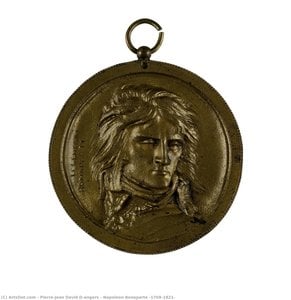
L’œuvre de Pierre-Jean David est remarquablement diversifiée, englobant des statues monumentales, des bas-reliefs, des monuments funéraires et, surtout, des médaillons en bronze. Il possédait une capacité extraordinaire à capturer non seulement la ressemblance physique mais aussi le caractère intérieur de ses sujets. Ses portraits ne se limitaient pas à des représentations ; ils étaient des interprétations – imprégnés d’une dignité, d'une intelligence et d'une force morale. Parmi ses œuvres les plus célèbres figurent "Wounded Philopoemen", conservée au Louvre, une représentation poignante du destin tragique du général grec, et "La Douleur", qui témoigne de sa maîtrise de l'expression émotionnelle. Cependant, ses commandes monumentales ont véritablement assuré sa renommée. La sculpture du fronton du Panthéon à Paris est sans doute son œuvre la plus importante – une représentation allégorique grandiose de la patrie et de l’héritage intellectuel français. D’autres œuvres notables incluent le monument Gutenberg à Strasbourg et la statue équestre de Général Gobert au cimetière Père-Lachaise, des exemples éloquents de sa capacité à transmettre le pouvoir et la dynamique grâce à la forme sculptée. Il réalisa également un portrait de Lafayette pour le Congrès américain, symbole d'une amitié franco-américaine.
Un Sculpteur de son Temps : Héritage et Signification Historique
Pierre-Jean David n’était pas seulement un sculpteur ; il était un produit de son époque – témoin des révolutions, de l’empire et de la restauration. Son art reflète les courants politiques et intellectuels qui ont façonné la France du XIXe siècle. Il embrassa les idéaux républicains, célébrant des figures incarnant le courage, l'intégrité et l'engagement envers le service public. Bien ancré dans la tradition néoclassique, son œuvre préfigurait également l’émergence du romantisme, avec son accent sur l'intensité émotionnelle et la narration dramatique. Son influence s'étendait au-delà de la sculpture, inspirant des générations d'artistes et façonnant le paysage visuel de la France. Aujourd'hui, ses œuvres sont exposées dans les musées les plus prestigieux du monde, notamment le Musée des Beaux-Arts à Angers, témoignant de son héritage durable. *David d’Angers demeure une figure fascinante – un sculpteur qui n’a pas seulement capturé les portraits de héros mais a aussi incarné l'esprit d'une époque.* Sa capacité à combiner la forme classique avec l'expression romantique continue de résonner auprès du public aujourd'hui, assurant sa place comme l'un des artistes les plus importants et les plus durables de France.



 Aperçu en situation
 Acheter la peinture faite à la main
 Partager
 Partager
 Détails
 Guide
Guide

 Télécharger
 Articles similaires
 Radiographie
 Voir le diaporama
 Statistiques


 Afficher la suite






































 L'option verre n'est disponible que pour les dimensions inférieures à 110 cm.


_-_Walters_54847.jpg)