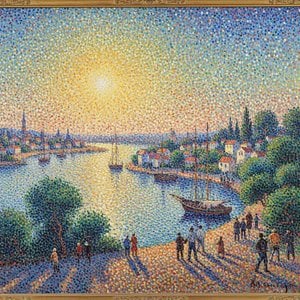
La Vision Harmonieuse de Paul Signac
Paul Victor Jules Signac, né à Paris en 1863, s'est imposé comme une figure charnière de l'évolution de l'art moderne, indissociablement lié à la naissance et au développement du Néo-Impressionnisme. Initialement attiré par l'architecture, une rencontre de jeunesse avec l'exposition de Claude Monet a allumé en lui une passion durable pour la peinture, le lançant sur une voie qui allait redéfinir la théorie des couleurs et l'expression artistique. Signac n'était pas seulement un peintre ; il était un explorateur dévoué de la lumière, de la couleur et de la science même qui sous-tend la perception visuelle. Ses premières œuvres, bien que manifestant des tendances impressionnistes, ont rapidement évolué sous l'influence profonde de Georges Seurat, forgeant un partenariat qui a donné naissance au Pointillisme – une technique caractérisée par l'application méticuleuse de minuscules points distincts de couleur pure, destinés à se mélanger optiquement dans l'œil du spectateur. Il ne s'agissait pas simplement d'esthétique ; c'était une tentative de systématiser la peinture, en l'ancrant dans des principes scientifiques et en défiant les normes artistiques conventionnelles.
Un Dialogue avec Seurat et la Naissance du Néo-Impressionnisme
La rencontre entre Signac et Seurat en 1884 s'est révélée transformative pour les deux artistes. Ils partageaient une fascination pour les écrits d'Eugène Delacroix sur la théorie des couleurs, particulièrement son exploration des contrastes complémentaires et de l'impact émotionnel de la teinte. Ensemble, ils se sont lancés dans une investigation rigoureuse de ces principes, les traduisant en une technique picturale révolutionnaire. Signac a embrassé de tout cœur la vision de Seurat, abandonnant les touches fugaces de l'Impressionnisme pour l'application précise et calculée de points de couleur.
Boulevard de Clichy (1886) constitue un premier témoignage de cette nouvelle approche, illustrant le style méticuleux de Signac et son engagement à capturer la vitalité de la vie urbaine à travers un prisme scientifique. Cependant, leur collaboration n'était pas seulement technique ; elle était intellectuelle, nourrie par le désir partagé d'élever la peinture au rang d'une science rigoureuse. Signac est devenu un fervent défenseur des idées de Seurat, promouvant sans relâche le Néo-Impressionnisme et défendant ses principes face aux critiques. La mort tragique et prématurée de Seurat en 1891 a laissé à Signac le rôle de principal champion de leur vision artistique commune, un rôle qu'il a assumé avec un dévouement inébranlable.
Rêveries Côtières et Indépendance Artistique
Après la disparition de Seurat, le voyage artistique de Signac a pris une nouvelle dimension, profondément influencée par son amour profond pour la voile et l'attrait de la côte méditerranéenne. Il découvrit Saint-Tropez en 1892, y établissant une demeure qui devint un refuge pour les artistes et une source d'inspiration infinie. Les eaux scintillantes, les ports baignés de soleil et les villes côtières pittoresques offrirent un cadre idéal pour explorer l'interaction entre la lumière et la couleur.
La Bouée Rouge, Saint-Tropez (1895) illustre parfaitement cette période, démontrant sa maîtrise du Pointillisme dans la capture des teintes vibrantes et de l'énergie dynamique de la mer. Sa technique a évolué, devenant plus fluide et expressive tout en conservant ses fondements scientifiques. Il commença à expérimenter avec des touches plus larges et une palette plus étendue, s'éloignant de l'adhésion stricte à la méthode de pointillé précis de Seurat. Les voyages de Signac s'étendirent au-delà de la France, englobant l'Italie, la Hollande et même Constantinople, chaque périple enrichissant son vocabulaire artistique et élargissant sa perspective.
Un Mécène de l'Avant-Garde et un Héritage Durable
Au-delà de ses propres aspirations artistiques, Signac joua un rôle crucial dans la promotion du développement de l'art moderne grâce à son leadership au sein de la Société des Artistes Indépendants. En tant que président de 1908 jusqu'à sa mort en 1935, il fut le défenseur de la liberté artistique et offrit une plateforme aux talents émergents, notamment Henri Matisse, André Derain et d'autres pionniers du Fauvisme et du Cubisme. Il fut parmi les premiers à reconnaître et à soutenir leurs travaux novateurs, exposant des œuvres controversées qui défiaient les normes esthétiques conventionnelles. L'engagement de Signac envers l'inclusivité et sa volonté d'embrasser l'innovation ont aidé à façonner la trajectoire de l'art du XXe siècle. Ses écrits théoriques, notamment
D'Eugène Delacroix au Néo-Impressionnisme (1899), ont davantage consolidé sa position de figure intellectuelle majeure dans le monde de l'art. L'héritage de Paul Signac s'étend bien au-delà de ses peintures captivantes ; il fut un artiste visionnaire, un théoricien dévoué et un mécène généreux qui influença profondément le cours de l'art moderne, laissant une marque indélébile sur les générations d'artistes à venir.
Dates Clés et Réalisations
- 1863 : Naissance à Paris, France.
- 1884 : Cofondateur de la Société des Artistes Indépendants avec Georges Seurat.
- 1886 : Peint *Boulevard de Clichy*, un exemple clé du début du Pointillisme.
- 1895 : Création de *La Bouée Rouge, Saint-Tropez*, illustrant sa maîtrise des scènes côtières.
- 1899 : Publication de *D'Eugène Delacroix au Néo-Impressionnisme*, une œuvre séminale sur la théorie des couleurs.
- 1908 – 1935 : Président de la Société des Artistes Indépendants, défenseur des artistes d'avant-garde.
- 1935 : Décès à Paris à l'âge de 72 ans, laissant derrière lui un riche héritage artistique.



 Aperçu en situation
 Commander la reproduction peinte à la main
 Envoyer
 Partager
 Détails de l'œuvre

 Télécharger
 Articles similaires
 Radiographie
 Diaporama
 Statistiques


 Lire la suite






































 L'option verre n'est disponible que pour les dimensions inférieures à 110 cm.