Paul Cézanne: Still Life – A Window Into Modern Art
Paul Cézanne’s
Still Life isn't merely a depiction of fruit and vessels; it’s a cornerstone of artistic revolution—a deliberate dismantling of Impressionistic conventions to forge the path toward Cubism and beyond. Painted in 1877 and currently residing within the hallowed halls of the Metropolitan Museum of Art, this artwork transcends its visual elements to embody Cézanne's profound philosophical engagement with art itself. He wasn’t simply trying to represent what he saw; he was striving to capture the essence of form—the underlying structure that defines an object’s presence in space.
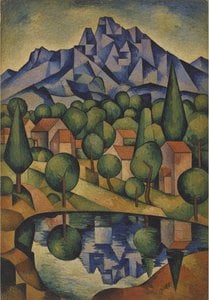
The painting immediately confronts us with Cézanne’s signature technique: planar abstraction. Rather than painstakingly rendering individual contours and textures, Cézanne employs overlapping planes of color—primarily shades of green, brown, and red—to build up complex fields of visual information. This method prioritizes geometric simplification over realistic representation, mirroring Cézanne's belief that art should strive for permanence and universality. Notice how the apple’s form isn’t defined by shading; instead, it exists as a solid mass of color, subtly modulated to convey its volume.
Analyzing Cézanne’s Style and Technique
- Plane Shapes: Cézanne's method abandons traditional perspective, favoring flattened planes that suggest depth rather than accurately portraying spatial recession.
- Small Brushstrokes: The artist utilizes numerous tiny brushstrokes—often applied in a rhythmic manner—to create textured surfaces and build up tonal variations.
- Color Modulation: Cézanne skillfully blends colors to achieve harmonious compositions, emphasizing the interplay of light and shadow without resorting to conventional shading techniques.
The arrangement of objects within Still Life is equally deliberate. The fruits—apples, plums, peaches, and pears—are positioned on a tablecloth draped in muted tones, creating a sense of understated elegance. Two cups are strategically placed to anchor the composition, while a vase adds verticality and contributes to the overall balance.
Historical Context and Influence
Cézanne’s work emerged during a pivotal moment in art history—the waning days of Impressionism and the burgeoning excitement surrounding Cubism. He stood apart from his contemporaries, rejecting their focus on fleeting impressions of light and color in favor of exploring fundamental artistic principles. His influence extended far beyond Cézanne himself, inspiring artists like Henri Matisse and Pablo Picasso who embraced his innovative approach to form and perspective.
"The father of us all," Picasso famously declared, recognizing Cézanne’s transformative impact on modern art. Cézanne's insistence on simplifying forms—reducing objects to geometric shapes—laid the groundwork for Cubism’s groundbreaking exploration of multiple viewpoints simultaneously. This legacy continues to resonate within contemporary artistic discourse, demonstrating Cézanne’s enduring relevance as a pioneer of abstraction and a champion of artistic experimentation.
Relevance in Contemporary Art Market
- Reproductions: WahooArt offers high-quality reproductions of Cézanne's Still Life, meticulously crafted by skilled artists to capture the essence of the original masterpiece.
- Decorative Appeal: These reproductions can elevate any interior space with Cézanne’s timeless aesthetic—a testament to his artistic vision and enduring legacy.
Investing in a WahooArt reproduction allows you to experience the beauty and intellectual depth of Cézanne's Still Life—a painting that continues to inspire artists and captivate audiences worldwide.
Questions et réponses
Quelle couleur domine la composition de «Still Life» de Paul Cézanne ?
La couleur dominante de «Still Life» de Paul Cézanne est le Vert de phtalo (#2d2113).
Quel est le rapport entre le sujet de « Still Life » et les thèmes habituels de Paul Cézanne ?
«Still Life» dépeint fruit, tablecloth, cups, color, composition, harmony, landscape, texture, tandis que les thèmes récurrents de Paul Cézanne sont bridging impressionism & cubism, exploring formal structure, earthly palette & tranquility, monumental vision, influenced matisse & picasso, symbolic representation, iconic cézanne piece. La comparaison des deux montre comment l'œuvre s'inscrit dans la lignée des sujets habituels de l'artiste.
À quelle étape de la carrière de Paul Cézanne appartient « Still Life » (1877) ?
Datée de 1877, l'œuvre « Still Life » s'inscrit dans la période Mature Period du développement de Paul Cézanne.



 Aperçu en situation
 Commander la reproduction peinte à la main
 Envoyer
 Partager
 Détails de l'œuvre
 Guide
Guide

 Télécharger l'image
 Articles similaires
 Radiographie
 Diaporama
 Statistiques


 Lire la suite






































 L'option verre n'est disponible que pour les dimensions inférieures à 110 cm.