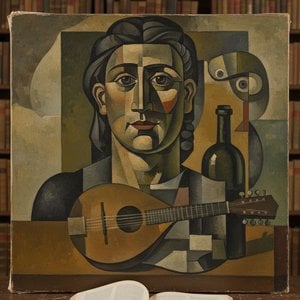
Seated Female Nude : A Bridge Between Cézanne and Africa
Pablo Picasso’s *Seated Female Nude* (1908) stands as an emblem of artistic innovation during the formative years of Cubism, embodying a profound dialogue between influences from Western masters like Cézanne and Eastern traditions rooted in African sculpture. This monumental canvas—measuring 73 x 60 cm—captures not merely a depiction of the human form but rather a deliberate exploration of spatial perception and sculptural representation, marking a pivotal moment in Picasso’s artistic evolution.
- Historical Context: The painting emerged against the backdrop of the burgeoning avant-garde movement in Paris and coincided with the Salon d’Automne honoring Cézanne—a retrospective exhibition that irrevocably altered the trajectory of young artists seeking new aesthetic horizons. Cézanne's late bather compositions, particularly *Large Bathers*, served as a crucial catalyst for Picasso’s stylistic experimentation, inspiring him to adopt a similar approach to form and structure.
- Cézanne’s Influence: Picasso recognized Cézanne’s unwavering commitment to depicting objects in their entirety—a revolutionary departure from traditional perspective—and sought to emulate this technique. As Picasso famously declared, “Painting isn’t an aesthetic process; it’s a form of magic designated as a mediator between this strange, hostile world and us…. When I came to that realization, I knew I had found my way.” The deliberate flattening of planes and the fracturing of forms—characteristic of Cézanne’s work—were adopted by Picasso to dismantle illusionistic representation.
- African Sculpture: Simultaneously, Picasso was captivated by the art of Africa, Iberia, and Oceania—a fascination fueled by visits to museums and private collections. The Musée d’Ethnographier du Trocadéro in Paris profoundly impacted his artistic vision, prompting him to embrace geometric abstraction and earthy tones reminiscent of African sculptures. He saw in these artworks a path toward liberating the human figure from conventional anatomical constraints.
- Technique: Picasso employed gauzy layers of scumbled strokes and thin washes of browns and tans—a deliberate rejection of thick impasto—to achieve an ethereal quality that contrasts sharply with Cézanne’s robust materiality. The background palette—greens and gray—further underscores this duality, mirroring the landscapes Picasso explored during 1908.
- Symbolism: The figure itself embodies a complex interplay of symbolism. Its mountainous form represents a deliberate allusion to Cézanne's monumental bather compositions, symbolizing stability and grandeur amidst fragmentation. Moreover, the cloth held between her legs echoes Cézanne’s preoccupation with drapery—a recurring motif in his paintings—emphasizing the artist’s desire to transcend mere visual depiction and engage in sculptural exploration.
Provenance: The painting was created by Pablo Picasso in 1908, during a period of intense artistic experimentation marked by the convergence of Cézanne's influence and the transformative impact of African art. Its enduring legacy resides in its pioneering contribution to Cubism—a movement that fundamentally reshaped Western art history.
Dimensions: 73 x 60 cm
Date: 1908
Detailed Analysis: Form and Space
Picasso’s masterful manipulation of form and space exemplifies the core tenets of Cubism. He deliberately excised areas beneath the breasts and on the top of her right thigh—a bold gesture that underscores Cézanne's rejection of illusionistic perspective—leaving the stomach and left thigh undefined. Simultaneously, he elongated Picasso’s stiff left hand far past her right, creating an impossible anatomical distortion that defies conventional representation. These deliberate distortions serve not merely as stylistic flourishes but rather as a conscious effort to dismantle traditional notions of volume and depth. The artist's exploration of geometric abstraction—inspired by African sculpture—further reinforces this commitment to sculptural experimentation.
Color Palette: Earthy Tones and Atmospheric Depth
The painting’s color palette—dominated by dark greens, warm browns, gray, and black—reflects Picasso’s fascination with the earthy tones prevalent in African art and contributes to an overall sense of atmospheric depth. The subdued hues evoke a contemplative mood, mirroring the artist's engagement with Cézanne’s landscapes and emphasizing his desire to capture the essence of nature through simplified forms.
Emotional Impact
Despite its apparent stillness, *Seated Female Nude* conveys a palpable tension—a subtle suggestion of discomfort and vulnerability—that resonates deeply with viewers. Picasso’s masterful use of light and shadow—coupled with the fragmented depiction of the human form—creates an emotionally charged experience that transcends mere visual representation. The painting stands as a testament to Picasso's ability to transform artistic innovation into profound psychological insight.



 Aperçu en situation
 Acheter la peinture faite à la main
 Partager
 Partager
 Détails

 Télécharger
 Articles similaires
 Radiographie
 Voir le diaporama
 Statistiques


 Afficher la suite






































 L'option verre n'est disponible que pour les dimensions inférieures à 110 cm.