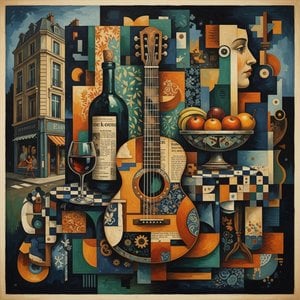
« Sans Titre » de Pablo Picasso (1937) : Un monde fragmenté en harmonie géométrique
L'œuvre « Sans Titre » de Pablo Picasso, peinte en 1937, n'est pas une simple nature morte ; c'est un puzzle méticuleusement construit, fait de formes fragmentées et de juxtapositions inattendues. Cette œuvre réalisée en collage, mesurant un peu plus de 60 par 81 centimètres, incarne le cœur même du Cubisme – un mouvement révolutionnaire qui a fondamentalement altéré la manière dont les artistes perçoivent et représentent la réalité. Bien plus que la simple représentation d'objets, Picasso a cherché à capturer leur essence à travers une multitude de points de vue simultanés, invitant ainsi le spectateur à participer activement à la reconstruction de l'image au sein de sa propre conscience.
La peinture s'articule autour d'une collection d'objets familiers : un vase, un bol, une tasse et divers autres articles domestiques. Cependant, ceux-ci ne sont pas présentés comme des formes solides et unifiées. Au contraire, Picasso les a décomposés en une série de formes géométriques imbriquées – angles vifs, plans superposés et perspectives déformées. Le vase, par exemple, n'est pas rendu comme un volume unique, mais plutôt comme un ensemble de plans fracturés qui suggèrent sa nature tridimensionnelle tout en le dissolvant simultanément dans l'espace environnant. Cette fragmentation délibérée est caractéristique du principe fondamental du Cubisme : représenter les objets sous plusieurs angles à la fois, créant une illusion de profondeur et de mouvement au sein d'une surface bidimensionnelle.
Les racines du Cubisme : L'influence de Cézanne et la naissance d'une nouvelle vision
« Sans Titre » est profondément ancré dans le paysage artistique ayant précédé sa création. La peinture répond directement aux dernières œuvres de Paul Cézanne, particulièrement à son insistance sur la simplification géométrique et l'exploration de la forme par des perspectives multiples. Picasso était captivé par les peintures de Cézanne, qu'il considérait comme une clé pour déverrouiller une nouvelle façon de voir et de représenter le monde. L'exigence de Cézanne consistant à analyser les objets selon leurs composants géométriques fondamentaux — cônes, cylindres et sphères — a fourni un cadre conceptuel crucial aux propres explorations de Picasso.
La création de cette œuvre a coïncidé avec une période d'intense effervescence artistique à Paris, alimentée par l'essor du Cubisme aux côtés d'autres mouvements d'avant-garde. Le mouvement, initialement mené par Picasso et Georges Braque, a défié les notions traditionnelles de perspective, de représentation et de forme. Il ne s'agissait pas simplement de dépeindre ce qui était vu ; il s'agissait de transmettre la sensation qu'un objet procure lorsqu'il est observé – une expérience simultanée de multiples points de vue. Ce changement radical dans la pensée artistique a eu des implications profondes non seulement pour la peinture, mais aussi pour la sculpture, l'architecture, la musique et la littérature.
Symbolisme et évocation de l'émotion
Bien que « Sans Titre » soit avant tout une démonstration des techniques cubistes, l'œuvre est également imprégnée d'une subtile couche de symbolisme. L'agencement des objets — le vase, le bol et la tasse — suggère des thèmes de domesticité, de subsistance, et peut-être même de rituel ou de cérémonie. Cependant, Picasso évite délibérément de fournir un récit ou une signification symbolique claire. Au lieu de cela, il présente ces éléments familiers dans un état de fragmentation troublant, invitant le spectateur à projeter ses propres interprétations sur la scène.
La palette de couleurs sourdes — principalement des bleus, des bruns et des gris — contribue à l'atmosphère sombre du tableau. Cette utilisation restreinte de la couleur accentue davantage la nature fracturée de la composition et renforce le sentiment de désorientation et d'incertitude qui caractérise le Cubisme. L'effet global est celui d'une contemplation silencieuse, incitant les spectateurs à réfléchir aux complexités de la perception et de la représentation.
Un héritage d'innovation : Au-delà du « Sans Titre » de Picasso
« Sans Titre » de Picasso s'impose comme une œuvre charnière de l'histoire de l'art moderne, influençant profondément les mouvements artistiques ultérieurs. Les principes du Cubisme — perspectives multiples, abstraction géométrique et fragmentation — ont été adoptés et adaptés par des artistes tels que les Futuristes, les Suprématistes, les Dadaïstes, les Constructivistes et même les designers du mouvement Art Déco. L'exploration de la mécanisation et de la vie moderne, thème récurrent dans ces mouvements ultérieurs, trouve ses racines dans l'approche pionnière de Picasso pour dépeindre la réalité.
Aujourd'hui, « Sans Titre » continue de résonner auprès du public mondial, servant de témoignage au génie de Picasso et à son héritage durable en tant qu'un des artistes les plus influents du XXe siècle. WahooArt propose des reproductions méticuleusement élaborées qui capturent fidèlement l'essence de ce chef-d'œuvre révolutionnaire, permettant aux amateurs d'art de découvrir sa beauté et sa complexité de manière directe.
Questions et réponses
L'image de «Sans Titre» de Pablo Picasso peut-elle être librement reproduite ?
«Sans Titre» de Pablo Picasso est dans le toujours protégé par le droit d'auteur. Ce statut régit les modalités de reproduction de l'image de l'œuvre.
Pourquoi le statut du droit d'auteur de « Sans Titre » est-il tel qu'il est ?
«Sans Titre» de Pablo Picasso est dans le toujours protégé par le droit d'auteur. La durée du droit d'auteur court à partir du décès de l'artiste, survenu en 1973.
Quelle place occupe « Sans Titre » parmi les thèmes récurrents de Pablo Picasso ?
Parmi les thèmes récurrents de Pablo Picasso — revolutionary, anti-war, legacy, innovation, cézanne, synthetic cubism, modernity, deconstruction — « Sans Titre » met l'accent sur collage, picasso, cubism, vase, bowl, geometric, abstraction, 1937.



 Aperçu en situation
 Commander la reproduction peinte à la main
 Envoyer
 Partager
 Détails de l'œuvre
 Guide
Guide

 Télécharger l'image
 Articles similaires
 Radiographie
 Diaporama
 Statistiques


 Lire la suite






































 L'option verre n'est disponible que pour les dimensions inférieures à 110 cm.