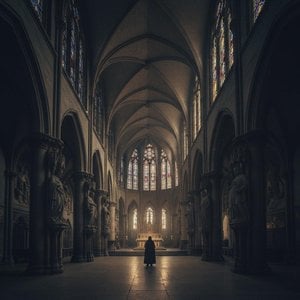
Mystical Conversation (1896) par Odilon Redon, reproduction de peinture à l'huile réalisée à la main par un maître artiste
Aperçu en situation Visualiser en RA Passer au format impression Passer au format numérique Envoyer
Détails de l'œuvre Guide Ajouter aux favoris Télécharger l'image Articles similaires Radiographie Diaporama Questions et réponses Télécharger la présentation Statistiques

Mystical Conversation Reproduction de peinture à l'huile faite à la main

This mesmerizing piece by Odilon Redon depicts three women engaged in a profound dialogue amidst a serene landscape punctuated by a solitary pillar and potted plant. Executed in 1896, the artwork showcases Redon's masterful use of etching and lithography techniques to convey an otherworldly atmosphere.

Odilon Redon (1840-1916): Maître du Symbolisme français, explorez son univers onirique & ses gravures énigmatiques. Précurseur du Surréalisme, influencé par le Japonisme et l'Orient.

Reproduction à l'huile faite à la main

Huile sur toile peinte à la main, avec cadre et dimensions personnalisés, réalisée sur commande par nos artistes. ( Passer au format impression Passer au format numérique)

Corner sample of the P118B picture frame: polystyrène moulé, 5 cm wide and 3 cm thick
P118B €10
Corner sample of the P118H picture frame: polystyrène moulé, 5 cm wide and 3 cm thick
P118H €10
Corner sample of the P118W picture frame: polystyrène moulé, 5 cm wide and 3 cm thick
P118W €10
Corner sample of the P438Z picture frame: polystyrène moulé, 5.5 cm wide and 3.5 cm thick
P438Z €10
Corner sample of the P508JH picture frame: polystyrène moulé, 7 cm wide and 3.5 cm thick
P508JH €12
Corner sample of the P508YH picture frame: polystyrène moulé, 7 cm wide and 3.5 cm thick
P508YH €12
Corner sample of the P805H picture frame: polystyrène moulé, 5 cm wide and 3.5 cm thick
P805H €10
Corner sample of the P805Z picture frame: polystyrène moulé, 5 cm wide and 3.5 cm thick
P805Z €10
Corner sample of the P919BZ picture frame: polystyrène moulé, 7 cm wide and 3.5 cm thick
P919BZ €10
Corner sample of the P919G picture frame: polystyrène moulé, 7 cm wide and 3.5 cm thick
P919G €10
Corner sample of the P919XJ picture frame: polystyrène moulé, 7 cm wide and 3.5 cm thick
P919XJ €10
Corner sample of the P959ZH picture frame: polystyrène moulé, 5 cm wide and 3 cm thick
P959ZH €10
Corner sample of the P968JZ picture frame: polystyrène moulé, 6 cm wide and 4 cm thick
P968JZ €12
Corner sample of the W106C picture frame: bois massif, 5 cm wide and 3 cm thick
W106C €8
Corner sample of the W218G picture frame: bois massif, 5 cm wide and 3 cm thick
W218G €10
Corner sample of the W218JH picture frame: bois massif, 5 cm wide and 3 cm thick
W218JH €8
Corner sample of the W218Y picture frame: bois massif, 5 cm wide and 3 cm thick
W218Y €10
Corner sample of the W307PJ picture frame: bois massif, 6 cm wide and 3 cm thick
W307PJ €10
Corner sample of the W316G picture frame: bois massif, 6 cm wide and 3 cm thick
W316G €10
Corner sample of the W316PJ picture frame: bois massif, 6 cm wide and 3 cm thick
W316PJ €8
Corner sample of the W316Y picture frame: bois massif, 6 cm wide and 3 cm thick
W316Y €10
Corner sample of the W398PJ picture frame: bois massif, 5 cm wide and 3 cm thick
W398PJ €8
Corner sample of the W4111J picture frame: bois massif, 6.5 cm wide and 3.5 cm thick
W4111J €10
Corner sample of the W500HY picture frame: bois massif, 7 cm wide and 5 cm thick
W500HY €15
Corner sample of the W500JH picture frame: bois massif, 7 cm wide and 5 cm thick
W500JH €15
Corner sample of the W692G picture frame: bois massif, 8 cm wide and 4 cm thick
W692G €12
Corner sample of the W849H picture frame: bois massif, 5 cm wide and 3 cm thick
W849H €8
Corner sample of the W940BG picture frame: bois massif, 7.5 cm wide and 4.5 cm thick
W940BG €15
Corner sample of the W953PJ picture frame: bois massif, 6 cm wide and 3.5 cm thick
W953PJ €8

Format standard
sur mesure
CM
INCH

Choisissez parmi nos formats prédéfinis qui respectent les proportions originales de l’œuvre.

largeur
hauteur

Saisissez la largeur et la hauteur souhaitées, pour s'adapter à votre cadre ou à votre mur. Cette œuvre est peinte à la main ; ainsi, pour un format de forme différente, l'artiste peut peindre un peu plus autour du tableau ou réduire légèrement les bords — c'est vous qui choisissez. Nous vous envoyons une maquette numérique pour approbation avant que la peinture ne commence. L'image présentée sur cette page ne reflète pas le résultat réel — seule la maquette le fait.

Exemples de personnalisation possibles : remplacer un visage par la photo du client ; ajouter un animal de compagnie (par exemple, remplacer un chat par un chien) ; inclure un message caché en arrière-plan ; modifier le paysage ou les éléments de l'arrière-plan.
Après la commande, l’équipe WahooArt.com contactera le client par e-mail pour recueillir ses instructions et lui fournira une maquette d’aperçu

Livraison dans le monde entier () en 3 à 4 semaines au lieu des 5 semaines habituelles. (8 novembre). Aucun compromis sur la qualité.

Livraison express gratuite dans le monde entier
Toile de lin de qualité supérieure
Assurance transport complète
Garantie de remboursement des droits de douane
Garantie de fidélité des couleurs
Politique de retour de 100 jours (uniquement en cas de défaut)
Garantie de remboursement à 100%
Offre de tarifs dégressifs

Prix total

€ 243

Mystical Conversation

Technique de reproduction

Format de la reproduction

-

Prix total

€ 243

Informations clés

  • Influences: Jean-Léon Gérôme
  • Artist: Odilon Redon
  • Notable elements or techniques: Impasto texture
  • Medium: Oil on canvas
  • Year: 1896

Quiz d'art

Chaque question ne comporte qu'une seule bonne réponse.

Question 1:
What artistic technique is prominently featured in Odilon Redon’s "Mystical Conversation", allowing for a textured surface and evocative imagery?
Question 2:
The painting depicts three women engaged in what activity, suggesting themes of connection and contemplation?
Question 3:
In what year was "Mystical Conversation" created?
Question 4:
What is the primary visual element that contributes to the painting's atmosphere of mystery and dreamlike quality?
Question 5:
Odilon Redon’s artistic style aligns with which broader movement in art history?

A Journey Into Shadowed Realms: Exploring Odilon Redon’s Mystical Conversation

Odilon Redon's "Mystical Conversation," completed in 1892, stands as a testament to the artist’s unwavering fascination with the subconscious and his masterful manipulation of visual language. More than just a depiction of two figures—a woman and a man—within an ambiguous space, it embodies a profound meditation on spirituality, isolation, and the elusive nature of human experience. The painting resides within The Art Institute of Chicago's collection, offering visitors a glimpse into Redon’s distinctive artistic vision.

Style and Technique: Impasto Texture and Dreamlike Atmosphere

Redon eschewed the conventions of academic realism, opting instead for an expressive style characterized by thick impasto—a technique where paint is applied in heavy layers—creating palpable textural surfaces that seem to pulsate with inner energy. This deliberate disregard for conventional representation prioritizes mood and emotion over precise detail. The artist’s use of muted colors – predominantly ochre, umber, and shades of grey – contributes to the painting's ethereal atmosphere, transporting viewers into a realm beyond the visible world. Light plays an integral role, casting dramatic shadows that heighten the sense of mystery and reinforce the psychological depth of the scene.

Historical Context: Symbolism in Late Impressionism

“Mystical Conversation” emerged during the waning years of Impressionism, marking a pivotal moment in artistic evolution. While Impressionists sought to capture fleeting moments of sensory experience, Redon delved into the realm of symbolism—drawing inspiration from mythology, folklore, and esoteric traditions. The figures themselves are deliberately indistinct, representing archetypal representations rather than identifiable individuals. Their posture suggests contemplation and dialogue, hinting at a quest for understanding or perhaps confronting unspoken anxieties. The presence of a solitary plant – positioned prominently on the right side of the canvas – symbolizes resilience and growth amidst darkness, mirroring the overarching theme of spiritual transformation.

Symbolism Unveiled: Figures, Space, and the Essence of Contemplation

The painting’s symbolism extends beyond its immediate visual elements. The ambiguous space—characterized by curving lines and undefined boundaries—represents the labyrinthine pathways of consciousness, reflecting the artist's preoccupation with exploring inner landscapes. The woman’s arms encircling the man convey a sense of protection and intimacy, yet also underscore their separation from each other and from the outside world. These figures are not merely present; they embody concepts – contemplation, vulnerability, and perhaps even fear—that resonate deeply within the viewer's psyche. Redon skillfully utilizes visual cues to communicate these intangible ideas, inviting interpretation and fostering a connection between the artwork and its audience.

Emotional Impact: A Resonance of Quiet Mystery

Ultimately, “Mystical Conversation” succeeds in evoking a powerful emotional response. Its subdued palette and textured surface create an immersive experience that encourages introspection. The painting’s haunting beauty lies not in grand spectacle but in its ability to capture the subtle nuances of human emotion—the quiet yearning for connection, the apprehension of the unknown, and the enduring fascination with the mysteries of existence. It remains a captivating example of Redon's artistic prowess and his profound engagement with the spiritual dimension of art.

Questions et réponses

Comment le style de « Mystical Conversation » s'inscrit-il dans l'époque de son créateur ?

Dans «Mystical Conversation» de Odilon Redon, le mouvement Surrealist Dreamscape rencontre l'époque XIXe siècle.

«Mystical Conversation» de Odilon Redon est-il une œuvre lumineuse ou sombre ?

Les valeurs enregistrées pour «Mystical Conversation» de Odilon Redon sont : une luminosité de bright, une luminance de Gentle Luminance.

Comment puis-je télécharger l'image de «Mystical Conversation» de Odilon Redon ?

«Mystical Conversation» de Odilon Redon peut être téléchargé depuis la page Téléchargement de l'œuvre, en tant que téléchargement d'une image numérique haute résolution.


Biographie de l'artiste

Jeunesse et Formation

Odilon Redon, né Bertrand Jean Redon le 20 avril 1840 à Bordeaux, en Aquitaine, est issu d'une famille aisée. Son père, ayant amassé une fortune grâce au commerce négrier en Louisiane, a contribué à la prospérité familiale. Sa mère, Odile, lui donna le surnom "Odilon". Très tôt, Redon manifesta un talent pour le dessin et remporta un prix scolaire dès l'âge de dix ans. Ses premières études d'architecture, suivies d'un passage bref mais significatif sous la direction de Jean-Léon Gérôme en 1864, ne menèrent pas à une carrière d'architecte, mais l’initièrent aux bases de la peinture. Il se tourna ensuite vers la sculpture avant de perfectionner ses compétences dans la gravure et la lithographie sous l'égide de Rodolphe Bresdin.

L’Évolution Artistique : Des “Noirs” au Symbolisme

Après son service militaire pendant la guerre franco-prussienne (1870-1871), Redon s'installa à Paris et se consacra principalement à la gravure, notamment à la lithographie. C’est durant cette période qu’il créa ses célèbres “noirs”, des œuvres en noir et blanc empreintes de mystère et d'une atmosphère onirique. Ces images, souvent peuplées de créatures fantastiques et de figures spectrales, témoignent d'une profonde exploration du subconscient. En 1878, "Esprit Gardien des Eaux" marqua une première reconnaissance publique. Son premier album de lithographies, "Dans le Rêve", publié en 1879, consolida sa réputation. Le roman "À rebours" de Joris-Karl Huysmans (1884) contribua grandement à la diffusion et à l'admiration pour son œuvre. Au cours des années 1890, Redon abandonna progressivement les noirs pour se tourner vers le pastel et l’huile, couleurs qui lui permirent d'exprimer une palette plus riche et lumineuse.

Influences et Thèmes Majeurs

L'œuvre de Redon est profondément marquée par diverses influences. Le Japonisme, avec ses estampes aux lignes épurées et à la composition originale, joue un rôle important dans son évolution artistique. Il s’intéressa également aux cultures orientales, notamment l'hindouisme et le bouddhisme, qui inspirèrent des œuvres comme "La Mort du Bouddha" (1899). Ses thèmes récurrents incluent les rêves, les mythes, la nature, et l'exploration de la psyché humaine. Les figures féminines, souvent énigmatiques et symboliques, occupent une place centrale dans son œuvre.

Réalisations Notables et Reconnaissance

Redon réalisa plusieurs commandes importantes, dont les 17 panneaux décoratifs pour le château de Domecy-sur-le-Vault (1900-1901), commandés par le baron Robert de Domecy. Ces œuvres marquent une transition vers une abstraction plus poussée et témoignent d'une maîtrise croissante des couleurs et des formes. Il fut exposé au musée d’Orsay et au Getty Museum, où ses portraits de la baronne de Domecy et de sa fille Jeanne furent particulièrement remarqués. En 1903, il reçut la Légion d'honneur. La publication d'un catalogue de ses gravures et lithographies par André Mellerio en 1913, suivie d’une exposition majeure à l’Armory Show de New York, contribuèrent à une reconnaissance internationale grandissante.

Héritage et Importance Historique

Odilon Redon est aujourd'hui considéré comme un précurseur du surréalisme et une figure majeure du symbolisme français. Son exploration de l’inconscient, son intérêt pour les cultures orientales et sa recherche d’une expression artistique nouvelle ont influencé de nombreux artistes après lui. Son œuvre continue d'inspirer et de fasciner par sa poésie visuelle et sa capacité à évoquer des mondes oniriques et mystérieux.
Odilon Redon

Odilon Redon

1840 - 1916 , France

L'essentiel de l'artiste

  • Artistes Influents:
    • Rodolphe Bresdin
    • Jean-Léon Gérôme
  • Date De Naissance: 20 avril 1840
  • Influences Artistiques:
    • Surréalisme
    • Japonisme
  • Lieu De Naissance: Bordeaux, France
  • Mouvement Artistique: Symbolisme
  • Nationalité: Française
  • Nom Complet: Odilon Redon
  • Œuvres Notables:
    • Esprit Gardien des Eaux
    • Cyclope
    • L'Enfant Prédestiné
    • La Mort du Bouddha
Explorez des œuvres d'art classées par thèmes, styles et caractéristiques.