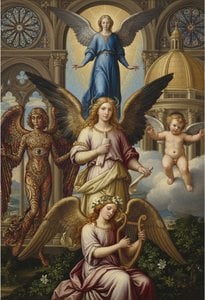
Apollo's Chariot (1908) by Odilon Redon, hand-painted oil painting reproduction by a master artist
Aperçu en situation Visualiser en RA Passer au format impression Passer au format numérique Envoyer
Détails de l'œuvre Guide Ajouter aux favoris Télécharger l'image Articles similaires Radiographie Diaporama Q&A Statistiques

Apollo's Chariot Hand-painted oil painting reproduction

A vibrant celestial journey unfolds in Odilon Redon's Apollo's Chariot where dreamlike horses soar through a colorful sky, offering a stunning piece of French Symbolism to elevate your private art collection.

Odilon Redon (1840-1916): Maître du Symbolisme français, explorez son univers onirique & ses gravures énigmatiques. Précurseur du Surréalisme, influencé par le Japonisme et l'Orient.

Reproduction à l'huile faite à la main

Huile sur toile peinte à la main, avec cadre et dimensions personnalisés, réalisée sur commande par nos artistes. ( Passer au format impression Passer au format numérique)

Corner sample of the P118B picture frame: polystyrène moulé, 5 cm wide and 3 cm thick
P118B €10
Corner sample of the P118H picture frame: polystyrène moulé, 5 cm wide and 3 cm thick
P118H €10
Corner sample of the P118W picture frame: polystyrène moulé, 5 cm wide and 3 cm thick
P118W €10
Corner sample of the P438Z picture frame: polystyrène moulé, 5.5 cm wide and 3.5 cm thick
P438Z €10
Corner sample of the P508JH picture frame: polystyrène moulé, 7 cm wide and 3.5 cm thick
P508JH €12
Corner sample of the P508YH picture frame: polystyrène moulé, 7 cm wide and 3.5 cm thick
P508YH €12
Corner sample of the P805H picture frame: polystyrène moulé, 5 cm wide and 3.5 cm thick
P805H €10
Corner sample of the P805Z picture frame: polystyrène moulé, 5 cm wide and 3.5 cm thick
P805Z €10
Corner sample of the P919BZ picture frame: polystyrène moulé, 7 cm wide and 3.5 cm thick
P919BZ €10
Corner sample of the P919G picture frame: polystyrène moulé, 7 cm wide and 3.5 cm thick
P919G €10
Corner sample of the P919XJ picture frame: polystyrène moulé, 7 cm wide and 3.5 cm thick
P919XJ €10
Corner sample of the P959ZH picture frame: polystyrène moulé, 5 cm wide and 3 cm thick
P959ZH €10
Corner sample of the P968JZ picture frame: polystyrène moulé, 6 cm wide and 4 cm thick
P968JZ €12
Corner sample of the W106C picture frame: bois massif, 5 cm wide and 3 cm thick
W106C €8
Corner sample of the W218G picture frame: bois massif, 5 cm wide and 3 cm thick
W218G €10
Corner sample of the W218JH picture frame: bois massif, 5 cm wide and 3 cm thick
W218JH €8
Corner sample of the W218Y picture frame: bois massif, 5 cm wide and 3 cm thick
W218Y €10
Corner sample of the W307PJ picture frame: bois massif, 6 cm wide and 3 cm thick
W307PJ €10
Corner sample of the W316G picture frame: bois massif, 6 cm wide and 3 cm thick
W316G €10
Corner sample of the W316PJ picture frame: bois massif, 6 cm wide and 3 cm thick
W316PJ €8
Corner sample of the W316Y picture frame: bois massif, 6 cm wide and 3 cm thick
W316Y €10
Corner sample of the W398PJ picture frame: bois massif, 5 cm wide and 3 cm thick
W398PJ €8
Corner sample of the W4111J picture frame: bois massif, 6.5 cm wide and 3.5 cm thick
W4111J €10
Corner sample of the W500HY picture frame: bois massif, 7 cm wide and 5 cm thick
W500HY €15
Corner sample of the W500JH picture frame: bois massif, 7 cm wide and 5 cm thick
W500JH €15
Corner sample of the W692G picture frame: bois massif, 8 cm wide and 4 cm thick
W692G €12
Corner sample of the W849H picture frame: bois massif, 5 cm wide and 3 cm thick
W849H €8
Corner sample of the W940BG picture frame: bois massif, 7.5 cm wide and 4.5 cm thick
W940BG €15
Corner sample of the W953PJ picture frame: bois massif, 6 cm wide and 3.5 cm thick
W953PJ €8

Format standard
sur mesure
CM
INCH

Choisissez parmi nos formats prédéfinis qui respectent les proportions originales de l’œuvre.

largeur
hauteur

Saisissez la largeur et la hauteur souhaitées, pour s'adapter à votre cadre ou à votre mur. Cette œuvre est peinte à la main ; ainsi, pour un format de forme différente, l'artiste peut peindre un peu plus autour du tableau ou réduire légèrement les bords — c'est vous qui choisissez. Nous vous envoyons une maquette numérique pour approbation avant que la peinture ne commence. L'image présentée sur cette page ne reflète pas le résultat réel — seule la maquette le fait.

Exemples de personnalisation possibles : remplacer un visage par la photo du client ; ajouter un animal de compagnie (par exemple, remplacer un chat par un chien) ; inclure un message caché en arrière-plan ; modifier le paysage ou les éléments de l'arrière-plan.
Après la commande, l’équipe WahooArt.com contactera le client par e-mail pour recueillir ses instructions et lui fournira une maquette d’aperçu

Livraison dans le monde entier () en 3 à 4 semaines au lieu des 5 semaines habituelles. (2 novembre). Aucun compromis sur la qualité.

Livraison express gratuite dans le monde entier
Toile de lin de qualité supérieure
Assurance transport complète
Garantie de remboursement des droits de douane
Garantie de fidélité des couleurs
Politique de retour de 100 jours (uniquement en cas de défaut)
Garantie de remboursement à 100%
Offre de tarifs dégressifs

Prix total

€ 242

Apollo's Chariot

Technique de reproduction

Format de la reproduction

-

Prix total

€ 242

Informations clés

  • Notable elements or techniques: Vibrant colors, clouds, sense of movement
  • Subject or theme: Celestial chariot journey through the sky
  • Year: 1908
  • Title: Apollo's Chariot

A Celestial Voyage Through Symbolist Dreams

In the ethereal realm of Odilon Redon, the boundaries between the waking world and the subconscious dissolve into a breathtaking spectacle of light and motion. Apollo's Chariot, painted in 1908, serves as a radiant testament to this mastery of the unseen. The canvas captures a moment of profound cosmic drama, where the sun god’s chariot surges through a sky thick with the textures of a dream. As the horses gallop across a sea of clouds, the viewer is transported into a celestial event that feels both ancient and intimately personal. This is not merely a depiction of mythology; it is an invitation to witness the triumph of light over the shadows that defined much of Redon's earlier, more somber works.

The composition is a whirlwind of movement and color, designed to stir the soul of any observer. Redon utilizes a palette of vibrant pinks, burning oranges, and deep, tranquil blues to create a sense of atmospheric depth that feels almost tactile. The technique reflects the artist's transition from his famous "noirs"—those monochromatic, shadowy etchings—into a period of luminous colorism. Here, the brushwork supports the sense of flight, with clouds that seem to swirl in the wake of the passing horses. For the discerning collector or interior designer, this piece offers a commanding presence, acting as a window into a more magical reality that can transform a room from a mere space into an immersive sanctuary of wonder.

The Language of Light and Myth

Beyond its visual splendor, Apollo's Chariot is steeped in the profound symbolism characteristic of the French Symbolist movement. Redon was a master at using mythological archetypes to explore psychological truths. The chariot, pulled by powerful steeds through the heavens, symbolizes the cyclical nature of life, the dawn of consciousness, and the unstoppable progression of time. The presence of figures within the scene—passengers or perhaps celestial observers—adds a layer of human connection to the divine spectacle, suggesting that we are all witnesses to the grand, unfolding mysteries of the universe.

For those seeking to incorporate fine art into their curated environments, this painting offers an unparalleled emotional resonance. It possesses the rare ability to evoke both excitement and tranquility simultaneously. The warmth of the sunset hues provides a comforting glow, while the dynamic energy of the horses inspires a sense of aspiration and movement. A high-quality hand-painted reproduction of this masterpiece allows the spirit of Redon’s imagination to reside within a home or gallery, providing a constant source of inspiration and a sophisticated focal point that celebrates the enduring power of the human imagination.

Questions et réponses

Où puis-je acheter une impression de «Apollo's Chariot» de Odilon Redon ?

« Apollo's Chariot » est disponible en tant que une impression d'art sur toile de coton ou sur papier canvas d'archive. Les commandes s'effectuent sur sa page Tirage d'art fine art, dans le format de votre choix.

Où puis-je télécharger «Apollo's Chariot» de Odilon Redon ?

«Apollo's Chariot» de Odilon Redon peut être téléchargé depuis la page Téléchargement de l'œuvre, en tant que téléchargement d'une image numérique haute résolution.

Quelle technique a été utilisée pour «Apollo's Chariot» de Odilon Redon ?

«Apollo's Chariot» de Odilon Redon est réalisé en Painting. Les reproductions visent à restituer l'aspect de cette technique.


Biographie de l'artiste

Jeunesse et Formation

Odilon Redon, né Bertrand Jean Redon le 20 avril 1840 à Bordeaux, en Aquitaine, est issu d'une famille aisée. Son père, ayant amassé une fortune grâce au commerce négrier en Louisiane, a contribué à la prospérité familiale. Sa mère, Odile, lui donna le surnom "Odilon". Très tôt, Redon manifesta un talent pour le dessin et remporta un prix scolaire dès l'âge de dix ans. Ses premières études d'architecture, suivies d'un passage bref mais significatif sous la direction de Jean-Léon Gérôme en 1864, ne menèrent pas à une carrière d'architecte, mais l’initièrent aux bases de la peinture. Il se tourna ensuite vers la sculpture avant de perfectionner ses compétences dans la gravure et la lithographie sous l'égide de Rodolphe Bresdin.

L’Évolution Artistique : Des “Noirs” au Symbolisme

Après son service militaire pendant la guerre franco-prussienne (1870-1871), Redon s'installa à Paris et se consacra principalement à la gravure, notamment à la lithographie. C’est durant cette période qu’il créa ses célèbres “noirs”, des œuvres en noir et blanc empreintes de mystère et d'une atmosphère onirique. Ces images, souvent peuplées de créatures fantastiques et de figures spectrales, témoignent d'une profonde exploration du subconscient. En 1878, "Esprit Gardien des Eaux" marqua une première reconnaissance publique. Son premier album de lithographies, "Dans le Rêve", publié en 1879, consolida sa réputation. Le roman "À rebours" de Joris-Karl Huysmans (1884) contribua grandement à la diffusion et à l'admiration pour son œuvre. Au cours des années 1890, Redon abandonna progressivement les noirs pour se tourner vers le pastel et l’huile, couleurs qui lui permirent d'exprimer une palette plus riche et lumineuse.

Influences et Thèmes Majeurs

L'œuvre de Redon est profondément marquée par diverses influences. Le Japonisme, avec ses estampes aux lignes épurées et à la composition originale, joue un rôle important dans son évolution artistique. Il s’intéressa également aux cultures orientales, notamment l'hindouisme et le bouddhisme, qui inspirèrent des œuvres comme "La Mort du Bouddha" (1899). Ses thèmes récurrents incluent les rêves, les mythes, la nature, et l'exploration de la psyché humaine. Les figures féminines, souvent énigmatiques et symboliques, occupent une place centrale dans son œuvre.

Réalisations Notables et Reconnaissance

Redon réalisa plusieurs commandes importantes, dont les 17 panneaux décoratifs pour le château de Domecy-sur-le-Vault (1900-1901), commandés par le baron Robert de Domecy. Ces œuvres marquent une transition vers une abstraction plus poussée et témoignent d'une maîtrise croissante des couleurs et des formes. Il fut exposé au musée d’Orsay et au Getty Museum, où ses portraits de la baronne de Domecy et de sa fille Jeanne furent particulièrement remarqués. En 1903, il reçut la Légion d'honneur. La publication d'un catalogue de ses gravures et lithographies par André Mellerio en 1913, suivie d’une exposition majeure à l’Armory Show de New York, contribuèrent à une reconnaissance internationale grandissante.

Héritage et Importance Historique

Odilon Redon est aujourd'hui considéré comme un précurseur du surréalisme et une figure majeure du symbolisme français. Son exploration de l’inconscient, son intérêt pour les cultures orientales et sa recherche d’une expression artistique nouvelle ont influencé de nombreux artistes après lui. Son œuvre continue d'inspirer et de fasciner par sa poésie visuelle et sa capacité à évoquer des mondes oniriques et mystérieux.
Odilon Redon

Odilon Redon

1840 - 1916 , France

L'essentiel de l'artiste

  • Artistes Influents:
    • Rodolphe Bresdin
    • Jean-Léon Gérôme
  • Date De Naissance: 20 avril 1840
  • Influences Artistiques:
    • Surréalisme
    • Japonisme
  • Lieu De Naissance: Bordeaux, France
  • Mouvement Artistique: Symbolisme
  • Nationalité: Française
  • Nom Complet: Odilon Redon
  • Œuvres Notables:
    • Esprit Gardien des Eaux
    • Cyclope
    • L'Enfant Prédestiné
    • La Mort du Bouddha
Explorez des œuvres d'art classées par thèmes, styles et caractéristiques.