Aperçu en situation Visualiser en RA Commander la reproduction peinte à la main Passer au format numérique Envoyer
Détails de l'œuvre Guide Ajouter aux favoris Télécharger l'image Articles similaires Radiographie Diaporama Q&A Statistiques

Plafond

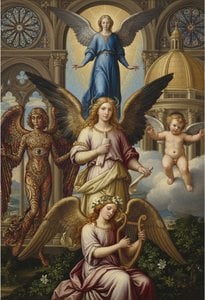
Nicholas Roerich’s "Plafond" showcases a breathtaking celestial scene with a central angel figure amidst swirling stars and planets, reflecting the artist's spiritual vision of 1913. Discover this stunning hand-painted reproduction and bring cosmic beauty into your home.

Explorez l'art captivant de Nicolas Roerich (1874-1947) : Symbolisme, paysages himalayens et peintures mystiques. Designs pour les Ballets Russes et défenseur de la préservation culturelle.

Giclées et impressions d'art

Impressions giclées ou sur toile de qualité musée, avec une production rapide et des finitions au choix. ( Commander la reproduction peinte à la main Passer au format numérique)

Corner sample of the P118B picture frame: polystyrène moulé, 5 cm wide and 3 cm thick
P118B €10
Corner sample of the P118H picture frame: polystyrène moulé, 5 cm wide and 3 cm thick
P118H €10
Corner sample of the P118W picture frame: polystyrène moulé, 5 cm wide and 3 cm thick
P118W €10
Corner sample of the P438Z picture frame: polystyrène moulé, 5.5 cm wide and 3.5 cm thick
P438Z €10
Corner sample of the P508JH picture frame: polystyrène moulé, 7 cm wide and 3.5 cm thick
P508JH €12
Corner sample of the P508YH picture frame: polystyrène moulé, 7 cm wide and 3.5 cm thick
P508YH €12
Corner sample of the P805H picture frame: polystyrène moulé, 5 cm wide and 3.5 cm thick
P805H €10
Corner sample of the P805Z picture frame: polystyrène moulé, 5 cm wide and 3.5 cm thick
P805Z €10
Corner sample of the P919BZ picture frame: polystyrène moulé, 7 cm wide and 3.5 cm thick
P919BZ €10
Corner sample of the P919G picture frame: polystyrène moulé, 7 cm wide and 3.5 cm thick
P919G €10
Corner sample of the P919XJ picture frame: polystyrène moulé, 7 cm wide and 3.5 cm thick
P919XJ €10
Corner sample of the P959ZH picture frame: polystyrène moulé, 5 cm wide and 3 cm thick
P959ZH €10
Corner sample of the P968JZ picture frame: polystyrène moulé, 6 cm wide and 4 cm thick
P968JZ €12
Corner sample of the W106C picture frame: bois massif, 5 cm wide and 3 cm thick
W106C €8
Corner sample of the W218G picture frame: bois massif, 5 cm wide and 3 cm thick
W218G €10
Corner sample of the W218JH picture frame: bois massif, 5 cm wide and 3 cm thick
W218JH €8
Corner sample of the W218Y picture frame: bois massif, 5 cm wide and 3 cm thick
W218Y €10
Corner sample of the W307PJ picture frame: bois massif, 6 cm wide and 3 cm thick
W307PJ €10
Corner sample of the W316G picture frame: bois massif, 6 cm wide and 3 cm thick
W316G €10
Corner sample of the W316PJ picture frame: bois massif, 6 cm wide and 3 cm thick
W316PJ €8
Corner sample of the W316Y picture frame: bois massif, 6 cm wide and 3 cm thick
W316Y €10
Corner sample of the W398PJ picture frame: bois massif, 5 cm wide and 3 cm thick
W398PJ €8
Corner sample of the W4111J picture frame: bois massif, 6.5 cm wide and 3.5 cm thick
W4111J €10
Corner sample of the W500HY picture frame: bois massif, 7 cm wide and 5 cm thick
W500HY €15
Corner sample of the W500JH picture frame: bois massif, 7 cm wide and 5 cm thick
W500JH €15
Corner sample of the W692G picture frame: bois massif, 8 cm wide and 4 cm thick
W692G €12
Corner sample of the W849H picture frame: bois massif, 5 cm wide and 3 cm thick
W849H €8
Corner sample of the W940BG picture frame: bois massif, 7.5 cm wide and 4.5 cm thick
W940BG €15
Corner sample of the W953PJ picture frame: bois massif, 6 cm wide and 3.5 cm thick
W953PJ €8

Format standard
sur mesure
CM
INCH

Choisissez parmi nos formats prédéfinis qui respectent les proportions originales de l’œuvre.

largeur
hauteur

Saisissez la largeur et la hauteur souhaitées pour qu'elles s'adaptent à votre cadre ou à votre mur. Une impression peut être recadrée, mais jamais agrandie au-delà de l'image originale ; ainsi, un format de forme différente entraînera la perte d'une partie de l'image. Nous vous envoyons une maquette numérique pour approbation avant toute impression. L'image présentée sur cette page ne montre pas le recadrage réel — seule la maquette le permet.

Livraison dans le monde entier () en 2 semaines au lieu des 4/5 semaines habituelles. (30 octobre)

Livraison express gratuite dans le monde entier
Toile de lin de qualité supérieure
Assurance transport complète
Garantie de remboursement des droits de douane
Garantie de fidélité des couleurs
Politique de retour de 100 jours (uniquement en cas de défaut)
Garantie de remboursement à 100%
Offre de tarifs dégressifs

Prix total

€ 60

Plafond

Giclées et impressions d'art

Format de la reproduction

-

Prix total

€ 60

Informations clés

  • Notable elements: Angel, night sky
  • Title: Plafond
  • Artistic style: Symbolic Realism
  • Location: Private Collection
  • Subject or theme: Cosmic spirituality

A Celestial Embrace: Exploring Roerich’s “Plafond”

Nicholas Roemerich's "Plafond," painted in 1913, is more than just a depiction of the night sky; it’s a profound meditation on humanity’s place within the vastness of the cosmos. This remarkable work, brimming with intricate detail and imbued with a spiritual sensibility, exemplifies Roerich’s unique artistic vision – one that seamlessly blended scientific observation with deeply held philosophical and religious beliefs. The painting immediately draws the eye to its central focus: a luminous circle dominated by a youthful figure, often interpreted as an angelic child or nascent human spirit, surrounded by a swirling tapestry of stars and planets.

  • Subject Matter: The primary subject is a meticulously rendered night sky, capturing the beauty and mystery of celestial bodies.
  • Central Figure: A prominent baby angel or child figure serves as the focal point, symbolizing innocence, potential, and connection to the divine.
  • Composition: The overall composition creates a sense of depth and movement, drawing the viewer into the heart of the universe.

Roerich’s Visionary Style and Technique

Roerich was deeply influenced by both Russian Orthodox spirituality and his extensive travels – particularly to Central Asia and Tibet – where he encountered ancient symbols and beliefs related to the cosmos. “Plafond” reflects this influence through its use of vibrant, almost iridescent colors, achieved through a technique known as ‘verlona,’ which Roerich developed himself. This method involved layering thin glazes of paint, creating an ethereal glow that seems to emanate from within the canvas. The meticulous detail in depicting constellations and planets demonstrates his dedication to scientific accuracy, reflecting his belief that art should be informed by knowledge.

The painting’s texture is rich and tactile, achieved through multiple layers of paint built up over time. This technique not only adds depth but also contributes to the overall sense of wonder and awe evoked by the scene. The brushwork is precise yet fluid, conveying both a scientific understanding of celestial mechanics and an emotional connection to the beauty of the universe.

Symbolism and Historical Context

"Plafond" was created during a period of significant intellectual and spiritual ferment in early 20th-century Russia. Roerich’s work aligns with broader trends of interest in esoteric knowledge, comparative religion, and the search for universal truths. The painting's symbolism is rich with layers of meaning, referencing ancient myths, religious iconography, and philosophical concepts related to creation, humanity’s destiny, and the interconnectedness of all things. The title itself, “Plafond,” suggests a ceiling or dome – a traditional symbol of heaven or the cosmos – further emphasizing the painting's spiritual dimension.

Painted in 1913, just before World War I dramatically reshaped Europe, "Plafond" represents a moment of relative peace and optimism within Roerich’s artistic trajectory. It stands as a testament to his enduring belief in humanity’s potential for harmony and understanding.

Emotional Impact and Artistic Legacy

"Plafond" possesses a powerful emotional impact, inviting viewers to contemplate their place in the universe and to connect with something larger than themselves. The painting's luminous quality and evocative imagery create a sense of serenity and wonder, while its complex symbolism encourages deeper reflection. Nicholas Roerich’s work continues to resonate today, demonstrating his mastery of technique, his profound spiritual vision, and his enduring legacy as one of the 20th century’s most important artists.

Questions et réponses

Que représente «Plafond» de Nicolas Roerich, et quelle atmosphère s'en dégage ?

«Plafond» de Nicolas Roerich allie night sky, celestial bodies, angel figure, nicholas roerich, cosmic wonder, symbolic art, russian artist à une atmosphère Ethereal.

Pour quel usage une reproduction de «Plafond» de Nicolas Roerich est-elle recommandée ?

L'utilisation suggérée pour «Plafond» de Nicolas Roerich est Statement. Elle peut également servir à d'autres fins.

Où puis-je acheter une reproduction numérique de «Plafond» de Nicolas Roerich ?

Une version numérique de «Plafond» de Nicolas Roerich est disponible à l'achat sur sa page Image numérique haute résolution : téléchargement d'une image numérique haute résolution.


Biographie de l'artiste

Nicholas Roerich : Vie, Art et Héritage

Jeunesse et Éducation

  • Nicolas Constantinovich Roerich est né le 9 octobre 1874 à Saint-Pétersbourg, en Russie.
  • Son père, notaire public allemand de la Baltique, et sa mère, une femme russe, ont cultivé chez lui un goût précoce pour les arts.
  • Roerich a poursuivi le droit et l'art simultanément, s'inscrivant à l'Université de Saint-Pétersbourg et à l'Académie des Beaux-Arts impériale en 1893.
  • Il a reçu le titre d'"Artiste" en 1897 et un diplôme de droit l'année suivante.

Poursuites Artistiques et Influences

  • Le développement artistique de Roerich a été significativement influencé par le Symbolisme russe, un mouvement mettant l'accent sur la spiritualité et la profondeur émotionnelle.
  • Il s'est impliqué dans la société "World of Art" de Sergueï Diaghilev, devenant son président de 1910 à 1916.
  • Ses premières œuvres ont mis en évidence une fascination pour l'archéologie et la conception de décors de scène, menant à des collaborations sur des productions pour les Ballets Russes.
  • Il a également été influencé par l'apocryphe et les écrits sectaires médiévaux comme le Livre de Colombe.

Collaboration avec les Ballets Russes

  • Les conceptions de Roerich pour les Ballets Russes ont été très saluées, en particulier son travail sur l'Opéra Prince Igor d'Alexandre Borodine (1909) et l’Opéra Le Rite de Printemps d'Igor Stravinsky (1913).
  • Ses décors de scène ont combiné des recherches historiques avec un art imaginatif, créant des productions visuellement époustouflantes.
  • Cette collaboration l'a établi comme une figure de proue en matière de conception théâtrale au début du XXe siècle.

Développement Artistique et Thèmes

  • Les peintures de Roerich ont évolué pour incorporer des thèmes de plus en plus mystiques et spirituels, reflétant son intérêt croissant pour la Théosophie et les religions orientales.
  • Sa série Études architecturales (1904–1905) a démontré sa prouesse architecturale et son engagement à préserver le patrimoine culturel.
  • Des motifs récurrents dans son œuvre comprennent des paysages majestueux, des villes anciennes et des figures religieuses telles que Saint Panteleimon et Kuan Yin.
  • Il a souvent représenté l'Himalaya, une région qui avait un profond sens spirituel pour lui.

Réalisations Majeures et Reconnaissance

  • Roerich était un défenseur dévoué de la protection de l'art et de l'architecture pendant les temps de guerre.
  • Ses efforts ont conduit à la création du Pacte Roerich (1935), un traité international pour la préservation des objets culturels, lui valant de nombreuses nominations au prix Nobel de la paix.
  • Il a voyagé largement en Asie centrale, menant des recherches archéologiques et documentant les cultures anciennes.
  • Son œuvre est présentée dans des collections muséales prestigieuses du monde entier, notamment la Galerie d'art d'Astrachane.

Signification Historique et Héritage

  • L'impact de Nicolas Roerich sur l'art et la culture russes est immeasurable.
  • Il a comblé le fossé entre l'expression artistique et l'exploration spirituelle, influençant des générations d'artistes et de penseurs.
  • Son engagement à préserver le patrimoine culturel reste pertinent aujourd'hui, soulignant l'importance de protéger notre héritage commun.
  • L'héritage de Roerich s'étend au-delà de ses peintures ; il est souvenu comme un artiste visionnaire, érudit et humanitaire.
Nicolas Roerich

Nicolas Roerich

1874 - 1947 , Russie

L'essentiel de l'artiste

  • Artistes Influents: ['Symbolisme russe']
  • Date De Décès: 13 décembre 1947
  • Date De Naissance: 9 octobre 1874
  • Lieu De Naissance: Saint-Pétersbourg, Russie
  • Mouvement Artistique: Symbolisme russe
  • Nationalité: Russe
  • Nom Complet: Nicolas Roerich
  • Œuvres Notables:
    • Lac des Nagas
    • Mont de cinq trésors
    • Chemin vers Kailas 4
    • Tempe-jal-tzen-baykin
    • Guerrier
    • Pont de Gloire
Explorez des œuvres d'art classées par thèmes, styles et caractéristiques.