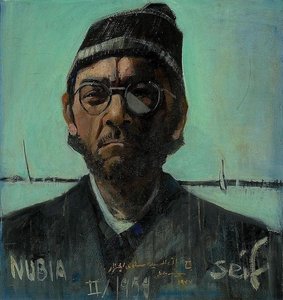
Aperçu en situation Aperçu en RA Passer au format impression Acheter la peinture faite à la main Partager
Détails Guide imprimable Ajouter aux favoris Télécharger Articles similaires Radiographie Voir le diaporama Statistiques

Untitled

Explore 'Untitled' by Mohamed Seif al-Din Wanly (1950). This stylized oil painting blends Islamic architecture & folk art, depicting a communal gathering. Discover Egyptian modernism!

Explore l’œuvre remarquable de Mohamed Seif al-Din Wanly ! Peintre égyptien innovateur fusionnant héritage culturel traditionnel et esthétique contemporaine. Découvrez ses peintures emblématiques et son rôle dans la naissance de l'art moderne en Égypte.

Acquérez une image numérique haute résolution et optimisée, d'une qualité bien supérieure à l'aperçu en ligne.

Chaque fichier est méticuleusement préparé par nos spécialistes internes à l'aide d'outils avancés et d'une retouche manuelle experte. Nous garantissons que chaque image possède une clarté exceptionnelle, une précision des couleurs irréprochable et un niveau de détail fin.

Le fichier final est livré par e-mail sous 72 heures, optimisé pour une utilisation immédiate dans des contextes professionnels, éditoriaux et d'impression. Il offre la même qualité de confiance que celle utilisée par les plus grands studios de création, éditeurs et galeries.

Image numérique

Téléchargez un fichier haute résolution pour votre usage personnel, l'impression et vos projets créatifs. ( Passer au format impression Acheter la peinture faite à la main)

Prix total

$ 24,90

Inclus avec chaque commande d'image numérique

Livraison numérique experte, garantie.

En choisissant WahooArt.com, vous n'obtenez pas seulement une simple image : vous recevez une œuvre numérique sublimée avec professionnalisme, conçue avec précision et accompagnée d'une garantie de satisfaction. Voici tout ce qui accompagne automatiquement votre commande :

shipping_icon
Livraison rapide par e-mail

Votre fichier d'image numérique haute résolution vous sera envoyé par e-mail sous 72 heures après votre commande — prêt à un usage immédiat.

canvas_icon
Fichier numérique optimisé par l'IA

Votre œuvre d'art bénéficie d'une optimisation professionnelle grâce à des outils d'IA avancés et une retouche manuelle, garantissant un niveau maximal de détail, de clarté et de fidélité chromatique.

insurance_icon
Réexpédition gratuite à vie

Vous avez accidentellement supprimé ou perdu votre fichier ? Pas d'inquiétude — nous vous le renverrons gratuitement, quand vous le souhaitez.

tax_icon
Aucuns frais de douane — À jamais

Profitez de votre œuvre d'art instantanément sans frais de douane ni de livraison — les téléchargements numériques sont toujours exonérés de taxes.

color_icon
Garantie de fidélité des couleurs

Nous garantissons que votre image numérique reproduit les couleurs de l'original aussi fidèlement que possible grâce à des outils professionnels et une gestion rigoureuse des couleurs.

return_icon
Garantie de satisfaction de 100 jours

Si vous n'êtes pas satisfait de votre image numérique, nous la retoucherons ou vous rembourserons 100% sous 100 jours — sans poser de questions.

guarantee_icon
Garantie de remboursement à 100%

Pas satisfait ? Obtenez un remboursement intégral dans les 100 jours suivant la réception de votre fichier numérique — sans aucune question posée.

discount_icon
Remises sur les commandes groupées

Achetez 3 images, économisez 10% - Achetez 5, économisez 15% - Achetez 10+, économisez 20%. Idéal pour les projets créatifs, les galeries et les agences.

L'essentiel de l'œuvre

  • Subject or theme: Communal gathering and architecture
  • Dimensions: 47 x 67 cm
  • Notable elements or techniques: Broad brushstrokes, bold outlines
  • Artist: Mohammed Seif al-Din Wanly
  • Medium: Oil paint
  • Title: Untitled

Quiz d'art

Chaque question ne comporte qu'une seule bonne réponse.

Question 1:
What is the primary artistic style used in this painting?
Question 2:
Which architectural feature dominates the composition of the artwork?
Question 3:
What does the presence of flags and a crowd in the painting likely symbolize?
Question 4:
Which medium was used to create this artwork?
Question 5:
The painting's color palette is primarily composed of which colors?

A Vision of Timeless Gathering

In this evocative oil painting from 1950, the renowned Egyptian master Mohammed Seif Al-Din Wanly invites us into a dreamlike realm where architecture and community converge. The composition is anchored by a magnificent white building, its domed roof rising with a quiet authority that commands the viewer's attention. Surrounded by a sea of figures, the scene captures a moment of profound communal significance, perhaps a religious festival or a national celebration. Through a stylized, folk-art lens, Wanly strips away the complexities of the modern world to reveal the essential spirit of a gathering. The flattened perspective and bold, graphic outlines create a sense of timelessness, as if we are peering into a cherished memory or an ancient tapestry brought to life on canvas.

The artist’s technique is a masterful blend of European training and deep-rooted cultural identity. Having studied under the Italian artist Otorino Becchi, Wanly possessed a sophisticated command of oil paint, yet he chose to apply it with broad, confident brushstrokes that favor essence over meticulous detail. This approach lends the work a textured, rhythmic quality, where the smooth surfaces of the white architecture contrast beautifully with the more gestural treatment of the crowd and the dark, brooding sky. The color palette is a sophisticated study in restraint; muted blues, soft greens, and earthy beiges are punctuated by sudden, joyful flickers of red and yellow, mirroring the vibrant energy of the flags that flutter above the assembly.

Symbolism and Cultural Resonance

Beyond its aesthetic beauty, the painting serves as a profound vessel for cultural symbolism. The geometric precision of the building’s roof and the rhythmic arrangement of the flags suggest an architectural heritage deeply connected to Islamic tradition, evoking a sense of stability and sacredness. The crowd itself acts as a powerful symbol of unity; in their collective presence, individual identities merge into a singular, harmonious entity. For the collector or interior designer, this piece offers more than mere decoration; it provides a window into the soul of mid-century Egypt, capturing a period of transition and the enduring strength of communal bonds. The interplay between the light, ethereal building and the heavy, dark hills in the background creates a tension that is both melancholic and celebratory, making it an intellectually stimulating addition to any curated collection.

Integrating such a piece into a contemporary space allows for a sophisticated dialogue between history and modernity. Its soft, diffused lighting and nostalgic atmosphere make it an ideal focal point for rooms designed for reflection or quiet conversation. Whether placed in a minimalist gallery setting or a richly textured study, Wanly’s Untitled continues to resonate with its ability to evoke nostalgia, dignity, and a profound sense of peace. It is a work that does not merely occupy space but transforms it, inviting all who gaze upon it to participate in the eternal dance of human connection.


Biographie de l'artiste

Mohamed Seif al-Din Wanly : Bridging Tradition and Modernity in Egyptian Art

Mohamed Seif al-Din Wanly, a pivotal figure in the evolution of Egyptian art, was born on March 31, 1906, in Alexandria, Egypt—a city steeped in history and cultural vibrancy. His lineage traced back to a Turkish aristocratic family, fostering an environment that nurtured intellectual curiosity and artistic aspiration from his earliest years. Growing up alongside his siblings, he received a privileged education shaped by the influence of European pedagogical approaches, notably at the Studio Otorino Becchi, where he encountered the transformative techniques of Italian Impressionism. This formative experience would become instrumental in introducing modern art concepts to Egypt’s artistic landscape.

Early Life and Artistic Formation

Becchi's studio proved to be more than just a place of instruction; it was an immersion into European artistic currents that profoundly impacted Wanly’s worldview. He diligently studied Becchi’s methods, absorbing the principles of plein air painting and capturing fleeting moments of light and color—a stylistic hallmark that would permeate his subsequent oeuvre. Following Becchi's departure from Egypt in 1934, Wanly continued his artistic pursuits independently, establishing a studio alongside his brother Adham Wanly and forging collaborations with fellow artists like Ahmad Fahmi and Mohammed Bayoumi. This collective spirit fueled experimentation and innovation within Alexandria’s burgeoning art scene.

A Pioneer of Modern Egyptian Art

Wanly's contribution to Egyptian art transcends mere stylistic imitation; he actively championed the dialogue between tradition and modernity—a distinction that defines his artistic legacy. Rejecting the folklorist tendencies prevalent in his time, he embraced bolder palettes and compositional explorations reminiscent of Fauvist principles and Cubism. His groundbreaking project documenting Nubia before the construction of the Aswan High Dam stands as a testament to this commitment. Traveling extensively throughout Europe during the 1950s—France, Italy, Spain—he meticulously sketched and painted scenes from ballet performances, opera houses, and sporting events, capturing dynamism and theatricality with remarkable precision.

Notable Achievements and Artistic Style

Wanly’s artistic style is characterized by a harmonious blend of influences: Becchi's Impressionistic sensitivity combined with the geometric rigor of Cubism and Futurism. He skillfully employed large canvases to convey emotion and movement, favoring expressive brushstrokes that captured the essence of his subjects—often portraits imbued with psychological depth—and landscapes rendered in luminous colors. Recurring themes included depictions of ballet dancers, opera singers, and equestrian competitions, reflecting Wanly’s fascination with performance arts and his desire to portray human figures in motion. His meticulous attention to detail and masterful command of color solidified his reputation as one of Egypt's foremost artists.

Legacy and Recognition

Today, an entire floor of the Mahmoud Said Museum in Alexandria honors Seif and Adham Wanly’s artistic achievements—a fitting tribute to their enduring influence on Egyptian art history. Their works are housed in prestigious collections worldwide, including Mathaf: Arab Museum of Modern Art in Doha, Darat AL Funoon in Amman, and Barjeel Art Foundation in Sharjah. Furthermore, Wanly's birthday was commemorated by Google Doodle in 2015—a poignant acknowledgment of his contribution to artistic expression and cultural heritage. Mohamed Seif al-Din Wanly remains an inspiration for artists striving to synthesize tradition and innovation, cementing his place as a cornerstone of Egyptian art’s modernist movement.
Mohamed Seif al-Din Wanly

Mohamed Seif al-Din Wanly

1906 - 1979 , Égypte

En bref

  • Artistic Movement Or Style: Art Moderne Égyptien
  • Artists Or Movements Influenced By This Artist: ['Islamic Architecture']
  • Artists Who Influenced This Artist: ['Otorino Becchi']
  • Date Of Birth: March 31, 1906
  • Date Of Death: February 15, 1979
  • Full Name: Mohamed Seif al-Din Wanly
  • Nationality: Egyptien
  • Notable Artworks:
    • La 3eme Symphonie
    • Le Héros
  • Place Of Birth: Alexandria, Egypt