Huile sur toile peinte à la main, avec cadre et dimensions personnalisés, réalisée sur commande par nos artistes. ( Commander l'impression Acheter l'image haute résolution)





























Choisissez parmi nos formats prédéfinis qui respectent les proportions originales de l’œuvre.

Vous pouvez saisir vos propres dimensions pour l'adapter à un cadre ou à un espace spécifique. Si la taille sélectionnée ne correspond pas aux proportions de l'image d'origine, nous recadrerons l'œuvre ou prolongerons la peinture avec des éléments peints à la main supplémentaires. Une maquette numérique vous sera envoyée pour approbation avant le début de la production.
Veuillez noter que l'aperçu à l'écran ne reflète pas le recadrage ou l'extension réels. Seule la maquette montrera fidèlement la composition finale.
Bien que des tailles personnalisées soient disponibles, nous vous recommandons de sélectionner une dimension dans la liste prédéfinie afin de préserver les proportions d'origine.
Livraison dans le monde entier () en 3 à 4 semaines au lieu des 5 semaines habituelles. (6 septembre). Aucun compromis sur la qualité.


LE MOULIN A EAU
Format de la reproduction
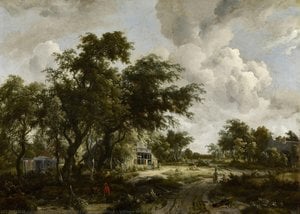
To gaze upon Meindert Hobbema's "Le Moulin à Eau" is to step directly into the hushed, contemplative heart of 17th-century Holland. This masterpiece of landscape painting does more than merely depict a scene; it invites the viewer into an atmosphere—a profound sense of pastoral calm punctuated by the steady rhythm of rural industry. The composition unfolds with masterful balance, drawing the eye from the gentle curve of the water in the foreground, which acts as a liquid invitation, leading us deeper into the pictorial space toward the central subject: the venerable water mill.
Hobbema’s genius lies in his ability to capture not just what was seen, but how it felt. The surrounding wooded area, dominated by the stately presence of large trees, frames the architecture with an organic embrace. It is a scene steeped in the quiet dignity of everyday life, where nature and human endeavor—represented by the mill—coexist in perfect, muted harmony.
The technical brilliance evident in this work speaks to Hobbema's meticulous observation. The palette itself is a study in restraint, dominated by the rich, earthy tones of browns, deep greens, and soft greys. These are not the vibrant hues of high noon, but rather the nuanced shades found under an overcast sky—a light that diffuses all harsh edges into a gentle, pervasive glow. This diffused lighting technique minimizes stark contrast, lending the entire scene a dreamlike quality.
Observe the texture: the rough bark of the trees, the subtle sheen on the water's surface, and the varied density of the foliage are rendered with palpable realism through visible brushwork. Hobbema employs atmospheric perspective so skillfully that the distant elements recede into a soft haze, giving the entire canvas an astonishing sense of depth and spatial recession. It is a lesson in pictorial illusion executed with the precision of a master craftsman.
Historically, the water mill was more than just a structure; it was a vital artery of Dutch prosperity and ingenuity. In art, such elements often symbolize human mastery over nature, yet Hobbema presents this industry not with fanfare, but with quietude. This juxtaposition suggests that true strength is found in enduring rhythm rather than dramatic display. The overcast sky, far from suggesting gloom, lends an air of deep contemplation—a perfect backdrop for the collector or designer seeking to infuse a space with thoughtful serenity.
The overall emotional resonance of "Le Moulin à Eau" is one of peaceful nostalgia. It speaks to a slower pace, a time when life unfolded according to the steady turning of the wheel and the slow drift of the water. Owning a reproduction allows one to curate this feeling of timeless repose within a modern setting.
For those curating an interior space that demands both historical gravitas and soothing calm, this artwork is unparalleled. Its muted, natural color scheme—the deep forest greens against the soft greys and warm beiges—integrates seamlessly into sophisticated design palettes. Whether placed above a mantelpiece or serving as a focal point in a study, its composition anchors a room with an undeniable sense of established beauty.
The reproduction captures not only the visual splendor but also the tactile quality of the original oil on canvas, allowing you to bring home a piece that feels both historically significant and immediately comforting. It is an investment in atmosphere itself—a permanent echo of Dutch Golden Age tranquility.


1638 - 1709 , Pays-Bas

Explore the breathtaking mastery of Dutch Golden Age landscapes. From Italianate light to atmospheric realism, discover the techniques of 17th-century masters and learn how to bring these timeless, museum-quality masterpieces into your home through expert oil reproductions.

Embark on a sophisticated journey through the Dutch Golden Age. Unveil the dramatic brilliance of Rembrandt’s chiaroscuro and the expressive landscapes of 17th-century masters in this authoritative exploration of light, shadow, and enduring artistic legacy.

 Aperçu en situation
 Envoyer
 Partager
 Détails de l'œuvre

 Télécharger
 Articles similaires
 Radiographie
 Diaporama

 Lire la suite







 L'option verre n'est disponible que pour les dimensions inférieures à 110 cm.