

L’œuvre d'art présentée sur cette page est protégée par le droit d'auteur, ce qui signifie que nous ne pouvons légalement créer ou vendre de reproduction identique. Cette protection est appliquée en vertu d'accords internationaux tels que la Convention de Berne et par les lois nationales, notamment celles énoncées par le Loi américaine sur le droit d'auteur - Titre 17.
Cette méthode est pleinement conforme aux réglementations sur le droit d'auteur car elle ne repose pas sur la copie ou la duplication de l'œuvre protégée. Il s'agit plutôt d'une réinterprétation créative — une nouvelle peinture qui s'inspire de l'original sans pour autant lui être identique.
Impressions giclées ou sur toile de qualité musée, avec une production rapide et des finitions au choix. ( Commander la reproduction peinte à la main Passer au format numérique)





























Choisissez parmi nos formats prédéfinis qui respectent les proportions originales de l’œuvre.

Saisissez la largeur et la hauteur souhaitées pour qu'elles s'adaptent à votre cadre ou à votre mur. Une impression peut être recadrée, mais jamais agrandie au-delà de l'image originale ; ainsi, un format de forme différente entraînera la perte d'une partie de l'image. Nous vous envoyons une maquette numérique pour approbation avant toute impression. L'image présentée sur cette page ne montre pas le recadrage réel — seule la maquette le permet.
Livraison dans le monde entier () en 2 semaines au lieu des 4/5 semaines habituelles. (9 novembre)
Landscape 1
Format de la reproduction
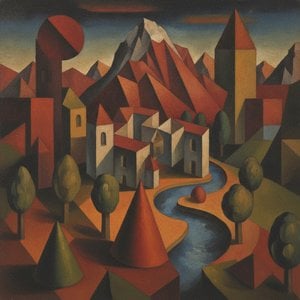
Max Ernst’s “Landscape,” painted in 1957, isn't merely a depiction of a rural scene; it’s an embodiment of the core tenets of Surrealist art – a deliberate disruption of rational thought and a fascination with the subconscious mind. This striking piece showcases Ernst’s signature blend of Cubism and Dada influences, resulting in an image that feels both meticulously crafted and profoundly unsettling.
Beyond its visual appeal lies a rich tapestry of symbolic references. Ernst’s use of geometric shapes—particularly angular rocks and abstracted tree trunks—reflects the Surrealists' preoccupation with dismantling traditional representations. These forms aren’t meant to mirror reality but rather to evoke psychological states, mirroring the fragmented perceptions inherent in dreams.
Painted during the height of Surrealism’s influence—a movement born from disillusionment with postwar Europe— “Landscape” speaks to a broader philosophical concern: the exploration of irrationality and the confrontation with anxieties surrounding societal change. Ernst, deeply impacted by Freud’s psychoanalytic theories, sought to liberate art from the constraints of logic, prioritizing intuition and dreamlike imagery.
"Landscape" transcends its formal elements to convey a profound sense of solitude and wonder. It captures the quiet contemplation of someone encountering something extraordinary—a hidden beauty or an unspoken truth—within the seemingly mundane expanse of nature. Ernst’s enduring contribution to art history lies in his unwavering commitment to artistic experimentation and his courageous exploration of the human psyche, cementing “Landscape” as a cornerstone of Surrealist aesthetics.
«Landscape 1» de Max Ernst est classé comme Recognized et appartient au mouvement Surrealist Landscape.
Une page Statistiques est disponible pour « Landscape 1 ». Elle présente l'évolution mensuelle des visites de l'œuvre ainsi que des autres créations de l'artiste, avec une répartition par pays et par langue.
La couleur dominante de «Landscape 1» de Max Ernst est le Putty (#d0d1a8).

Max Ernst a fait son entrée dans le monde le 2 avril 1891 à Brühl, en Allemagne. Il a grandi au sein d'une famille catholique de la classe moyenne, troisième d'une fratrie de neuf enfants. Son éducation a été façonnée par l'atmosphère calme et disciplinée de son foyer, où son père, Philipp, exerçait la profession d'enseignant pour sourds et muets. Philipp était également peintre amateur, et c'est par son intermédiaire que le jeune garçon a découvert pour la première fois les outils et la pratique de la création artistique.
Dès 1909, alors qu'il était étudiant à l'Université de Bonn, Max Ernst a commencé à peindre. Cette première période de sa vie fut marquée par un intérêt croissant pour le monde visuel, bien que son parcours finisse par s'étendre bien au-delà de la simple toile. Il est devenu un artiste aux multiples facettes, travaillant comme peintre, sculpteur, graveur, artiste graphique et poète. Ses premières années n'étaient pas tant une quête d'une direction unique qu'une exploration portée par une curiosité insatiable sur la manière de représenter le monde et l'esprit humain.
Le chemin d'Ernst vers l'art fut sculpté par une curiosité insatiable pour l'esprit humain et les structures de la pensée. Durant ses années à l'Université de Bonn, il ne se consacra pas uniquement au pinceau et à la toile. Il consacra plutôt son temps à l'étude de la philosophie, de l'histoire de l'art, de la littérature, de la psychologie et de la psychiatrie. Ces disciplines lui ont offert un cadre pour appréhender le monde qui transcendait la simple esthétique. Il se passionnait pour les raisons profondes de l'existence, cherchant à comprendre les mécanismes de la psyché et l'histoire de l'expression humaine. Ce socle intellectuel lui permettrait, plus tard, de s'affranchir de la représentation traditionnelle pour explorer les strates les plus occultes et irrationnelles de l'expérience humaine.
Ses premières années furent marquées par un rapprochement croissant avec la communauté artistique allemande. En 1911, il intégra le groupe des Die Rheinischen Expressionisten. Cette période de sa vie fut définie par la quête d'un nouveau langage visuel. Un tournant décisif survint en 1912, lors de sa visite à l'exposition Sonderbund à Cologne. La découverte des œuvres de Pablo Picasso, Vincent van Gogh et Paul Gauguin bouleversa sa perspective. Ces artistes lui offrirent une voie pour rompre avec les normes établies. Il se sentit attiré par leurs approches, ce qui l'orienta vers l'expérimentation radicale qui allait définir toute sa carrière.
Le déclenchement de la Grande Guerre a fondamentalement fracturé la trajectoire de la vie d'Ernst. Mobilisé pour le service, il a passé quatre années en tant que soldat sur les lignes de front. Servant comme artilleur, il a été confronté aux réalités brutales des fronts oriental et occidental. Cette expérience fut bien plus qu'une simple interruption de ses études ; ce fut un choc psychologique profond. Le chaos et la destruction dont il a été témoin l'ont profondément ébranlé, nourrissant un scepticisme durable envers le monde moderne et ses ordres établis.
Le traumatisme du conflit fut si absolu qu'il sembla effacer son ancien moi. Dans son autobiographie, il a évoqué cette mort intérieure avec une clarté saisissante, affirmant que Max Ernst est mort le 1er août 1914. Ce sentiment de perte et le désenchantement qui s'ensuivit allaient finalement le porter vers les expressions radicales et anti-rationalistes des mouvements qui allaient suivre.
Le chaos de la Grande Guerre a laissé en Max Ernst un scepticisme profond envers les structures du monde moderne. Dès 1919, ce désenchantement a trouvé une voix à Cologne, où il a uni ses forces à celles de Hans Arp et Johannes Theodor Baargeld pour fonder le groupe Dada de Cologne. Ce fut une période de création intense et fébrile. Aux côtés de ses nouveaux compagnons, il a contribué au lancement de revues éphémères telles que Der Strom et die Schammade, utilisant la parole écrite pour repousser les limites de ce que l'art était autorisé à être. Ce fut une époque de mutations radicales, tant dans sa production créative que dans sa vie privée, puisqu'il épousait Luise Straus, une étudiante en histoire de l'art, en 1919.
Durant ces années, Max Ernst a commencé à s'éloigner de la peinture traditionnelle, trouvant un nouveau langage dans l'art de l'assemblage. Il a produit ses premiers collages en 1919, travaillant avec des fragments d'images pour créer quelque chose de totalement différent des éléments originaux. Un exemple notable de cette période est Fiat modes, un portfolio de lithographies qui témoignait de son intérêt croissant pour ces compositions fragmentées. Ces expérimentations n'étaient pas de simples choix stylistiques ; elles constituaient une manière de naviguer dans un monde qui ne semblait plus ni cohérent, ni rationnel.
Dès 1922, l'énergie fébrile qui avait nourri ses années dadaïstes trouva un nouveau foyer lors de l'installation d'Ernst en France. Il s'imprégna des cercles intellectuels de Paris, trouvant un sentiment d'appartenance parmi les Surréalistes. Il intégra ce groupe soudé dirigé par André Breton, un cercle qui cherchait à cartographier les territoires étranges et inexplorés de l'esprit humain. Ce fut une époque de collaboration intense et de desseins partagés, où les frontières de la représentation artistique étaient repoussées vers le royaume des rêves et de l'inconscient.
Sa présence au sein de ce cercle se distingua par un engagement profond envers le mot écrit et l'image visuelle. Il collabora avec Paul Éluard à la revue Littérature, un projet qui contribua à définir l'envergure du mouvement. Ces années furent marquées par une quête incessante de nouveaux moyens pour visualiser l'irrationnel. En 1924, sa curiosité le transporta bien au-delà des rues de Paris lors de son voyage en Indochine, une expérience qui ajouta de nouvelles strates à sa vision du monde en pleine expansion.
Max Ernst était un expérimentateur insatiable qui cherchait sans cesse à contourner le contrôle de l'esprit conscient. Il se tournait souvent vers l'accidentel pour puiser son imagerie, une quête qui l'a conduit à développer le frottage, une méthode consistant à placer du papier sur des surfaces texturées pour les frotter avec un crayon ou du fusain. Ce simple geste de frottement permettait à des formes inattendues d'émerger du grain du bois ou des nervures d'une feuille. Il a enrichi ce concept avec le grattage, un processus par lequel il raclait la peinture sur la toile pour révéler les textures d'objets placés en dessous. Ces méthodes lui permettaient de façonner des paysages qui semblaient à la fois organiques et étranges.
Son intérêt pour l'irrationnel l'a également mené vers la décalcomanie. En pressant la peinture d'une surface sur une autre, il parvenait à obtenir des distorsions oniriques et des effets de superposition qui semblaient surgir directement d'un rêve. Maître incontesté du collage, il assemblait avec minutie des éléments disparates — tels que des illustrations scientifiques ou des coupures de magazines — pour créer des compositions qui défiaient notre perception de la réalité. Il ne se contentait pas de peindre une scène ; il la construisait à partir de fragments du monde qui l'entourait.
Une étrange et personnelle fixation pour les oiseaux a accompagné Max Ernst tout au long de sa vie. Il ne s'agissait pas d'un simple intérêt pour la nature, mais d'une préoccupation profonde née d'un souvenir d'enfance. Il se rappelait le moment où son oiseau de compagnie préféré s'était éteint, précisément à l'instant même où sa petite sœur venait de naître. Cette coïncidence semblait avoir fusionné les notions de vie et de mort dans son esprit, transformant les oiseaux en des symboles porteurs à la fois de présages et de mystère. Il les percevait souvent comme des créatures capables de jeter un pont entre l'expérience humaine et le surnaturel.
Cette fascination a fini par prendre une forme physique, presque psychologique, à travers un alter ego freudien aviaire qu'il a baptisé Loplop. Ce personnage était bien plus qu'un simple motif récurrent ; il agissait comme un guide à travers les paysages de son esprit. Loplop a fait sa première apparition formelle dans son roman-collage de 1929, La Femme 100 Têtes. Dans cette œuvre, l'oiseau fait office de narrateur, guidant le lecteur à travers une série d'images assemblées et de réalités fragmentées. À travers Loplop, Max Ernst a trouvé un moyen de personnifier les pulsions irrationnelles de l'inconscient, donnant un visage — ou un bec — aux parties de lui-même qui défiaient la logique.
Les ombres de la Seconde Guerre mondiale finirent par atteindre jusqu'au sanctuaire de l'artiste en France. En 1938, le climat politique se tourna brutalement contre lui, et il fut interné au Camp des Milles, près d'Aix-en-Provence. Cette période de confinement fut un fardeau pesant, d'autant plus que le régime nazi le désignait comme un étranger indésirable. L'incertitude de sa situation s'accentua à mesure que la guerre s'intensifiait, l'obligeant à prendre la décision de laisser derrière lui la vie qu'il avait bâtie en Europe.
Une voie vers la sécurité s'ouvrit grâce à l'aide de Peggy Guggenheim. En 1941, il s'enfuit à New York, arrivant dans une ville qui devenait un refuge pour nombre de ses contemporains. Ce départ fut bien plus qu'un simple changement de décor ; ce fut un déplacement total. Il épousa Guggenheim en 1942, trouvant l'un dans l'autre un sentiment de stabilité au milieu du chaos de l'époque. Durant son séjour aux États-Unis, il continua d'expérimenter ses méthodes, trouvant de nouvelles manières de traduire les textures de l'inconscient sur la toile.
Après avoir passé de nombreuses années aux États-Unis, Max Ernst regagna Paris en 1953. Ce retour aux sources marqua une période de reconnaissance majeure pour toute une vie consacrée à l'expérimentation. En 1954, il reçut le Grand Prix de peinture lors de la 27ème Biennale de Venise. Sa présence sur la scène artistique mondiale demeura constante, alors qu'il continuait de repousser les frontières de son art jusque dans ses dernières années.
Sa curiosité insatiable le portait souvent vers des matériaux qui semblaient à la fois fragiles et éternels. En 1966, il créa un jeu d'échecs en verre intitulé Immortel. Cette œuvre témoignait de sa capacité unique à déceler la magie dans les propriétés physiques des objets, faisant écho aux textures qu'il avait passé des décennies à révéler par le frottage et le grattage. Il resta pleinement engagé dans sa quête créative jusqu'à son dernier souffle à Paris, le 1er avril 1976.
Partir à la recherche des traces de l'imagination insatiable de Max Ernst nécessite un voyage à travers plusieurs grands carrefours culturels. À Venise, la Peggy Guggenheim Collection abrite des pièces qui reflètent son lien profond avec le cercle surréaliste. Sa présence se fait également sentir dans les salles du Metropolitan Museum of Art, où ses expérimentations sur la texture et la forme sont préservées pour ceux qui étudient les mutations du début du XXe siècle.
Les voyageurs peuvent également rencontrer son œuvre à Édimbourg, au sein des National Galleries of Scotland. La collection qui s'y trouve offre la chance de contempler sa vision de près. D'autres collections significatives se trouvent à la Staatsgalerie Stuttgart et au Tel Aviv Museum of Art, garantissant que son influence demeure accessible sur différents continents. Ces institutions maintiennent vivant son héritage matériel, nous permettant d'observer les surfaces mêmes qu'il a grattées et frottées pour faire émerger son imagerie.

1891 - 1976 , Allemagne
Explore the profound evolution of Cubist landscapes. Discover how masters like Braque and Picasso redefined perspective through geometric mastery, transforming nature into an intellectual mosaic of form and light for the discerning modern art collector.
 Aperçu en situation
 Envoyer
 Partager
 Détails de l'œuvre
 Guide
Guide

 Télécharger l'image
 Articles similaires
 Radiographie
 Diaporama
 Questions et réponses
 Statistiques
 Lire la suite









 L'option verre n'est disponible que pour les dimensions inférieures à 110 cm.


