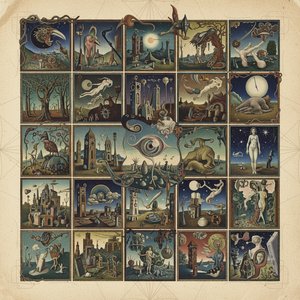
Une Œuvre Captivante de Max Ernst : La Vie des Animaux
Max Ernst’s “La vie des animaux” stands as a testament to the artist's unwavering commitment to surrealist principles and his masterful manipulation of color and form. Painted circa 1964, this artwork transcends mere representation; it invites contemplation on themes of metamorphosis, instinct, and the hidden realities lurking beneath the surface of perception.
The painting’s dominant hue is a serene blue, establishing a tranquil backdrop that contrasts sharply with the scattered yellow dots punctuating the canvas. These dots aren't randomly placed—they are meticulously arranged in irregular shapes – spirals, circles, and amorphous blobs – creating an interplay of visual rhythms that draws the eye across the surface. Ernst’s technique relies on layering oil paint onto burlap, a material chosen for its textural qualities which contribute to the artwork’s tactile presence.
Symbolism et Réflexions Philosophiques
Ernst's fascination with psychoanalysis profoundly influenced his artistic vision. “La vie des animaux” embodies this influence through its evocative imagery, mirroring Freudian concepts of unconscious desires and repressed emotions. The yellow dots can be interpreted as symbols of vitality, illumination, and perhaps even the subconscious mind striving to break free from constraints.
Furthermore, the painting speaks to broader philosophical inquiries into the nature of existence and the relationship between humanity and the natural world. Ernst’s exploration of animal imagery aligns with a wider artistic movement concerned with confronting anxieties about societal norms and embracing irrationality as a path toward creative liberation.
Contexte Historique et Influence Artistique
“La vie des animaux” emerged during the height of Surrealism, a movement spearheaded by André Breton that sought to liberate art from rational thought and embrace dreamlike imagery. Ernst’s work alongside Jean Dubuffet and Yves Tanguy solidified Surrealist aesthetics as a powerful counterpoint to prevailing artistic conventions.
The painting's enduring appeal lies in its ability to resonate with viewers on an emotional level, prompting introspection about the hidden forces shaping our perceptions and behaviors. It remains a compelling example of Ernst’s distinctive style—characterized by meticulous detail combined with spontaneous gesture—and a cornerstone of Surrealist art history.
Reproductions Haute Qualité pour Votre Intérieur
WahooArt offers exceptional reproductions of “La vie des animaux,” meticulously crafted to capture the artwork's original vibrancy and textural nuances. Explore our curated collection of prints and canvases—perfect for enriching your home décor or gifting to art enthusiasts.



 Aperçu en situation
 Passer au format impression
 Partager
 Partager
 Détails
 Guide
Guide

 Télécharger
 Articles similaires
 Radiographie
 Voir le diaporama
 Statistiques
 Afficher la suite






































 L'option verre n'est disponible que pour les dimensions inférieures à 110 cm.