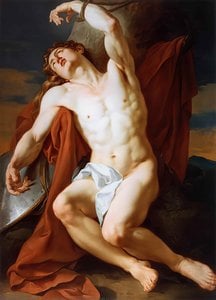
A Study in Suffering: Mattia Preti’s St Sebastian
Mattia Preti's "St Sebastian" (c. 1660) is not merely a depiction of a biblical martyr; it’s a profoundly moving exploration of human suffering and faith, rendered with the dramatic intensity characteristic of the Calabrian Knight himself. This painting, showcasing St. Sebastian’s agonizing martyrdom – his imprisonment and self-flagellation after being shot with arrows – immediately draws the viewer into a world of palpable anguish. Preti, deeply influenced by Caravaggio's masterful use of *chiaroscuro*, employs this technique to devastating effect, sculpting the figure’s muscular form from pools of deep shadow while simultaneously illuminating his exposed flesh and contorted expression. The ropes and chains binding him to the post are not simply restraints; they become extensions of his torment, emphasizing his vulnerability against a backdrop of brutal reality.
Baroque Drama and Calabrian Roots
Born in Taverna, Calabria, in 1613, Mattia Preti’s artistic development was inextricably linked to the vibrant Baroque movement sweeping through Italy. His early training under Giovanni Battista Caracciolo provided a crucial foundation, introducing him to the Caravaggist style – a commitment to realism, dramatic lighting, and emotionally charged narratives. This influence is powerfully evident in “St Sebastian,” where Preti doesn’t shy away from depicting the raw physicality of suffering. The subdued color palette—earth tones dominate—contributes significantly to the painting's somber mood, amplifying the sense of despair and isolation. Preti’s time spent in Rome further solidified his artistic vision, allowing him to absorb the lessons of Caravaggio and Guercino before ultimately establishing himself as a leading figure in Malta, where he would spend much of his career.
Symbolism of Pain and Redemption
The iconography surrounding St. Sebastian is rich with symbolic meaning. He was martyred for refusing to worship pagan gods, representing unwavering faith against worldly temptations. The arrows piercing his body are a potent symbol of suffering and sacrifice, while the ropes and chains represent earthly bonds that cannot contain the spirit. Preti’s skillful rendering of these elements elevates the painting beyond a simple historical narrative; it becomes a meditation on human endurance and the promise of redemption. The figure's raised arms, though clearly in agony, also suggest a plea for divine intervention – a desperate reaching out to a higher power amidst unimaginable pain.
Technical Mastery and Emotional Resonance
“St Sebastian” exemplifies Preti’s technical brilliance and his ability to translate complex emotions onto canvas. The meticulous detail of the figure's anatomy, combined with the dramatic use of light and shadow, creates an incredibly realistic and emotionally resonant image. The artist’s attention to texture – from the rough grain of the wood to the tautness of Sebastian’s muscles – adds another layer of depth and intensity. This painting is a testament to Preti's mastery of Baroque technique, resulting in a work that continues to captivate viewers with its raw emotion and enduring power. It remains a cornerstone of his oeuvre, showcasing his profound understanding of human suffering and his ability to evoke powerful responses through masterful artistic execution.



 Aperçu en situation
 Passer au format impression
 Envoyer
 Partager
 Détails de l'œuvre

 Télécharger
 Articles similaires
 Radiographie
 Diaporama
 Statistiques


 Lire la suite






































 L'option verre n'est disponible que pour les dimensions inférieures à 110 cm.