Earth and Green : An Exploration of Color and Emotion
Mark Rothko’s “Earth and Green,” painted in 1955, stands as a cornerstone of Color Field Painting—a movement that fundamentally challenged conventional artistic representation. More than just pigment on canvas, this artwork embodies an ambitious pursuit of pure emotion, reflecting the artist's profound engagement with existential themes.
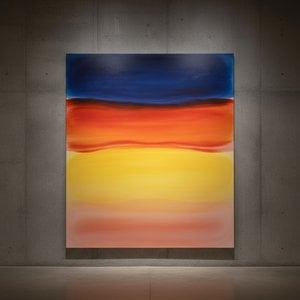
The painting’s simplicity is deceptive. At first glance, it presents two rectangular blocks of color – a deep maroon red occupying the upper left quadrant and a vibrant lime green dominating the lower right. These hues are positioned against a muted bluish background, creating an atmospheric space that invites contemplation. Rothko meticulously applied thin layers of oil paint to achieve a velvety surface texture, emphasizing the materiality of the canvas itself.
Rothko’s stylistic choices were driven by his desire to transcend literal depiction and tap into universal human experience. Influenced by Surrealism and Expressionism before him, he rejected representational art altogether, believing that color alone could convey profound psychological states. As he famously stated, “I want to paint what I see—but I don’t see things as they are. I see them as they feel.” This conviction is palpable in "Earth and Green," where the colors seem to pulsate with an inner luminescence.
The color palette itself carries significant symbolic weight. Red, traditionally associated with passion, energy, and primal instinct, contrasts sharply with green—a hue symbolizing growth, renewal, and harmony with nature. This juxtaposition speaks to a broader meditation on duality – the tension between opposing forces that shape human consciousness.
- Artist: Mark Rothko (1903-1970)
- Style: Color Field Painting
- Medium: Oil Paint
- Dimensions: Unknown
- Location: Museum Ludwig, Cologne
“Earth and Green” continues to resonate with viewers today because it captures the essence of Rothko’s artistic vision—a commitment to conveying emotion through abstraction. Its enduring appeal lies in its ability to provoke introspection and inspire a connection with the sublime beauty of color itself.
Further Research & Context
This artwork is part of Mark Rothko's prolific output during his formative years as an artist, reflecting his exploration of Expressionist techniques before embracing Color Field Painting. His early influences included artists like Franz Marc and Wassily Kandinsky, who championed the use of color to express spiritual ideas.
Rothko’s artistic journey began in Latvia, where he experienced firsthand the anxieties of a Jewish family living under oppressive conditions. This formative experience instilled within him a sensitivity to human suffering—a theme that would permeate his oeuvre. His subsequent move to Portland, Oregon, marked a crucial step toward establishing himself as an independent artist.
The painting’s placement in the Museum Ludwig underscores its importance within the broader context of contemporary art history. Alongside other masterpieces by artists like László Moholy-Nagy and Robert Rauschenberg, “Earth & Green” exemplifies the modernist impulse to liberate art from representational constraints—a legacy that continues to inspire artists and collectors alike.
Notable Reproduction Sites
Recommended Reproduction Options
WahooArt offers high-quality reproductions of “Earth and Green” in various sizes and framing styles. Explore our selection to bring this iconic artwork into your home or office.
Earth & Green: 1955 - Poster & Frame Art Group
Questions et réponses
Quelle place occupe « La Terre et le Vert » parmi les thèmes récurrents de Mark Rothko ?
«La Terre et le Vert» dépeint color field, abstraction, geometric shapes, red square, green rectangle, rothko style, emotional depth, minimalist composition, tandis que les thèmes récurrents de Mark Rothko sont expressionist roots, existential anxiety, color as emotion, minimalist aesthetic, central rothko piece. La comparaison des deux montre comment l'œuvre s'inscrit dans la lignée des sujets habituels de l'artiste.
Dans quelle pièce de la maison une reproduction de « La Terre et le Vert » s'intégrerait-elle bien ?
Une reproduction de « La Terre et le Vert » s'intègre parfaitement dans une Salon.
Quelle couleur domine dans « La Terre et le Vert » ?
La couleur dominante de «La Terre et le Vert» de Mark Rothko est le Brun espresso (#422924).



 Aperçu en situation
 Commander la reproduction peinte à la main
 Envoyer
 Partager
 Détails de l'œuvre
 Guide
Guide

 Télécharger l'image
 Articles similaires
 Radiographie
 Diaporama
 Statistiques
 Lire la suite






































 L'option verre n'est disponible que pour les dimensions inférieures à 110 cm.