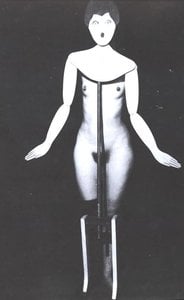
A Shadowed Portrait: Unveiling Man Ray’s “Self-Portrait”
Man Ray's "Self-Portrait," painted in 1927, isn’t merely a depiction of an individual; it’s a carefully constructed meditation on identity, the gaze, and the very act of representation. Born Emmanuel Radnitzky in Philadelphia, Man Ray – a name he adopted to signify his artistic liberation – was a pivotal figure in the Dada and Surrealist movements, constantly challenging conventional notions of art and perception. This particular self-portrait, rendered in oil on canvas, embodies this restless spirit, presenting a subtly unsettling image that invites prolonged contemplation.
The painting’s style is rooted in early Modernism, yet it transcends simple categorization. Ray employs a flattened perspective, reminiscent of Cubist influences, but softens the edges with an almost dreamlike quality. The composition is strikingly direct – we confront the artist directly, his gaze meeting ours across the canvas. However, this apparent straightforwardness belies a complex layering of symbolism and technique. Notice the meticulous detail in the rendering of his face: the slight furrow of his brow, the subtle curve of his lips, the almost imperceptible glint in his eyes – each element contributes to an aura of quiet intensity.
The Alchemy of Photogram and Paint
Ray’s artistic practice was characterized by a remarkable versatility. While he is celebrated for his groundbreaking work in photography—particularly his photograms (rayographs)—“Self-Portrait” demonstrates his mastery of oil painting. He skillfully blends photographic techniques with traditional brushwork, creating an effect that feels both familiar and utterly unique. The use of muted tones – predominantly browns, grays, and blacks – contributes to the painting’s somber mood, while subtle highlights draw attention to key features of the face. The texture is rich and layered, achieved through multiple thin glazes of paint, a technique that adds depth and luminosity to the canvas.
Interestingly, Ray often referenced his photographic experiments in his paintings. The slightly blurred quality of the image, reminiscent of a photograph captured with a slow shutter speed, subtly echoes the ephemeral nature of memory and perception. This connection between photography and painting highlights Ray’s belief that both mediums could be used to explore similar themes – the subjective experience of reality.
A Symbol of Transformation and Self-Discovery
The “Self-Portrait” is more than just a likeness; it's a visual representation of Man Ray’s own evolving identity. Born into a Jewish immigrant family in Philadelphia, he deliberately shed his original name – Emmanuel Radnitzky – to create the persona of Man Ray, a symbol of artistic freedom and experimentation. The painting can be interpreted as a declaration of this transformation, a conscious effort to break free from traditional constraints and forge a new path.
Furthermore, the direct gaze of the subject challenges the viewer’s own role in the act of observation. Ray isn't simply presenting himself; he is inviting us to confront our own perceptions and consider how we see ourselves reflected in his image. The painting subtly suggests that identity is not a fixed entity but rather a fluid and ever-changing construct, shaped by experience and self-awareness.
A Timeless Reflection for the Modern Eye
“Self-Portrait” remains a powerfully resonant work of art, offering insights into the complexities of identity, perception, and artistic innovation. Its understated elegance, combined with its subtle symbolism, makes it a captivating piece for collectors and interior designers alike. Reproductions of this iconic painting capture the depth and nuance of Ray’s original vision, allowing viewers to appreciate its beauty and intellectual richness in their own homes. It's a testament to Man Ray's enduring legacy as one of the most influential artists of the 20th century – an artist who dared to challenge conventions and redefine the boundaries of art itself.
Questions et réponses
Comment puis-je découvrir des œuvres d'art proches de «Self-Portrait» de Man Ray ?
Les œuvres similaires à « Self-Portrait » sont répertoriées sur la page Œuvres similaires de l'œuvre.
Qui est l'artiste derrière « Self-Portrait » ?
L'artiste à l'origine de « Self-Portrait » est Man Ray. L'œuvre est répertoriée sous le nom de Man Ray.
Où puis-je acheter une impression de «Self-Portrait» de Man Ray ?
Une impression de «Self-Portrait» de Man Ray peut être commandée directement sur cette page : une impression d'art sur toile de coton ou sur papier canvas d'archive.
Quelle est l'intensité des couleurs de «Self-Portrait» de Man Ray ?
L'intensité des couleurs de « Self-Portrait » est Monochromatic. L'intensité décrit la force avec laquelle les couleurs apparaissent.
Puis-je voir «Self-Portrait» de Man Ray sur mon propre mur avant de l'acheter ?
La page Aperçu RA de «Self-Portrait» de Man Ray utilise la réalité augmentée pour visualiser l'œuvre dans votre propre espace, à partir d'un appareil compatible.
Où puis-je acheter une reproduction peinte à la main de «Self-Portrait» de Man Ray ?
Vous pouvez commander une reproduction peinte à la main de «Self-Portrait» de Man Ray directement sur cette page : une reproduction à l'huile peinte à la main sur toile de lin, réalisée sur commande.
Quel format choisir pour l'impression de "Self-Portrait" afin qu'il s'adapte à ma pièce ?
Pour une Living Room, la taille d'impression recommandée pour «Self-Portrait» de Man Ray est Large.



 Aperçu en situation
 Passer au format impression
 Partager
 Partager
 Détails
 Guide imprimable

 Télécharger
 Articles similaires
 Radiographie
 Voir le diaporama
 Statistiques

 Afficher la suite






































 L'option verre n'est disponible que pour les dimensions inférieures à 110 cm.