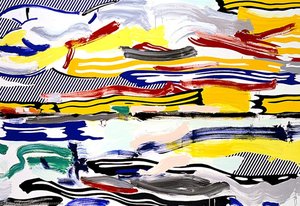
Louis Ritman: The Quiet Impressionist of Giverny
Louis Ritman (1889–1963) stands as a testament to the enduring legacy of American Impressionism, particularly its serene exploration of feminine beauty and subtle tonal harmonies. Born in Kamenets-Podolsky, Russia—a region steeped in artistic tradition but largely outside the mainstream European art scene—Ritman’s early life foreshadowed his distinctive artistic path. Moving with his family to Chicago around 1900 provided him with access to burgeoning educational institutions like Hull House and the Art Institute of Chicago, fostering connections that would prove pivotal to his formative years.
- Hull House: Ritman’s involvement with Hull House, a settlement house founded by Jane Addams, exposed him to social reform movements and broadened his understanding of human experience—influences subtly woven into the contemplative mood of many of his paintings.
- The Art Institute: His studies at the Art Institute under William Merritt Chase instilled in him a disciplined approach to technique and encouraged experimentation with tonal color palettes, laying the groundwork for his later stylistic innovations.
Ritman’s artistic journey truly blossomed when he arrived in Paris in 1909, guided by the encouragement of fellow Impressionist Lawton S. Parker. Recognizing the transformative potential of immersion within the vibrant Parisian art world—a hub for avant-garde experimentation and intellectual discourse—he enrolled at the École des Beaux-Arts and pursued intensive studies under John H. Vanderpoel.
- Parker’s Influence: Parker’s unwavering belief in Ritman's talent and his insistence on pursuing Giverny, France, proved instrumental in shaping Ritman’s artistic trajectory.
The idyllic village of Giverny, home to Claude Monet and a burgeoning community of Impressionist artists, became Ritman’s creative sanctuary for the next two decades.
- Giverny Collaboration: Ritman's association with Richard Miller and Frederick Carl Frieseke—all American artists who embraced Giverny’s aesthetic ideals—created an unparalleled environment for artistic exchange.
Ritman’s stylistic evolution mirrored broader trends within Impressionism itself. Initially influenced by Monet’s luminous palette and atmospheric perspective, he gradually adopted Cézanne’s bolder brushstrokes and simplified geometric forms—a deliberate move toward structural integrity that nonetheless honored the aesthetic principles of his predecessors. “An appealing wistfulness,” as art historian William H. Gerdts noted, distinguished Ritman's work from Frieseke’s, highlighting his unique artistic vision. He focused on portraying female nudes bathed in dappled sunlight or nestled within richly textured interiors—subjects rendered with meticulous observation and heartfelt emotion. These paintings are characterized by a remarkable sensitivity to light and color, reflecting Cézanne’s influence while retaining the Impressionist spirit of capturing fleeting moments of beauty. Ritman's signature style combined Impressionistic luminosity with Cézanne’s structural precision, resulting in compositions that conveyed both visual splendor and intellectual depth. Returning to Chicago in 1929, Ritman continued his teaching career at the Art Institute until his retirement around 1958—passing on his knowledge and fostering the artistic development of generations of students. His enduring influence continues to inspire artists today, reminding us that profound artistic expression can emerge from seemingly simple subjects rendered with meticulous observation and heartfelt emotion.
### Additional Information:
Louis Ritman’s oeuvre comprises approximately 300 paintings, predominantly depicting landscapes and portraits—often featuring female figures—executed in a distinctive Impressionist style marked by tonal harmonies and subtle color gradations. His works are held in prominent museums across the United States and Europe, testament to his artistic merit and lasting contribution to American art history.



 Commander la reproduction
 Partager
 Partager
 Détails de l'œuvre

 Télécharger
 Articles similaires
 Radiographie
 Diaporama
 Afficher la suite






































 L'option verre n'est disponible que pour les dimensions inférieures à 110 cm.