Kazimir Malevich: Exploring the Essence of Pure Feeling Through Suprematism
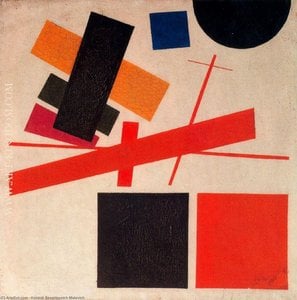
Malevich’s *Suprematist Composition*, created in 1916 during the tumultuous period of the Russian Revolution, stands as a cornerstone of abstract art and a testament to his radical vision for artistic expression. More than just an arrangement of geometric shapes—primarily rectangles and circles—the painting embodies the core principles of Suprematism: rejecting representational imagery altogether in favor of pure feeling or perception. This approach sought to liberate art from the constraints of depicting the external world, prioritizing instead the fundamental elements of form and color as conduits for spiritual experience.
Deconstructing the Visual Language
The composition immediately captivates with its striking simplicity. Three rectangles dominate the canvas—one large rectangle positioned centrally at the top, flanked by two smaller rectangles on either side. These rectangles are arranged in a dynamic interplay of horizontal and vertical lines, creating tension and suggesting movement despite their static appearance. A prominent orange circle sits atop the largest rectangle, serving as a focal point that draws the eye inward. Noticeably absent is any illusion of depth or perspective; instead, Malevich employs a flattened pictorial space—a deliberate rejection of traditional artistic conventions—to emphasize the two-dimensional nature of the artwork and heighten its visual impact. The subtle texture of the beige background provides a grounding element against which the geometric forms stand out with remarkable clarity.
Technique & Materials
Executed in oil paint on canvas, *Suprematist Composition* showcases Malevich’s meticulous attention to detail and mastery of technique. Visible brushstrokes within the textured surface hint at the artist's hand, imbuing the painting with a sense of materiality that contrasts sharply with its abstract content. The careful application of pigment ensures vibrant color saturation—particularly in the orange circle—enhancing the overall visual intensity. Malevich’s deliberate use of geometric precision reflects his belief that art should distill form to its purest essence, stripping away extraneous ornamentation and focusing solely on fundamental visual elements.
Historical Context: A Response to Revolution
Kazimir Malevich's artistic trajectory was profoundly shaped by the seismic events unfolding in Russia during 1915-1917. Witnessing the fervor of revolutionary sentiment—fueled by disillusionment with Tsarist rule and propelled forward by burgeoning socialist ideals—Malevich sought to articulate a new aesthetic sensibility that mirrored this transformative moment in history. Suprematism emerged as a direct response to these societal upheavals, representing an attempt to transcend bourgeois materialism and reconnect with spiritual values. Influenced by thinkers like Nikolai Berdyaev and Vladimir Solovyov, Malevich envisioned art as a vehicle for achieving transcendence—a means of accessing “the supremacy of pure feeling” beyond the limitations of rational thought.
## Symbolism & Emotional Resonance
Despite its apparent lack of recognizable imagery, *Suprematist Composition* resonates with profound symbolic significance. The rectangles and circles themselves are not merely decorative elements; they embody fundamental concepts—stability and dynamism—that capture the essence of Malevich’s artistic philosophy. The orange circle symbolizes “the sun,” representing enlightenment and spiritual illumination—a key motif in Orthodox Christianity, which Malevich embraced as a source of inspiration. Furthermore, the painting's austere aesthetic conveys a sense of serenity and contemplation, inviting viewers to engage in an introspective dialogue with its visual language. It’s a piece that speaks not to what things look like, but how they feel—a powerful testament to Malevich’s unwavering conviction that art could elevate human consciousness and foster a deeper understanding of the universe.
## Considerations for Collectors & Designers
- A Bold Statement: This artwork's uncompromising geometric abstraction commands attention in any interior space, injecting energy and intellectual curiosity into its surroundings.
- Versatile Aesthetic Integration: Its minimalist design complements both modern and contemporary interiors seamlessly—creating a harmonious balance between form and color.
- Art Historical Significance: Acquiring a reproduction of *Suprematist Composition* honors the legacy of Kazimir Malevich—a visionary artist who irrevocably altered the course of art history.
Photo Description: --Overall Impression-- The artwork is a geometric abstraction presenting a composition of intersecting and overlapping rectangular shapes against a textured beige background. It exemplifies the Suprematist style, characterized by its focus on pure form and non-representational imagery. The arrangement feels deliberately unbalanced, creating a dynamic tension between the solid blocks and the open space. Lines are primarily straight and angular, defining the edges of the shapes and adding to the overall sense of structure. Shapes are predominantly rectangular with varying sizes and orientations. Texture is evident in the background, appearing slightly rough or uneven. Lighting appears even across the composition, with no strong highlights or shadows. Perspective is deliberately flattened; there's no illusion of depth. The subject matter is purely abstract – it’s not intended to depict anything recognizable from the real world. Symbolic elements are minimal, relying on the inherent qualities of form and color to evoke emotion or meaning. The style aligns closely with Suprematism, a Russian art movement pioneered by Kazimir Malevich. Technique involves precise geometric rendering and careful placement of shapes. Materials appear to be oil paint on canvas, judging from the texture and brushstrokes visible in the background. --Composition-- The composition is vertically oriented, utilizing a strong diagonal line that bisects the image. The largest rectangular shape dominates the upper portion, while smaller rectangles are scattered across the lower half. A central orange circle provides a focal point. --Color Use-- The colors are bold and contrasting, contributing to the artwork's dynamic feel.
Size: Unknown
Date: Unknown
ARTIST INFORMATION:
==================
Artist: Kazimir Malevich
Birth Year: 1879
Death Year: 1935
Birth City: Kyiv Oblast
Birth Country: Ukraine
Biography:
Kazimir Malevich: A Pioneer of Abstract Art
Malevich’s artistic journey began in Kyiv, Ukraine, where he absorbed the influence of Ukrainian folk art and its traditions. He pursued formal training in Moscow, broadening his horizons and immersing himself in the burgeoning avant-garde movements of Europe—particularly Cubism—before forging his own distinctive path. His fascination with Russian Orthodox Christianity fueled his spiritual quest and profoundly impacted his artistic vision. Malevich’s unwavering belief in the transformative power of art—specifically its ability to transcend rational thought and connect with a higher realm—became the cornerstone of Suprematism, his revolutionary aesthetic theory. He championed the idea that art should liberate itself from the constraints of depicting the external world, prioritizing instead pure feeling or perception as its primary expressive force. This conviction drove him to create groundbreaking works like *Black Square*, which remains an iconic symbol of abstract art and a testament to Malevich’s enduring legacy. His influence extended far beyond his own lifetime, shaping the trajectory of movements such as Minimalism and Conceptual Art—solidifying his position as one of the most influential artists of the 20th century.



 Aperçu en situation
 Passer au format impression
 Partager
 Partager
 Détails
 Guide
Guide

 Télécharger
 Articles similaires
 Radiographie
 Voir le diaporama
 Statistiques

 Afficher la suite






































 L'option verre n'est disponible que pour les dimensions inférieures à 110 cm.




![Cercles noirs [1913]](/media/artworks/images-thumb/62/67/6267e452b0c8476772a6511e19ce1616.jpg)


