Aperçu en situation Aperçu en RA Passer au format impression Passer au format image numérique Partager
Détails Guide imprimable Ajouter aux favoris Télécharger Articles similaires Radiographie Voir le diaporama Statistiques

Untitled

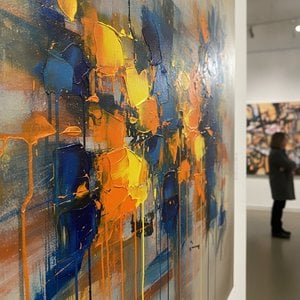
Experience the vibrant energy of Karel Appel's COBRA masterpiece; this abstract burst of color captures raw instinct from 1960—discover your own artistic freedom.

Découvrez Karel Appel, peintre et sculpteur néerlandais, figure emblématique du CoBrA ! Explorez son art audacieux, expressif et empreint d'une poésie unique.

L’œuvre d'art présentée sur cette page est protégée par le droit d'auteur, ce qui signifie que nous ne pouvons légalement créer ou vendre de reproduction identique. Cette protection est appliquée en vertu d'accords internationaux tels que la Convention de Berne et par les lois nationales, notamment celles énoncées par le Loi américaine sur le droit d'auteur - Titre 17.

En tant qu'alternative respectueuse et légale, nous proposons des œuvres d'art personnalisées, peintes à la main et inspirées de l'original. Nos artistes talentueux et professionnels étudient avec soin le style, l'ambiance et l'essence artistique de l'œuvre originale pour créer une pièce nouvelle et unique qui évoque la même émotion — tout en restant une création originale en soi.

Cette méthode est pleinement conforme aux réglementations sur le droit d'auteur car elle ne repose pas sur la copie ou la duplication de l'œuvre protégée. Il s'agit plutôt d'une réinterprétation créative — une nouvelle peinture qui s'inspire de l'original sans pour autant lui être identique.

Reproduction à l'huile faite à la main

Huile sur toile peinte à la main, avec cadre et dimensions personnalisés, réalisée sur commande par nos artistes. ( Passer au format impression Passer au format image numérique)

Corner sample of the P118B picture frame: polystyrène moulé, 5 cm wide and 3 cm thick
P118B 10
Corner sample of the P118H picture frame: polystyrène moulé, 5 cm wide and 3 cm thick
P118H 10
Corner sample of the P118W picture frame: polystyrène moulé, 5 cm wide and 3 cm thick
P118W 10
Corner sample of the P438Z picture frame: polystyrène moulé, 5.5 cm wide and 3.5 cm thick
P438Z 10
Corner sample of the P508JH picture frame: polystyrène moulé, 7 cm wide and 3.5 cm thick
P508JH 12
Corner sample of the P508YH picture frame: polystyrène moulé, 7 cm wide and 3.5 cm thick
P508YH 12
Corner sample of the P805H picture frame: polystyrène moulé, 5 cm wide and 3.5 cm thick
P805H 10
Corner sample of the P805Z picture frame: polystyrène moulé, 5 cm wide and 3.5 cm thick
P805Z 10
Corner sample of the P919BZ picture frame: polystyrène moulé, 7 cm wide and 3.5 cm thick
P919BZ 10
Corner sample of the P919G picture frame: polystyrène moulé, 7 cm wide and 3.5 cm thick
P919G 10
Corner sample of the P919XJ picture frame: polystyrène moulé, 7 cm wide and 3.5 cm thick
P919XJ 10
Corner sample of the P959ZH picture frame: polystyrène moulé, 5 cm wide and 3 cm thick
P959ZH 10
Corner sample of the P968JZ picture frame: polystyrène moulé, 6 cm wide and 4 cm thick
P968JZ 12
Corner sample of the W106C picture frame: bois massif, 5 cm wide and 3 cm thick
W106C 8
Corner sample of the W218G picture frame: bois massif, 5 cm wide and 3 cm thick
W218G 10
Corner sample of the W218JH picture frame: bois massif, 5 cm wide and 3 cm thick
W218JH 8
Corner sample of the W218Y picture frame: bois massif, 5 cm wide and 3 cm thick
W218Y 10
Corner sample of the W307PJ picture frame: bois massif, 6 cm wide and 3 cm thick
W307PJ 10
Corner sample of the W316G picture frame: bois massif, 6 cm wide and 3 cm thick
W316G 10
Corner sample of the W316PJ picture frame: bois massif, 6 cm wide and 3 cm thick
W316PJ 8
Corner sample of the W316Y picture frame: bois massif, 6 cm wide and 3 cm thick
W316Y 10
Corner sample of the W398PJ picture frame: bois massif, 5 cm wide and 3 cm thick
W398PJ 8
Corner sample of the W4111J picture frame: bois massif, 6.5 cm wide and 3.5 cm thick
W4111J 10
Corner sample of the W500HY picture frame: bois massif, 7 cm wide and 5 cm thick
W500HY 15
Corner sample of the W500JH picture frame: bois massif, 7 cm wide and 5 cm thick
W500JH 15
Corner sample of the W692G picture frame: bois massif, 8 cm wide and 4 cm thick
W692G 12
Corner sample of the W849H picture frame: bois massif, 5 cm wide and 3 cm thick
W849H 8
Corner sample of the W940BG picture frame: bois massif, 7.5 cm wide and 4.5 cm thick
W940BG 15
Corner sample of the W953PJ picture frame: bois massif, 6 cm wide and 3.5 cm thick
W953PJ 8

Format standard
personnalisé
CM
INCH

Choisissez parmi nos formats prédéfinis qui respectent les proportions originales de l’œuvre.

largeur
hauteur

Vous pouvez saisir vos propres dimensions pour l'adapter à un cadre ou à un espace spécifique. Si la taille sélectionnée ne correspond pas aux proportions de l'image d'origine, nous recadrerons l'œuvre ou prolongerons la peinture avec des éléments peints à la main supplémentaires. Une maquette numérique vous sera envoyée pour approbation avant le début de la production.
Veuillez noter que l'aperçu à l'écran ne reflète pas le recadrage ou l'extension réels. Seule la maquette montrera fidèlement la composition finale.
Bien que des tailles personnalisées soient disponibles, nous vous recommandons de sélectionner une dimension dans la liste prédéfinie afin de préserver les proportions d'origine.

Exemples de personnalisation possibles : remplacer un visage par la photo du client ; ajouter un animal de compagnie (par exemple, remplacer un chat par un chien) ; inclure un message caché en arrière-plan ; modifier le paysage ou les éléments de l'arrière-plan.
Après la commande, l’équipe WahooArt.com contactera le client par e-mail pour recueillir ses instructions et lui fournira une maquette d’aperçu

Livraison dans le monde entier () en 3 à 4 semaines au lieu des 5 semaines habituelles. (12 octobre). Aucun compromis sur la qualité.

Livraison express gratuite dans le monde entier
Toile de lin de haute qualité
Assurance transport complète
Garantie de remboursement des droits de douane
Garantie de fidélité des couleurs
Garantie de retour de 100 jours (uniquement en cas de défaut)
Garantie de remboursement à 100%
Tarifs dégressifs sur quantité

Prix total

€ 235

Untitled

Technique de reproduction

Format de la reproduction

-

Prix total final

€ 235

L'essentiel de l'œuvre

  • Notable elements or techniques: Gestural forms, Layered texture
  • Subject or theme: Organic shapes
  • Location: Private Collection
  • Title: Untitled
  • Artistic style: Abstract Expressionism

Quiz d'art

Chaque question ne comporte qu'une seule bonne réponse.

Question 1:
What avant-garde movement is Karel Appel strongly associated with for this artwork?
Question 2:
Which element of the artwork's composition is described as eschewing traditional perspective?
Question 3:
According to the description, what emotion is often symbolized by the color yellow in Appel's work?
Question 4:
What type of forms populate the artwork, described as rounded and organic, reminiscent of natural elements?
Question 5:
What medium is the artwork most likely to be, given the visible layering and texture?

A Symphony of Spontaneity: The Primal Energy of Karel Appel

In the landscape of post-war European modernism, few voices resonate with as much raw, unbridled vitality as that of Karel Appel. His 1960 work, Untitled, serves as a breathtaking manifesto of the COBRA movement, an avant-garde collective that sought to strip away the suffocating layers of academic tradition in favor of something far more primal. To encounter this piece is to witness a deliberate rebellion; it is not merely a composition of pigment on paper, but an explosion of instinctual expression. The artwork captures a moment where the artist’s hand moves with the freedom of a child, yet carries the profound weight of a man navigating a world recovering from the shadows of conflict. Through its vibrant palette and gestural urgency, the work invites the viewer into a realm where emotion dictates form, and where the boundaries between the creator and the canvas dissolve into pure, rhythmic motion.

The visual language of this masterpiece is defined by its biomorphic forms—organic, rounded shapes that seem to pulse with an internal life force. There is no rigid geometry here, nor any attempt at traditional perspective; instead, Appel utilizes an asymmetrical arrangement where colors and shapes overlap in a dance of beautiful chaos. The palette is nothing short of celebratory, dominated by sun-drenched yellows, deep oceanic blues, and fiery reds, all anchored by bold strokes of black and punctuated by flashes of orange and white. These colors are not merely decorative choices but are deeply symbolic; the yellow radiates an infectious optimism, while the blue offers a moment of contemplative stillness amidst the surrounding energy. This interplay of hues creates a complex textural landscape, where the visible layering of the printmaking process suggests a tactile depth that draws the eye into a continuous, wandering exploration.

Historical Resonance and Interior Inspiration

To understand the soul of this work, one must look to the historical heartbeat of the COBRA movement. Born from a desire to break free from the constraints of Surrealism and Cubism, Appel and his contemporaries looked toward the "primitive"—finding profound inspiration in African masks, tribal art, and the uninhibably honest drawings of children. This 1960 print embodies that search for authenticity, rejecting meticulous representation in favor of intuition and gesture. The technique, likely a screenprint or lithograph, allows for a fascinating tension between the flatness of the medium and the perceived movement of the brushstrokes. Each layer of ink contributes to a sense of immediacy, as if the artist’s energetic movements were captured in mid-motion, frozen forever in a state of becoming.

For the discerning collector or interior designer, this artwork offers more than just visual interest; it provides a transformative emotional atmosphere. Its lack of a singular focal point allows it to integrate seamlessly into sophisticated modern environments, acting as a dynamic anchor in a room. In a minimalist setting, its bold colors can provide a much-needed burst of life and character, while in a more eclectic space, it serves as a testament to the enduring power of the avant-garde. Owning a high-quality reproduction of this piece is an invitation to live alongside a fragment of art history—a piece that celebrates the joy of existence, the beauty of imperfection, and the eternal, restless spirit of human creativity.

Questions et réponses

Comment puis-je prévisualiser une reproduction de «Untitled» de Karel Appel ?

La page Aperçu de « Untitled » vous permet de prévisualiser l'œuvre avant de passer commande.

L'œuvre « Untitled » est-elle restée dans le pays d'origine de son artiste ?

Non - l'œuvre est conservée à l'étranger. L'artiste est né en Pays-Bas, tandis que le musée qui conserve l'original se situe en Royaume-Uni.

Puis-je visionner « Untitled » sous forme de diaporama en plein écran ?

Vous pouvez visionner «Untitled» de Karel Appel sous forme de diaporama sur la page Diaporama de l'œuvre.

«Untitled» de Karel Appel utilise-t-il des contrastes marqués ou des harmonies douces ?

La composition chromatique de «Untitled» de Karel Appel allie un contraste Statement à une harmonie Balanced Harmony.

Pour quel usage une reproduction de «Untitled» de Karel Appel est-elle recommandée ?

L'utilisation recommandée d'une impression de « Untitled » est Accent.

Comment les couleurs de «Untitled» de Karel Appel se rapportent-elles à l'émotion qui s'en dégage ?

Dans « Untitled », des couleurs Neutrals accompagnent une sensation Joyful.

Où puis-je voir l'original de «Untitled» de Karel Appel ?

L'original de «Untitled» de Karel Appel est conservé au Tate Britain, Londres, Royaume-Uni. Une reproduction permet d'exposer l'œuvre chez soi.

Qu'est-ce que "Untitled" partage avec le reste de l'œuvre de Karel Appel ?

«Untitled» appartient à l'œuvre COBRA Expressionism de Karel Appel, dont les thèmes récurrents incluent expressionist roots, organic forms exploration, bold color dialogue, rejection formal norms, central cobra vision.


Biographie de l'artiste

Premières années et formation

  • Né : 25 avril 1921, Amsterdam, Pays-Bas
  • Décédé : 3 mai 2006, Zurich, Suisse
  • Parents : Jan Appel (barbier), Johanna Chevalier (descendante de Huguenots français)
  • Surnom d'enfance : 'Kik'
  • Première peinture à l'âge de quatorze ans : une nature morte d'un panier de fruits.
  • A reçu un ensemble de peintures et un chevalet comme cadeau pour son quinzième anniversaire de la part de son oncle Karel Chevalier, qui lui a également donné des premières leçons d'art.
  • A étudié à la Rijksakademie van Beeldende Kunsten à Amsterdam (1940-1943) pendant l'occupation allemande. A rencontré les artistes Corneille et Constant pendant cette période, formant des amitiés durables.
  • A quitté son domicile en raison de l'opposition de ses parents à ses aspirations artistiques et pour échapper à la capture par la police allemande pour un travail forcé potentiel.

Le mouvement CoBrA et développement artistique

  • Première exposition à Groningue (1946).
  • Participation significative à l'exposition du Stedelijk Museum d'Amsterdam en 1949, qui a suscité la controverse et le débat public.
  • Influences : Pablo Picasso, Henri Matisse, Jean Dubuffet.
  • A commencé à sculpter en 1947 en utilisant des matériaux de récupération (technique d'assemblage), en les peignant dans des couleurs vives comme le blanc, le rouge, le jaune, le bleu et le noir.
  • A rejoint le Groupe Expérimental avec Anton Rooskens, Theo Wolvecamp et Jan Nieuwenhuys ; plus tard rejoint par Hugo Claus.
  • Co-fondateur de CoBrA (Copenhague, Bruxelles, Amsterdam) en 1948 aux côtés de Corneille, Constant, Jan Nieuwenhuys et Christian Dotremont.
  • Le style artistique de CoBrA mettait l'accent sur la spontanéité, l'imagerie enfantine et le rejet des conventions artistiques traditionnelles. Inspiré par la mythologie danoise et nordique.
  • A créé la fresque controversée "Enfants qui interrogent" (1949) pour l'hôtel de ville d'Amsterdam, qui a été recouverte plus tard en raison de la protestation publique.

Reconnaissance internationale et carrière ultérieure

  • A déménagé à Paris en 1950 après avoir fait face à des réactions négatives au CoBrA aux Pays-Bas.
  • A développé une réputation internationale grâce à ses voyages au Mexique, aux États-Unis, en Yougoslavie et au Brésil.
  • A vécu et travaillé à New York City et Florence.
  • Première exposition américaine dans une galerie à la Martha Jackson Gallery (1954).
  • La peinture "Enfant et Bête II" (1951) a été présentée dans l'exposition influente du Museum of Modern Art "La Nouvelle Décennie" (1955).
  • Connu pour son travail de muraliste.
  • A connu une résurgence de popularité aux Pays-Bas après 1990, avec d'importantes expositions à Amsterdam et Bruxelles organisées par Rudy Fuchs.
  • Son œuvre a été présentée en bonne place au Musée CoBrA à Amstelveen.

Héritage et reconnaissance

  • A fondé la Fondation Karel Appel pour préserver ses œuvres d'art et promouvoir la sensibilisation du public à son œuvre.
  • A connu une perte temporaire d'œuvres d'art en 2002, qui ont été retrouvées en 2012.
  • La Fondation Karel Appel sert de patrimoine officiel et d'archive d'images.
  • Le représentant américain des droits d'auteur pour la fondation est The Artists Rights Society.
  • L'œuvre d'Appel continue d'être exposée à l'international et reste une contribution significative à l'art européen d'après-guerre, en particulier au sein du mouvement CoBrA.
Karel Appel

Karel Appel

1921 - 2006 , Pays-Bas

En bref

  • Artistic Movement Or Style: CoBrA, Expressionnisme abstrait
  • Artists Or Movements Influenced By This Artist: ['Art expérimental']
  • Artists Who Influenced This Artist:
    • Pablo Picasso
    • Henri Matisse
    • Jean Dubuffet
  • Date De Décès: 3 mai 2006
  • Date De Naissance: 25 avril 1921
  • Full Name: Christiaan Karel Appel
  • Lieu De Naissance: Amsterdam, Pays-Bas
  • Nationalité: Néerlandais
  • Notable Artworks:
    • Enfant et Bête II
    • Questioning Children