Aperçu en situationAperçu en situation Visualiser en RAVisualiser en RA Commander la reproduction peinte à la main Commander la reproduction peinte à la mainPasser à l'image numérique Passer à l'image numérique EnvoyerEnvoyer
Détails de l'œuvreDétails de l'œuvre Ajouter aux favoris Ajouter aux favoris TéléchargerTélécharger Articles similairesArticles similaires RadiographieRadiographie DiaporamaDiaporama StatistiquesStatistiques

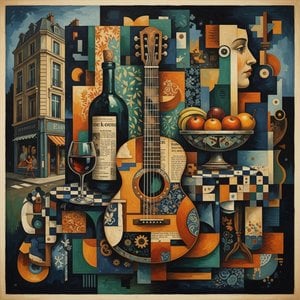
Still life with checked tablecloth - -

Experience the geometric brilliance of Juan Gris's Still Life with Checked Tablecloth, a 1915 masterpiece of Synthetic Cubism featuring vibrant overlapping planes and textures that invite you to explore its beauty.

Découvrez Juan Gris (1887-1927), maître espagnol du cubisme ! Explorez son style géométrique, le cubisme synthétique et son influence durable sur l'art moderne. Admirez ses œuvres maintenant.

Giclées et impressions d'art

Impressions giclées ou sur toile de qualité musée, avec une production rapide et des finitions au choix. (Commander la reproduction peinte à la main Commander la reproduction peinte à la mainPasser à l'image numérique Passer à l'image numérique)

P118B $10
P118H $10
P118W $10
P438Z $10
P508JH $12
P508YH $12
P805H $10
P805Z $10
P919BZ $10
P919G $10
P919XJ $10
P959ZH $10
P968JZ $12
W106C $8
W218G $10
W218JH $8
W218Y $10
W307PJ $10
W316G $10
W316PJ $8
W316Y $10
W398PJ $8
W4111J $10
W500HY $15
W500JH $15
W692G $12
W849H $8
W940BG $15
W953PJ $8

Format standard
sur mesure
CM
INCH

Choisissez parmi nos formats prédéfinis qui respectent les proportions originales de l’œuvre.

largeur
hauteur

Vous pouvez saisir vos propres dimensions pour vous adapter à un cadre ou à un espace spécifique. Si la taille sélectionnée ne correspond pas aux proportions de l'image originale, nous recadrerons l'œuvre ou étendrons l'image avec une bordure en miroir ou une couleur unie. Une maquette numérique vous sera envoyée pour approbation avant le début de la production.
Veuillez noter que l'aperçu à l'écran ne reflète pas le recadrage ou l'extension réelle. Seule la maquette montrera avec précision la composition finale.
Bien que des tailles personnalisées soient disponibles, nous vous recommandons de choisir une dimension dans la liste prédéfinie afin de préserver les proportions originales.

Livraison dans le monde entier () en 2 semaines au lieu des 4/5 semaines habituelles. (9 septembre)

why_choose_icon
Livraison express gratuite dans le monde entier
why_choose_icon
Toile de lin de qualité supérieure
why_choose_icon
Assurance transport complète
why_choose_icon
Garantie de remboursement des droits de douane
why_choose_icon
Garantie de fidélité des couleurs
why_choose_icon
Politique de retour de 100 jours (uniquement en cas de défaut)
why_choose_icon
Garantie de remboursement à 100%
why_choose_icon
Offre de tarifs dégressifs

Prix total

$ 68

reproduction

Still life with checked tablecloth - -

Giclées et impressions d'art

Format de la reproduction

-

Prix total

$ 68

Informations clés

  • Notable elements or techniques: Geometric shapes, overlapping planes
  • Subject or theme: Still life with objects on a tablecloth
  • Movement: Synthetic Cubism
  • Artistic style: Cubism
  • Dimensions: 116 x 89 cm
  • Year: 1915

A Masterpiece of Geometric Harmony

In the pantheon of early twentieth-century modernism, few works capture the intellectual rigor and tactile beauty of Synthetic Cubism as exquisitely as Juan Gris’s Still Life with Checked Tablecloth. Created in 1915, this seminal painting serves as a profound meditation on the relationship between structure and surface. At first glance, the viewer is greeted by a rhythmic arrangement of everyday objects—a bowl of grapes, glassware, and printed materials—all resting upon a striking checkered tablecloth. However, beneath this seemingly domestic scene lies a complex architectural feat of color and form. Gris, with his unique background in engineering, approaches the canvas not merely as a surface for depiction, but as a space for construction, where overlapping planes and interlocking shapes create a sense of depth that defies the flatness of the medium.

The technique employed here is a hallmark of the Synthetic Cubist movement. Unlike the earlier Analytical phase, which often dissolved objects into monochromatic fragments, Gris utilizes larger, more legible geometric shapes to build his composition. The checkered pattern of the tablecloth acts as a structural grid, anchoring the floating elements and providing a visual pulse that vibrates across the canvas. Through the masterful use of muted tones punctuated by strategic highlights, the artist achieves a delicate balance between abstraction and reality. One can almost feel the texture of the paper and the weight of the glass, as Gris integrates typography and numerals into the very fabric of the painting, blurring the line between the physical world and the graphic language of modern life.

The Soul of Synthetic Cubism

To understand this work is to understand a pivotal moment in art history. Between 1915 and 1920, the art world underwent a radical transformation, moving away from the imitation of nature toward a celebration of the painted object itself. Still Life with Checked Tablecloth stands as a testament to this shift. The painting does not seek to replicate a window into another world; instead, it invites us to appreciate the beauty of the canvas as an autonomous entity. The way the light seems to catch the edge of a glass or the curve of a fruit is not a trick of realism, but a calculated use of color and shape designed to evoke a sensory response. This approach creates an atmosphere that is simultaneously cerebral and deeply inviting, making it a piece that rewards repeated, contemplative viewing.

For the discerning collector or interior designer, this artwork offers more than mere decoration; it provides a sophisticated focal point that bridges the gap between classical elegance and avant-garde energy. The composition’s inherent stability, provided by its geometric foundations, makes it an ideal centerpiece for contemporary spaces that value structural integrity and intellectual depth. Whether placed in a minimalist gallery setting or a richly textured study, the painting brings with it a sense of historical gravity and timeless aesthetic grace. Owning a high-quality reproduction of this Gris masterpiece allows one to inhabit the same world of rhythmic complexity and quiet beauty that defined the height of the Cubist revolution.


Biographie de l'artiste

Juan Gris : Pionnier du Cubisme

  • Né : 23 mars 1887, Madrid, Espagne
  • Décédé : 11 mai 1927

Jeunesse et Développement Artistique

José Victoriano González-Pérez, connu sous le nom de Juan Gris, est né à Madrid, en Espagne. Sa jeunesse a été marquée par des études d'ingénierie à l’École des Arts et Sciences de 1902 à 1904. Durant cette période, il contribuait avec des dessins à des périodiques locaux, démontrant un talent précoce pour la représentation visuelle. De 1904 à 1905, Gris a étudié la peinture avec José Moreno Carbonero, perfectionnant ainsi ses compétences artistiques. En 1905, il adopta le pseudonyme Juan Gris, un nom qui deviendrait synonyme de son style distinctif.

Influences Parisiennes et l'Émergence du Cubisme

Un moment décisif dans la carrière de Gris survint en 1906 lorsqu’il déménagea à Paris. Ce déménagement l’exposa à une communauté artistique vibrante, où il se lia d’amitié avec des figures influentes telles que Henri Matisse, Georges Braque et Fernand Léger. Il fut profondément influencé par Pablo Picasso, soumettant initialement des illustrations humoristiques à des revues comme *L'Assiette au Beurre*, *Le Rire*, *Le Charivari* et *Le Cri de Paris*. Vers 1910, Gris se consacra sérieusement à la peinture, se dévouant au développement d’un style cubiste personnel. Il s’éloigna de l’illustration satirique pour adopter des compositions plus abstraites.

Œuvres Clés et Style Artistique

La production artistique de Juan Gris se caractérise par plusieurs éléments clés :

  • Clarté et Ordre : Son œuvre mettait l’accent sur la clarté et l’ordre, influençant le style puriste défendu par Amédée Ozenfant et Charles Edouard Jeanneret (Le Corbusier).
  • Structure Géométrique : La « période cristalline » de Gris, illustrée par des œuvres telles que *Nature morte devant une fenêtre ouverte* et *Place Ravignan* (1915), présentait une structure géométrique forte.
  • Cubisme Synthétique : Après 1913, Gris adopta le cubisme synthétique, utilisant intensivement des techniques comme le papier collé ou le collage. Cela impliquait d’incorporer des matériaux du monde réel dans ses peintures, ajoutant texture et profondeur.

Parmi ses œuvres notables figurent :

  • Guitare devant la mer (1925) : Démontre sa simplicité et son adhésion aux principes cubistes.
  • Hommage à Pablo Picasso (1912) : Sa première exposition au Salon des Indépendants, témoignant de sa reconnaissance croissante dans le monde artistique.

Héritage et Importance Historique

La contribution de Juan Gris au cubisme est significative. Il a dépassé la phase analytique initiale du mouvement pour adopter une approche plus structurée et synthétique. Son insistance sur la clarté, les formes géométriques et l’incorporation d’objets du quotidien dans ses compositions l'ont établi comme une figure de proue de l'art du XXe siècle. Son œuvre continue d'être célébrée pour sa rigueur intellectuelle et sa beauté esthétique, influençant les générations futures d'artistes.

Juan Gris

Juan Gris

1887 - 1927 , Espagne

L'essentiel de l'artiste

  • Artistes Influents:
    • Pablo Picasso
    • Georges Braque
    • Henri Matisse
  • Date De Décès: 11 mai 1927
  • Date De Naissance: 23 mars 1887
  • Influences Artistiques:
    • Amédée Ozenfant
    • Le Corbusier
  • Lieu De Naissance: Madrid, Espagne
  • Mouvement Artistique: Cubisme, Cubisme synthétique
  • Nationalité: Espagnole
  • Nom Complet: Juan Gris
  • Oeuvres Notables:
    • Guitare devant la mer
    • Hommage à Picasso
    • Nature morte Place Ravignan
Explorez des œuvres d'art classées par thèmes, styles et caractéristiques.