


L’œuvre d'art présentée sur cette page est protégée par le droit d'auteur, ce qui signifie que nous ne pouvons légalement créer ou vendre de reproduction identique. Cette protection est appliquée en vertu d'accords internationaux tels que la Convention de Berne et par les lois nationales, notamment celles énoncées par le Loi américaine sur le droit d'auteur - Titre 17.
Cette méthode est pleinement conforme aux réglementations sur le droit d'auteur car elle ne repose pas sur la copie ou la duplication de l'œuvre protégée. Il s'agit plutôt d'une réinterprétation créative — une nouvelle peinture qui s'inspire de l'original sans pour autant lui être identique.
Impressions giclées ou sur toile de qualité musée, avec une production rapide et des finitions au choix. ( Commander la reproduction peinte à la main Passer au format numérique)





























Choisissez parmi nos formats prédéfinis qui respectent les proportions originales de l’œuvre.

Saisissez la largeur et la hauteur souhaitées pour qu'elles s'adaptent à votre cadre ou à votre mur. Une impression peut être recadrée, mais jamais agrandie au-delà de l'image originale ; ainsi, un format de forme différente entraînera la perte d'une partie de l'image. Nous vous envoyons une maquette numérique pour approbation avant toute impression. L'image présentée sur cette page ne montre pas le recadrage réel — seule la maquette le permet.
Livraison dans le monde entier () en 2 semaines au lieu des 4/5 semaines habituelles. (9 novembre)
Mujer desnuda
Format de la reproduction
In the quiet, evocative depths of Joy St Clair Hester’s 1945 masterpiece, Mujer desnuda, we encounter a profound dialogue between the human form and the natural world. This striking work, executed during a transformative period in Australian Modernism, transcends mere representation to touch upon the very essence of vulnerability. The composition presents a stylized, nude female figure nestled within an abstracted landscape, where the boundaries between skin and scenery begin to blur. Through a masterful use of asymmetrical balance, Hester positions her subject off-center, creating a rhythmic tension that breathes life and movement into the stillness of the paper. It is a piece that does not merely ask to be seen, but demands to be felt, inviting the viewer into a private moment of deep introspection.
The technical execution of Mujer desnuda reveals Hester’s unparalleled command over the fluid medium of ink and watercolor. Eschewing the rigid constraints of realism, she employs bold, expressive brushstrokes that define the figure with a spontaneous energy. The lines are thick and purposeful, tracing the contours of the body and the surrounding foliage with a rhythmic grace that suggests both strength and fragility. This technique creates a tactile quality, where the subtle variations in ink density provide a sense of organic life. The palette is intentionally restrained, relying on a somber, earthy harmony of browns, beiges, and deep blacks. This monochromatic approach strips away the distractions of color, forcing the eye to focus on the raw emotional weight of the shapes and the haunting beauty of the silhouettes.
Beyond its aesthetic allure, the artwork serves as a poignant window into the psyche of one of Australia's most significant modernist voices. As a key figure within the influential Heide Circle and the "Angry Penguins" movement, Hester was deeply invested in exploring the complexities of the human condition—themes of love, loss, and identity. In Mujer desnuda, the integration of the female form into the landscape can be read as a symbolic return to nature, an exploration of femininity as an elemental force. The abstracted trees and vague horizon lines create a dreamlike, almost primordial setting, where the figure’s reaching pose suggests a profound longing or a spiritual aspiration. There is a palpable sense of solitude within the frame, yet it is not a lonely isolation; rather, it is a contemplative state of being that resonates with anyone who has sought solace in the quietude of nature.
For the discerning collector or interior designer, this reproduction offers more than just a visual accent; it provides a focal point of intellectual and emotional depth. The artwork’s ability to anchor a room with its muted tones and sophisticated abstraction makes it an ideal choice for contemporary spaces that value understated elegance and historical significance. Whether placed in a curated gallery setting or as a soulful addition to a private study, Mujer desnuda continues to evoke the same sense of wonder and melancholy that Joy St Clair Hester captured decades ago. It remains a timeless testament to the power of the expressive line and the enduring beauty of the human spirit caught in a moment of quiet revelation.
Le diaporama de « Mujer desnuda » est disponible sur la page Diaporama de l'œuvre.
Un aperçu de «Mujer desnuda» de Joy St Clair Hester est disponible sur la page Aperçu en situation de l'œuvre.
Grâce à sa palette de couleurs Neutrals, l'œuvre « Mujer desnuda » s'intègre parfaitement dans une Bedroom.


1920 - 1960 , Australie
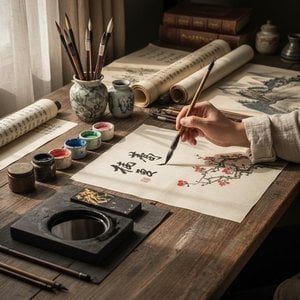
Embark on a sophisticated exploration of ink wash painting and Sumi-e. Uncover the profound historical lineages, Zen philosophies, and technical mastery behind this timeless medium in our authoritative guide for fine art enthusiasts.

Explore the profound artistry of graphite drawing. Discover professional techniques for mastering depth, texture, and detail through a lens of art history, from classical sketches to modern masterpieces. Elevate your understanding of the pencil medium with our expert guide.

Explorez la maîtrise du clair-obscur de Ugo da Carpi au Caravage. Plongez dans l'histoire technique du relief et de la lumière.
 Aperçu en situation
 Envoyer
 Partager
 Détails de l'œuvre
 Guide
Guide

 Télécharger l'image
 Articles similaires
 Radiographie
 Diaporama
 Questions et réponses
 Statistiques


 Lire la suite









 L'option verre n'est disponible que pour les dimensions inférieures à 110 cm.


