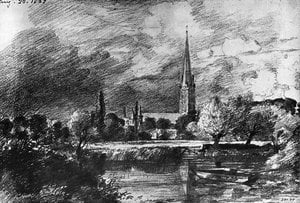
A Symphony of Suffolk: John Constable’s “The Cornfield”
John Constable's "The Cornfield" isn't simply a depiction of a rural scene; it is a profound meditation on the relationship between humanity and the land, rendered with an almost unbearable tenderness. Painted during a period of immense personal and artistic growth for the Suffolk artist, this work embodies the core of Constable’s philosophy – a deep, empathetic connection to his native landscape that he sought to capture not just visually, but emotionally. The painting transports us to the heart of Dedham Vale, a region intimately tied to Constable's life and the very foundation of his artistic vision. It speaks of a timelessness, a quiet dignity found in the rhythms of agricultural life, where the changing light and weather patterns dictate both the beauty and the toil of existence.
Subject Matter and Composition
The subject matter itself is deceptively simple: a dirt road cutting through a vast expanse of golden cornfields. However, Constable elevates this commonplace scene into something extraordinary through his meticulous observation and masterful composition. The road acts as a visual artery, drawing the viewer’s eye deep into the heart of the painting, while the flanking trees – ancient oaks and maples – create a sense of enclosure and depth. Notice the careful placement of figures: individuals walking along the path, seemingly absorbed in their own thoughts, and others pausing to observe the landscape. The inclusion of animals—a loyal dog and two horses—adds an element of domesticity and reinforces the painting’s connection to rural life. Constable's use of perspective is particularly noteworthy; he employs atmospheric perspective – a technique borrowed from Claude Lorrain – to create a sense of distance and heighten the feeling of vastness, emphasizing the scale of the landscape.
Technique and Style: A Masterclass in Light and Color
- Impressionistic Precursors: While predating the formal Impressionist movement, Constable’s work demonstrates a remarkable sensitivity to light and color that anticipates its innovations. He meticulously observed how sunlight filtered through the trees, creating dappled patterns on the cornfields and illuminating the figures with a warm glow.
- Oil Paint Application: Constable employed a broken brushstroke technique, applying thin layers of oil paint in rapid succession – a method known as ‘impasto’ – to build up texture and capture the fleeting effects of light. This approach allowed him to convey the shimmering quality of water and the subtle variations in color within the landscape.
- Dedham Vale's Influence: The painting is deeply rooted in Constable’s lifelong study of Dedham Vale, a region he considered his primary subject matter. His familiarity with this area informed every detail, from the types of trees depicted to the way the light interacted with the fields.
Symbolism and Emotional Resonance
"The Cornfield" is more than just a picturesque landscape; it’s imbued with symbolic meaning. The corn itself represents fertility, abundance, and the cyclical nature of life – themes central to Constable's artistic vision. The figures within the scene suggest humanity’s place within this grand scheme, highlighting our connection to the natural world. The painting evokes a profound sense of peace and tranquility, inviting viewers to contemplate the beauty and serenity of rural England. It speaks to a longing for simplicity, a desire to escape the pressures of urban life, and an appreciation for the enduring power of nature. The emotional impact is palpable – a feeling of quiet contemplation, nostalgia, and perhaps even a touch of melancholy.
Questions et réponses
L'œuvre « the cornfield » est-elle disponible en tirage d'art ?
Pour obtenir un tirage de «the cornfield» de John Constable, il vous suffit de le commander sur cette page : une impression d'art sur toile de coton ou sur papier canvas d'archive.
Puis-je commander une reproduction à l'huile de « the cornfield » ?
Vous pouvez commander une reproduction peinte à la main de «the cornfield» de John Constable directement sur cette page : une reproduction à l'huile peinte à la main sur toile de lin, réalisée sur commande.
Quels sujets apparaissent dans «the cornfield» de John Constable ?
Les thèmes présents dans «the cornfield» de John Constable incluent english countryside, john constable, rural life, cornfield scene, landscape painting, british art, agricultural theme. Ensemble, ils résument le sujet de l'œuvre.
Quelle place occupe « the cornfield » dans l'œuvre de John Constable ?
Dans l'œuvre de John Constable, « the cornfield » s'inscrit dans le style Romantic Landscape Painting, tout en abordant les thèmes de claude lorrain influence, english rural life, dedham vale scenes, landscape poetry themes, constable’s key work.
Quelle est la place de «the cornfield» de John Constable dans l'histoire de l'art ?
«the cornfield» de John Constable appartient au mouvement Romantic Landscape Painting, durant la période 19th Century. Ensemble, ils confèrent à l'œuvre sa place dans l'histoire de l'art.
De quoi est fait « the cornfield » ?
Le médium de «the cornfield» de John Constable est Acrylic On Canvas. Les reproductions visent à restituer l'aspect de cette technique.
À quel artiste est attribuée l'œuvre "the cornfield" ?
« the cornfield » est attribué à John Constable.



 Aperçu en situation
 Passer au format impression
 Partager
 Partager
 Détails
 Guide imprimable

 Télécharger
 Articles similaires
 Radiographie
 Voir le diaporama
 Statistiques

 Afficher la suite






































 L'option verre n'est disponible que pour les dimensions inférieures à 110 cm.