Introduction
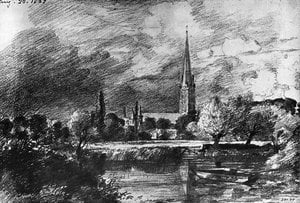
John Constable is widely regarded as one of the greatest landscape painters in the history of British art. His painting "Trees at Hampstead" is a prime example of his mastery of this genre, showcasing his deep appreciation for the natural world and his ability to capture its beauty on canvas. In this article, we will take a closer look at this remarkable work of art and explore some of the key features that make it so special.
Background
"Trees at Hampstead" was painted in 1820, during the latter part of Constable's career. At this time, he had already established himself as a leading figure in the British art world, known for his innovative approach to landscape painting and his commitment to capturing the natural beauty of the English countryside. The painting depicts a grove of trees in Hampstead Heath, a large park located in north London, which was one of Constable's favorite places to paint.
Composition
The composition of "Trees at Hampstead" is characterized by its simplicity and elegance. The painting features a single tree, situated in the center of the canvas, with its branches reaching out towards the edges of the frame. The tree is depicted in great detail, with each leaf and branch rendered with meticulous care. The background consists of a soft, hazy sky, which provides a subtle contrast to the sharpness of the tree's form.
Color
Constable was known for his innovative use of color, and "Trees at Hampstead" is no exception. The painting features a rich palette of greens, blues, and browns, which are used to create a sense of depth and volume in the tree's form. The leaves are depicted in various shades of green, from bright lime to deep forest, while the bark of the trunk is rendered in warm, earthy tones.
Technique
Constable was a master of oil painting, and "Trees at Hampstead" showcases his skill in this medium. The painting features a variety of brushstrokes, from delicate, feathery touches to bold, sweeping gestures. This creates a sense of movement and energy in the work, which is further enhanced by the use of impasto, a technique in which paint is applied thickly to create texture and depth.
Conclusion
"Trees at Hampstead" is a masterpiece of landscape art, showcasing John Constable's deep appreciation for the natural world and his ability to capture its beauty on canvas. The painting features a simple yet elegant composition, a rich palette of colors, and a variety of brushstrokes that create a sense of movement and energy. If you are interested in learning more about this remarkable work of art, be sure to visit our website at
https://WahooArt.com where you can view a high-resolution image and learn more about the artist and his work.
John Constable: Trees at Hampstead (1820, Oil on canvas)
Note: All informations used in this article are from
https://WahooArt.com
Questions et réponses
Comment puis-je télécharger l'image de «Les arbres de Hampstead» de John Constable ?
Un téléchargement est disponible pour « Les arbres de Hampstead » : la page Téléchargement de l'œuvre propose téléchargement d'une image numérique haute résolution.
D'où viennent les visiteurs de «Les arbres de Hampstead» de John Constable ?
Une page Statistiques est disponible pour « Les arbres de Hampstead ». Elle présente l'évolution mensuelle des visites de l'œuvre ainsi que des autres créations de l'artiste, avec une répartition par pays et par langue.
Que représente « Les arbres de Hampstead » ?
Les thèmes présents dans «Les arbres de Hampstead» de John Constable incluent english landscape, constable painting, hampstead heath, tree silhouette, atmospheric light, rural tranquility, british art. Ensemble, ils résument le sujet de l'œuvre.



 Aperçu en situation
 Passer au format impression
 Envoyer
 Partager
 Détails de l'œuvre
 Guide
Guide

 Télécharger l'image
 Articles similaires
 Radiographie
 Diaporama
 Q&A
Q&A Statistiques

 Lire la suite






































 L'option verre n'est disponible que pour les dimensions inférieures à 110 cm.