Aperçu en situation Aperçu en RA Passer au format impression Passer au format image numérique Partager
Détails Guide Ajouter aux favoris Télécharger Articles similaires Radiographie Voir le diaporama Statistiques

La Table des Sept Péchés Capitaux

Explore Hieronymus Bosch's "La Table des Sept Péchés Capitaux," une œuvre emblématique de la Renaissance flamande riche en symbolisme et détails saisissants. Admirez cette peinture fascinante !

Explorez le monde surréaliste et symbolique de Jérôme Bosch (c. 1450-1516), un maître de la Renaissance néerlandaise. Découvrez ses tableaux emblématiques, ses visions cauchemardesques du paradis perdu, ses thèmes religieux et son influence durable sur l'histoire de l'art.

Reproduction à l'huile faite à la main

Huile sur toile peinte à la main, avec cadre et dimensions personnalisés, réalisée sur commande par nos artistes. ( Passer au format impression Passer au format image numérique)

P118B $10
P118H $10
P118W $10
P438Z $10
P508JH $12
P508YH $12
P805H $10
P805Z $10
P919BZ $10
P919G $10
P919XJ $10
P959ZH $10
P968JZ $12
W106C $8
W218G $10
W218JH $8
W218Y $10
W307PJ $10
W316G $10
W316PJ $8
W316Y $10
W398PJ $8
W4111J $10
W500HY $15
W500JH $15
W692G $12
W849H $8
W940BG $15
W953PJ $8

Format standard
personnalisé
CM
INCH

Choisissez parmi nos formats prédéfinis qui respectent les proportions originales de l’œuvre.

largeur
hauteur

Vous pouvez saisir vos propres dimensions pour l'adapter à un cadre ou à un espace spécifique. Si la taille sélectionnée ne correspond pas aux proportions de l'image d'origine, nous recadrerons l'œuvre ou prolongerons la peinture avec des éléments peints à la main supplémentaires. Une maquette numérique vous sera envoyée pour approbation avant le début de la production.
Veuillez noter que l'aperçu à l'écran ne reflète pas le recadrage ou l'extension réels. Seule la maquette montrera fidèlement la composition finale.
Bien que des tailles personnalisées soient disponibles, nous vous recommandons de sélectionner une dimension dans la liste prédéfinie afin de préserver les proportions d'origine.

Exemples de personnalisation possibles : remplacer un visage par la photo du client ; ajouter un animal de compagnie (par exemple, remplacer un chat par un chien) ; inclure un message caché en arrière-plan ; modifier le paysage ou les éléments de l'arrière-plan.
Après la commande, l’équipe WahooArt.com contactera le client par e-mail pour recueillir ses instructions et lui fournira une maquette d’aperçu

Livraison dans le monde entier () en 3 à 4 semaines au lieu des 5 semaines habituelles. (24 septembre). Aucun compromis sur la qualité.

why_choose_icon
Livraison express gratuite dans le monde entier
why_choose_icon
Toile de lin de haute qualité
why_choose_icon
Assurance transport complète
why_choose_icon
Garantie de remboursement des droits de douane
why_choose_icon
Garantie de fidélité des couleurs
why_choose_icon
Garantie de retour de 100 jours (uniquement en cas de défaut)
why_choose_icon
Garantie de remboursement à 100%
why_choose_icon
Tarifs dégressifs sur quantité

Prix total

$ 272

reproduction

La Table des Sept Péchés Capitaux

Technique de reproduction

Format de la reproduction

-

Prix total final

$ 272

L'essentiel de l'œuvre

  • Notable elements or techniques: Complex symbolism, detail
  • Artistic style: Fantastical, symbolic
  • Subject or theme: Morality, sin, afterlife
  • Title: The Seven Deadly Sins and the Four Last Things
  • Artist: Hieronymus Bosch

Quiz d'art

Chaque question ne comporte qu'une seule bonne réponse.

Question 1:
Hieronymus Bosch is renowned for his distinctive style. Which of the following best describes a key characteristic of his work?
Question 2:
The artwork 'The Seven Deadly Sins and the Four Last Things' primarily explores themes related to:
Question 3:
Based on the image description, what visual element is prominently featured within 'The Seven Deadly Sins and the Four Last Things'?
Question 4:
What medium did Hieronymus Bosch primarily use for his paintings?
Question 5:
The presence of an angelic figure in the painting suggests a focus on:

The Seven Deadly Sins and the Four Last Things - A Visionary Landscape of Sin and Salvation

Hieronymus Bosch’s *The Seven Deadly Sins and the Four Last Things* is not merely a painting; it's a sprawling, intensely detailed panorama of the human condition, a moralizing spectacle rendered with breathtaking imagination. Created around 1500 – though questions regarding its complete authorship persist, with some scholars attributing portions to his workshop – this work transcends simple illustration and becomes a profound meditation on temptation, consequence, and ultimate destiny. The sheer scale and complexity invite prolonged contemplation, drawing the viewer into a world teeming with symbolic figures and unsettling imagery. It’s a piece that doesn't offer easy answers but instead compels us to confront our own vulnerabilities and moral compass within the grand narrative of existence.

Decoding Bosch’s Symbolic Language

Bosch was a master of symbolism, and *The Seven Deadly Sins and the Four Last Things* is arguably his most ambitious attempt to create a visual encyclopedia of vice and virtue. The painting isn't structured as a straightforward depiction of each sin; rather, it presents them interwoven with scenes representing the inevitability of death and judgment. Look closely, and you’ll find allegorical representations of Pride, Gluttony, Lust, Envy, Greed, Wrath, and Sloth manifesting in bizarre and often grotesque forms. These aren't simply moral warnings; they are explorations of the psychological roots of human failings. The inclusion of the Four Last Things – Death, Judgment, Heaven, and Hell – serves as a stark reminder that earthly pleasures are fleeting and that accountability awaits all. The central figure of Christ, appearing as the “Man of Sorrows,” offers a glimmer of hope amidst the darkness, his wounds symbolizing sacrifice and redemption. The painting’s circular composition reinforces the cyclical nature of life, sin, and divine justice.

Technique and Historical Context

Bosch's technique is remarkable for its meticulous detail and vibrant color palette, achieved through layers of oil paint applied to oak panels. He possessed an extraordinary ability to render textures – from the smooth skin of figures to the rough bark of trees – creating a sense of tangible reality within his fantastical scenes. His style stands apart from the prevailing artistic trends of his time; while influenced by Early Netherlandish painting, he rejected strict realism in favor of imaginative compositions and symbolic representations. Bosch lived during a period of religious upheaval and social change. The late 15th and early 16th centuries were marked by anxieties about mortality, sin, and the uncertainties of the afterlife. *The Seven Deadly Sins and the Four Last Things* reflects these concerns, serving as both a warning against temptation and a reminder of the importance of faith. It’s important to remember that Bosch wasn't simply creating art for aesthetic pleasure; he was crafting moral lessons intended to inspire repentance and guide viewers toward salvation.

An Enduring Emotional Resonance

Even today, centuries after its creation, *The Seven Deadly Sins and the Four Last Things* retains a powerful emotional impact. The painting’s unsettling imagery evokes feelings of unease, fear, and even fascination. Bosch doesn't shy away from depicting the darker aspects of human nature, forcing us to confront our own capacity for sin and self-destruction. Yet, amidst the darkness, there is also a sense of hope – a suggestion that redemption is possible through faith and repentance. The painting’s enduring appeal lies in its ability to tap into universal themes of morality, mortality, and the search for meaning. It's a work that continues to provoke thought, inspire debate, and challenge our perceptions of ourselves and the world around us. Owning a hand-painted reproduction allows one to engage with this complex masterpiece on a deeply personal level, inviting daily contemplation and offering a timeless reflection on the human experience.

Size: Unknown

Date: Unknown

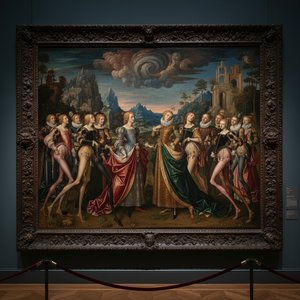
PHOTO DESCRIPTION: The painting is a detailed depiction of the Seven Deadly Sins and the Four Last Things. The scene features numerous people in various positions throughout the artwork. Some individuals can be seen sitting or standing near each other, while others are positioned more individually. In addition to the people, there are several objects scattered throughout the painting. A few of these include a cross located towards the top left corner and another one further down on the right side. There is also an angelic figure in the middle of the scene, adding to the religious theme of the artwork. The overall composition of the painting showcases a complex and intricate representation of the Seven Deadly Sins and the Four Last Things, with each element contributing to the richness of the story being told through this masterpiece.

Biographie de l'artiste

vie et carrière

Hieronymus Bosch, un peintre néerlandais/flandrien renommé du Brabant, est né vers 1450 à ‘s-Hertogenbosch, aux Pays-Bas. Sa vie reste enveloppée de mystère, avec seulement quelques traces de son existence. Malgré le manque d'informations biographiques, l’art de Bosch a eu un impact profond sur l’art européen du nord, en particulier au XVIe siècle.

style artistique et influences

Le style unique de Bosch, caractérisé par des représentations surréalistes et imaginatives de thèmes religieux, est largement influent. Ses peintures à l'huile sur bois, souvent représentant des visions étranges et cauchemardesques de l’enfer, ont fait l’objet de nombreuses interprétations. Le Triptyque du Jugement Dernier (c. 1480-1490) et le Jardin du Paradis Terrestre (c. 1490-1510) sont deux de ses œuvres les plus célèbres, mettant en valeur sa maîtrise du médium.

Œuvres notables et collections

* L’Ascension des Bienheureux (renaissance du nord, huile sur panneau) : un exemple rare de l'œuvre de Bosch, présentant une scène onirique et étrange. * Épiphanie (c. 1495, Musée du Prado, Madrid) : Un triptyque qui démontre l’utilisation innovante de l’huile sur bois par Bosch. * Tête d'un Halberdiers (Musée du Prado, Madrid) : Un bel exemple de la peinture à portrait de Bosch, mettant en valeur son souci du détail.

Musées et collections présentant l’œuvre de Bosch

* Le Musée du Prado, Madrid : abrite certaines des œuvres les plus célèbres de Bosch, notamment l’Épiphanie et le Triptyque du Jugement Dernier. * Le Musée d'Art de Philadelphie, Philadelphie : présente une version de l’Épiphanie, offrant une perspective unique sur le style artistique de Bosch.

Héritage

Le style énigmatique de Hieronymus Bosch captive les amateurs d'art depuis des siècles, et son influence peut encore être observée dans l'œuvre de nombreux artistes. Son mélange unique de surréalisme et d’intuitions profondes sur la condition humaine a solidifié sa place en tant que maître de la peinture néerlandaise.
Jérôme Bosch

Jérôme Bosch

1450 - 1516 , Pays-Bas

En bref

  • Artistes Influencés: ['Pieter Bruegel le Vieux']
  • Artistes Influents:
    • Jan van Eyck
    • Pieter Bruegel l'Ancien
  • Date De Décès: 1516
  • Date De Naissance: c. 1450
  • Lieu De Naissance: 's-Hertogenbosch, Pays-Bas
  • Mouvement Artistique: Renaissance nordique
  • Nationalité: Néerlandais/Flamand
  • Nom Complet: Jérôme Bosch
  • Œuvres Notables:
    • Le Jardin des délices terrestres
    • Triptyque du Jugement Dernier
    • L'Ascension des Bienheureux
    • Épiphanie
Explorez des œuvres d'art classées par thèmes, styles et caractéristiques.