A Study in Classical Restraint: Ingres' Self-Portrait
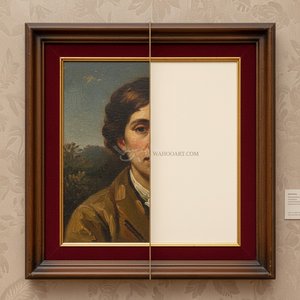
Jean-Auguste-Dominique Ingres’s “Self-Portrait,” painted in 1804, is more than just a likeness; it’s an embodiment of the Neoclassical ideals that defined his career and continues to resonate with viewers today. Executed in oil on canvas at a modest 86 x 69 cm, this work reveals Ingres' meticulous approach – a hallmark of his style – and offers a glimpse into the mind of one of France’s most influential artists. The painting immediately draws the eye to the artist himself, presented with an almost austere dignity within the confines of a dark robe accented by a crisp white collar. His gaze is direct, serious, hinting at the intellectual rigor that underpinned his artistic practice.
- Subject and Composition: The self-portrait immediately establishes Ingres as both artist and subject, inviting contemplation on the role of the creative spirit. The composition is remarkably balanced, with the figure occupying a central space within the frame, emphasizing his importance and authority.
- Technique – A Masterclass in Detail: Ingres’s technique is characterized by its precision and control. Notice the smooth blending of colors, particularly in rendering the fabric of the robe, and the subtle modeling of the face. These details demonstrate a dedication to observation and an almost obsessive attention to accuracy—a trait that would become synonymous with his name.
The Echoes of Antiquity
Ingres’s work is deeply rooted in the classical tradition, reflecting the Neoclassical movement's fascination with ancient Greece and Rome. The formal pose, reminiscent of Roman portrait busts, speaks to this influence. The artist deliberately evokes a sense of timelessness, suggesting that he is not merely depicting himself but participating in an unbroken chain of artistic endeavor stretching back through the centuries. This isn’t simply a representation; it's a deliberate engagement with history and its most celebrated figures.
The inclusion of a piece of paper or cloth – a subtle detail often overlooked – further reinforces this connection to antiquity. Such objects were frequently used by ancient artists for sketching and preliminary studies, suggesting that Ingres is not just a painter but also an apprentice, learning from the masters of old. The overall effect is one of quiet contemplation and scholarly devotion.
Historical Context and Artistic Legacy
Created in 1804, during a period of significant artistic change in Europe, “Self-Portrait” represents a reaction against the Rococo style that had dominated the preceding decades. Ingres’s commitment to classical forms and techniques aligned him with a growing movement seeking to restore order and reason after the excesses of the Enlightenment. His work anticipated the later developments of Academic painting, establishing a standard for realism and formal correctness that would influence generations of artists.
The painting's enduring appeal lies not only in its technical mastery but also in its ability to evoke a sense of intellectual curiosity and artistic aspiration. It’s a reminder of the power of observation, discipline, and a deep respect for tradition – qualities that remain relevant to artists today. It stands as a testament to Ingres's profound understanding of art history and his unwavering commitment to creating works of lasting beauty and significance.
A Timeless Masterpiece
Handmade oil paintings reproductions of Ingres’s “Self-Portrait” offer an exceptional opportunity to bring this iconic work into your home or studio. Each reproduction meticulously recreates the original's nuanced details, color palette, and textural qualities, allowing you to experience the full impact of Ingres’s artistic vision. This piece is more than just a decoration; it’s an investment in art history, a celebration of classical beauty, and a reminder of the enduring power of human creativity.



 Aperçu en situation
 Commander la reproduction peinte à la main
 Envoyer
 Partager
 Détails de l'œuvre

 Télécharger
 Articles similaires
 Radiographie
 Diaporama
 Statistiques


 Lire la suite






































 L'option verre n'est disponible que pour les dimensions inférieures à 110 cm.