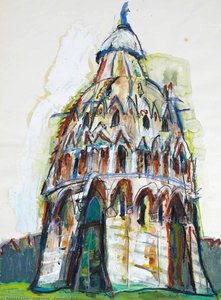
The Visceral Poetics of Janie Nicoll
Born in 1965, Janie Nicoll stands as a compelling figure in the contemporary British art scene, an artist whose practice serves as a bridge between the raw, emotive power of Expressionism and the lyrical, atmospheric grace of Romanticism. Rooted in the cultural landscape of Dundee, Scotland, her artistic journey is one of profound exploration, where the boundaries between human emotion and the natural world are perpetually blurred. Nicoll’s work does not merely seek to represent reality but aims to capture its psychological essence, creating a space where the viewer can encounter the complexities of identity, isolation, and connection through a lens of intense, often turbulent, beauty.
Her formal education provided the rigorous foundation upon which her experimental spirit could flourish. After honing her early skills at Duncanrig School, she pursued higher studies at the prestigious Glasgow School of Art, where she earned her Master of Fine Arts. This academic journey was further enriched by postgraduate studies at the Edinburgh College of Art, a period that proved transformative for her stylistic evolution. During these formative years, Nicoll developed a deep reverence for the masters of light and shadow, drawing significant inspiration from the dramatic chiaroscuro of Rembrandt and the sublime, sweeping landscapes of J.M.W. Turner. These influences instilled in her a lifelong commitment to using light not just as a tool for visibility, but as a medium for conveying profound psychological depth and the grandeur of existence.
A Synthesis of Expression and Form
As her practice matured, Nicoll underwent a significant stylistic shift, moving away from academic precision toward the more visceral techniques of the Expressionist movement. Influenced by the works of Edvard Munch and Ernst Ludwig Kirchner, she began to embrace bold, gestural brushstrokes and jarring, emotive color palettes. This evolution allowed her to move beyond mere figurative representation, enabling her canvases to pulsate with a raw, unmediated feeling. Her work often features:
- Dynamic Nudes: Works such as Two Nudes Wrestling exemplify her ability to use the human form to depict intense struggle and physical tension through dark tones and powerful compositions.
- Intimate Portraits: A recurring exploration of the human face and psyche, often imbuing subjects with a sense of quiet introspection or underlying anxiety.
- Multidisciplinary Approaches: While celebrated for her painting, Nicoll’s versatility extends into collage, photography, film, and digital imaging, often re-appropriating cultural references to create site-specific installations.
This technical breadth allows her to navigate a wide spectrum of themes, from the monumental scale of landscape studies to the delicate intimacy of portraiture. In her studio in Glasgow, she continues to experiment with the intersection of digital image-making and traditional collage, ensuring that her work remains a living, breathing dialogue between historical tradition and contemporary innovation.
Legacy and Artistic Significance
Beyond the canvas, Janie Nicoll has been a vital contributor to the structural fabric of the Scottish art community. Her leadership as the President of the Scottish Artists Union from 2014 to 2017 underscores her commitment to the advocacy and sustainability of the visual arts in her home country. This dedication to the broader artistic ecosystem complements her individual creative achievements, marking her as an artist who is as invested in the community as she is in her personal vision.
The historical significance of Nicoll’s work lies in its ability to harmonize seemingly contradictory impulses: the chaotic energy of modern expressionism and the structured beauty of classical romanticism. By weaving together these disparate threads, she creates a body of work that resonates with the universal human experience—capturing the fleeting moments of struggle, the enduring presence of nature, and the eternal search for meaning within the shadows of the human condition.



 Aperçu en situation
 Passer au format impression
 Envoyer
 Partager
 Détails de l'œuvre

 Télécharger
 Articles similaires
 Radiographie
 Diaporama
 Statistiques


 Lire la suite






































 L'option verre n'est disponible que pour les dimensions inférieures à 110 cm.