CONSEIL EN ART GRATUIT

x
Commander l'impression Commander l'impressionAcheter l'image haute résolution Acheter l'image haute résolution PartagerPartager
DétailsDétails Ajouter aux favoris Ajouter aux favoris TéléchargerTélécharger Articles similairesArticles similaires RadiographieRadiographie DiaporamaDiaporama

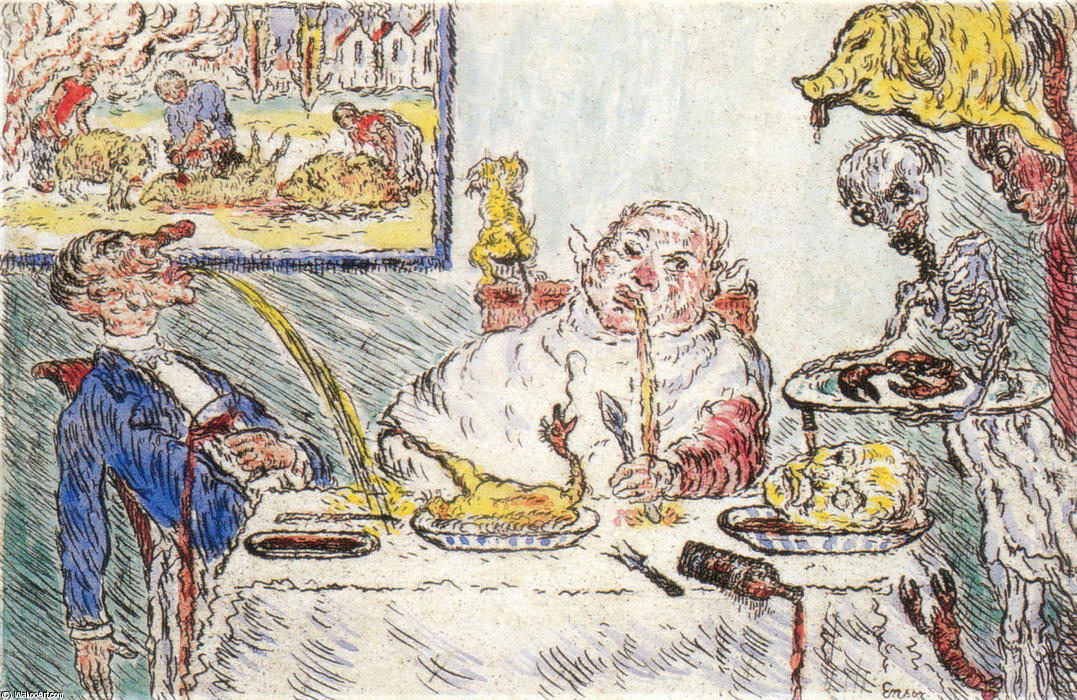
Gluttony

James Ensor's unsettling 'Gluttony,' from The Deadly Sins series (1904), depicts a decadent dining table scene—a masterful exploration of excess and moral decay through stark black and white etching.

Découvrez James Ensor (1860-1949), un peintre et graveur belge pionnier. Explorez ses scènes troublantes et oniriques de masques, de carnavals et de squelettes qui ont profondément influencé l'Expressionnisme et le Surréalisme. #JamesEnsor #Expressionnisme #Surréalisme #Bel

Reproduction à l'huile faite à la main

Huile sur toile peinte à la main, avec cadre et dimensions personnalisés, réalisée sur commande par nos artistes.

P118B $10
P118H $10
P118W $10
P438Z $10
P508JH $12
P508YH $12
P805H $10
P805Z $10
P919BZ $10
P919G $10
P919XJ $10
P959ZH $10
P968JZ $12
W106C $8
W218G $10
W218JH $8
W218Y $10
W307PJ $10
W316G $10
W316PJ $8
W316Y $10
W398PJ $8
W4111J $10
W500HY $15
W500JH $15
W692G $12
W849H $8
W940BG $15
W953PJ $8

Standard
custom
CM
INCH

Choisissez parmi nos formats prédéfinis qui respectent les proportions originales de l’œuvre.

largeur
hauteur

Vous pouvez saisir vos propres dimensions pour l'adapter à un cadre ou à un espace spécifique. Si la taille sélectionnée ne correspond pas aux proportions de l'image d'origine, nous recadrerons l'œuvre ou prolongerons la peinture avec des éléments peints à la main supplémentaires. Une maquette numérique vous sera envoyée pour approbation avant le début de la production.
Veuillez noter que l'aperçu à l'écran ne reflète pas le recadrage ou l'extension réels. Seule la maquette montrera fidèlement la composition finale.
Bien que des tailles personnalisées soient disponibles, nous vous recommandons de sélectionner une dimension dans la liste prédéfinie afin de préserver les proportions d'origine.

Exemples de personnalisation : remplacer un visage par la photo du client ; ajouter un animal de compagnie (par exemple, remplacer un chat par un chien) ; inclure un message caché en arrière-plan ; modifier le paysage ou les éléments de l'arrière-plan.
Après la commande, l’équipe WahooArt.com contactera le client par e-mail pour obtenir ses instructions et lui fournira une maquette d’aperçu.

Livraison dans le monde entier () en 3 à 4 semaines au lieu des 5 semaines habituelles. (2 juillet). Aucune concession sur la qualité.

why_choose_icon
Livraison express gratuite dans le monde entier
why_choose_icon
Toile de lin de haute qualité
why_choose_icon
Assurance transport complète
why_choose_icon
Garantie de remboursement des frais de douane
why_choose_icon
Garantie de fidélité des couleurs
why_choose_icon
Politique de retour de 60 jours (uniquement en cas de défaut)
why_choose_icon
Garantie de remboursement à 100%
why_choose_icon
Réduction sur les achats groupés

Prix total

-

reproduction

Gluttony

Technique de reproduction

Format de reproduction

-

Prix total final

-

En bref

  • Movement: Expressionism
  • Location: MSK Gent
  • Artistic style: Surrealist
  • Subject or theme: Sin, Greed
  • Title: Gluttony
  • Medium: Etching, heightened
  • Artist: James Ensor

Quiz d'art

Chaque question ne comporte qu'une seule bonne réponse.

Question 1:
What is the primary subject matter depicted in James Ensor’s ‘Gluttony’?
Question 2:
The etching technique employed by James Ensor in ‘Gluttony’ is known for its:
Question 3:
‘Gluttony’ belongs to Ensor's influential series ‘The Seven Deadly Sins’. What is the overarching purpose of this series?
Question 4:
According to the image description, what is prominent in the composition?
Question 5:
James Ensor’s stylistic approach is characterized by:

Description de l'œuvre

James Ensor’s *Gluttony*: A Descent into the Grotesque

James Ensor's Gluttony (circa 1897) is not merely a depiction of a dinner party; it’s a profoundly unsettling exploration of human excess, societal decay, and perhaps most significantly, the anxieties simmering beneath the surface of late Victorian Europe. Painted in stark black and white, the canvas immediately confronts the viewer with a scene of almost unbearable tension. The figures seated around the table – three primary subjects and two indistinct background individuals – are rendered with an unsettling realism that borders on caricature. Their postures, expressions, and the sheer abundance of food on the table contribute to a palpable sense of unease, hinting at a feast not of pleasure but of something far more sinister.

  • Subject Matter: The painting’s subject is straightforward – a group consuming a meal. However, Ensor elevates this commonplace scene into a powerful allegory for moral corruption and the dangers of unchecked indulgence.
  • Style & Technique: Ensor's style aligns with the Symbolist movement, prioritizing emotional expression over strict representational accuracy. His technique employs bold, expressive brushstrokes and a deliberate flattening of perspective, creating a claustrophobic atmosphere that intensifies the psychological impact of the scene. The monochromatic palette further amplifies this effect, stripping away any potential distractions and focusing attention on the figures’ distorted features and the unsettling arrangement of objects.

Historical Context & Ensor's Vision

Created during a period of rapid social change and growing anxieties in Europe – marked by industrialization, urbanization, and burgeoning psychological theories – *Gluttony* reflects these concerns. Ensor was deeply influenced by the Symbolist movement, which sought to express subjective emotions and ideas through symbolic imagery rather than objective representation. His personal background also played a crucial role; his upbringing amidst the vibrant, often unsettling atmosphere of Ostend, a port town known for its carnivals and eccentric characters, undoubtedly shaped his artistic vision. The souvenir shop run by his parents – filled with masks, curiosities, and objects that hinted at hidden meanings – provided him with a rich visual vocabulary that he would later employ to great effect.

Ensor’s rejection of the rigid academic traditions of the Brussels Academy was deliberate. He sought to create art that spoke directly to the subconscious, confronting viewers with uncomfortable truths rather than offering pleasant illusions. This commitment to psychological realism is evident in *Gluttony*, where the figures are not simply eating; they are trapped within a cycle of self-indulgence and moral degradation.

Symbolism & Emotional Impact

The symbolism embedded within *Gluttony* is layered and complex. The abundance of food itself represents excess, waste, and perhaps even a symbolic representation of the sins of mankind. The distorted faces of the figures suggest a loss of identity and an inability to escape their own appetites. The presence of masks – subtly alluded to in the artist’s broader oeuvre – reinforces the theme of disguise and deception. The overall effect is profoundly unsettling, evoking feelings of anxiety, dread, and perhaps even disgust. Ensor masterfully uses composition and technique to create a scene that feels both familiar and deeply disturbing, inviting viewers to confront their own anxieties about morality, consumption, and the darker aspects of human nature.

  • Color Palette: The deliberate use of black and white heightens the dramatic effect and emphasizes the painting's psychological intensity.
  • Composition: The tightly framed composition creates a sense of confinement and intensifies the viewer’s engagement with the scene.

Perfecting Your Collection – A WahooArt Reproduction

WahooArt offers meticulously crafted hand-painted reproductions of James Ensor's *Gluttony*, capturing every nuance of detail and emotional intensity of the original artwork. Our skilled artisans employ traditional techniques, using archival quality materials to ensure that your reproduction will retain its beauty and vibrancy for generations to come. Whether you are a seasoned art collector, an interior designer seeking to create a dramatic focal point, or simply someone captivated by Ensor’s unsettling vision, a WahooArt reproduction of *Gluttony* is the perfect way to bring this iconic masterpiece into your home or workspace.


Biographie de l'artiste

jeunesse et parcours artistique

James Sidney Edouard, Baron Ensor, peintre et graveur belge de premier plan, est né le 13 avril 1860 à Ostende, en Belgique. Sa jeunesse fut marquée par un milieu culturel diversifié, avec un père anglais, James Frederic Ensor, et une mère belge, Maria Cathérine Haegheman. Manquant d'intérêt pour les études académiques traditionnelles, Ensor quitta l'école à quinze ans pour poursuivre sa passion pour l'art, se formant auprès de peintres locaux et étudiant ensuite à l’Académie Royale des Beaux-Arts de Bruxelles.

style et thèmes artistiques

Le style artistique d'Ensor se caractérisait par son exploration de l'inconscient et d'images oniriques, ce qui a influencé considérablement l'expressionnisme et le surréalisme. Ses peintures mettaient souvent en scène des sujets bizarres, notamment des carnavals, des masques, la marionnetterie, des squelettes et des allégories fantastiques. Parmi ses œuvres notables figurent Les Masques Scandalisés (1883) et Les Squelettes se Battant au Sur un Pendu (1891), qui témoignent de son mélange unique de grotesque et de fantastique.

reconnaissance et héritage

Malgré un rejet initial, l'œuvre d'Ensor a progressivement gagné acceptation et reconnaissance. En 1920, il était le sujet de grandes expositions ; en 1929, il fut nommé baron par le roi Albert, et en 1933, il reçut la Légion d’honneur. Son héritage en tant que figure pionnière de l'art moderne est évident dans son influence sur les mouvements artistiques ultérieurs, notamment l'expressionnisme et le surréalisme.

Œuvres clés et expositions

* L’Intrigue (90 x 150 cm, Koninklijk Museum voor Schone Kunsten, Anvers, Belgique) * Les Tribulations de Saint Antoine (1887, conservé au Museum of Modern Art, New York) Le style innovant et l’approche audacieuse d’Ensor ont laissé une marque indélébile sur le monde de l'art moderne.
James Ensor

James Ensor

1860 - 1949 , Belgique

En bref

  • Artistes Influencés:
    • Expressionnisme
    • Surréalisme
  • Artistes Influents:
    • Pieter Bruegel l'Ancien
    • Francisco Goya
    • James Abbott McNeill Whistler
  • Date De Naissance: 13 avril 1860
  • Lieu De Naissance: Ostende, Belgique
  • Mouvement Artistique: Expressionnisme, Surréalisme
  • Nationalité: Belge
  • Nom Complet: James Sidney Edouard Ensor
  • Oeuvres Notables:
    • Les Masques Scandalisés
    • Les Tribulations de Saint Antoine
    • Squelettes se battant sur un pendu
    • Christ entrant à Bruxelles
Explorez des œuvres d'art classées par thèmes, styles et caractéristiques.