CONSEIL EN ART GRATUIT

x
Commander l'impression Commander l'impressionAcheter l'image haute résolution Acheter l'image haute résolution PartagerPartager
DétailsDétails Ajouter aux favoris Ajouter aux favoris TéléchargerTélécharger Articles similairesArticles similaires RadiographieRadiographie DiaporamaDiaporama

Caprice (sketch)

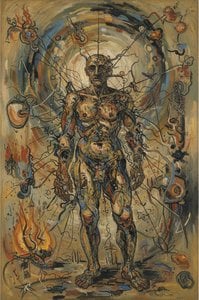
James Ensor's 'Caprice' (sketch) plunges viewers into a haunting scene of skeletons and angels amidst a dark carnival. Explore the artist’s unsettling vision of life, death, and social commentary – a masterpiece of Expressionism.

Découvrez James Ensor (1860-1949), un peintre et graveur belge pionnier. Explorez ses scènes troublantes et oniriques de masques, de carnavals et de squelettes qui ont profondément influencé l'Expressionnisme et le Surréalisme. #JamesEnsor #Expressionnisme #Surréalisme #Bel

Reproduction à l'huile faite à la main

Huile sur toile peinte à la main, avec cadre et dimensions personnalisés, réalisée sur commande par nos artistes.

Standard
custom
CM
INCH

Choisissez parmi nos formats prédéfinis qui respectent les proportions originales de l’œuvre.

largeur
hauteur

Vous pouvez saisir vos propres dimensions pour l'adapter à un cadre ou à un espace spécifique. Si la taille sélectionnée ne correspond pas aux proportions de l'image d'origine, nous recadrerons l'œuvre ou prolongerons la peinture avec des éléments peints à la main supplémentaires. Une maquette numérique vous sera envoyée pour approbation avant le début de la production.
Veuillez noter que l'aperçu à l'écran ne reflète pas le recadrage ou l'extension réels. Seule la maquette montrera fidèlement la composition finale.
Bien que des tailles personnalisées soient disponibles, nous vous recommandons de sélectionner une dimension dans la liste prédéfinie afin de préserver les proportions d'origine.

Exemples de personnalisation : remplacer un visage par la photo du client ; ajouter un animal de compagnie (par exemple, remplacer un chat par un chien) ; inclure un message caché en arrière-plan ; modifier le paysage ou les éléments de l'arrière-plan.
Après la commande, l’équipe WahooArt.com contactera le client par e-mail pour obtenir ses instructions et lui fournira une maquette d’aperçu.

Livraison dans le monde entier () en 3 à 4 semaines au lieu des 5 semaines habituelles. (3 juillet). Aucune concession sur la qualité.

why_choose_icon
Livraison express gratuite dans le monde entier
why_choose_icon
Toile de lin de haute qualité
why_choose_icon
Assurance transport complète
why_choose_icon
Garantie de remboursement des frais de douane
why_choose_icon
Garantie de fidélité des couleurs
why_choose_icon
Politique de retour de 60 jours (uniquement en cas de défaut)
why_choose_icon
Garantie de remboursement à 100%
why_choose_icon
Réduction sur les achats groupés

Prix total

-

reproduction

Caprice (sketch)

Technique de reproduction

Format de reproduction

-

Prix total final

-

En bref

  • Subject or theme: Life, death, spirituality
  • Influences: Carnival culture
  • Artistic style: Unsettling & Dramatic
  • Title: Caprice (sketch)
  • Notable elements: Bird, skeletons
  • Medium: Sketch

Quiz d'art

Chaque question ne comporte qu'une seule bonne réponse.

Question 1:
What is the primary subject depicted in James Ensor’s ‘Caprice (sketch)’?
Question 2:
The image description highlights the painting’s dark atmosphere. What effect does this darkness primarily contribute to?
Question 3:
Based on the description, what is the symbolic significance of the bird in ‘Caprice (sketch)’?
Question 4:
James Ensor’s artistic style is often associated with which movement?

Description de l'œuvre

A Descent into Shadow and Spectacle: James Ensor’s “Caprice”

James Ensor's "Caprice," a sketch rendered in stark black and white, is not merely a depiction of a scene; it’s an immersion into the unsettling heart of human experience. Created around 1890, this work exemplifies Ensor’s signature style – a potent blend of Symbolism, Expressionism, and a deeply rooted fascination with the grotesque and the macabre. The image presents a dramatic tableau: a colossal bird, seemingly an angel yet radiating an unnerving presence, dominates the composition, casting its shadow over a group of figures rendered as skeletal or ghostly forms. This isn’t a comforting vision of salvation; instead, it's a chilling meditation on suffering, mortality, and the anxieties simmering beneath the surface of contemporary society.

Ensor’s artistic journey was profoundly shaped by his upbringing in Ostend, Belgium – a vibrant seaside resort town brimming with carnival traditions. His family operated a souvenir shop overflowing with masks, costumes, and exotic objects, providing him with an unparalleled visual vocabulary. This early exposure to the theatricality of life, particularly the elaborate rituals surrounding Mardi Gras, became a recurring theme in his work, informing his use of disguise, symbolism, and a deliberate blurring of reality and illusion. “Caprice,” like much of Ensor’s oeuvre, draws heavily on this carnival imagery, injecting it with a distinctly unsettling atmosphere.

The Anatomy of Unease: Style and Technique

The monochrome palette of "Caprice" immediately establishes a mood of somber intensity. Ensor masterfully employs hatching and cross-hatching to build form and texture, creating a sense of depth and volume despite the absence of color. The bird itself is rendered with meticulous detail – its wings spread wide, almost aggressively so – drawing the viewer’s eye and anchoring the composition. Notice how he uses varying line weights to suggest movement and emotion; the skeletal figures seem to writhe in silent agony, while the bird exudes a quiet authority.

Crucially, Ensor abandons traditional perspective and realistic representation. Instead, he employs a flattened picture plane, compressing space and intensifying the claustrophobic feeling of the scene. This deliberate distortion contributes to the painting’s unsettling effect, forcing the viewer to confront the uncomfortable realities it depicts. The figures are densely packed together, almost suffocating one another, mirroring the anxieties of a rapidly changing society.

Symbolism and Interpretation: Angels and Anguish

The central figure of the bird is particularly complex. While often interpreted as an angel, Ensor subverts this traditional symbolism. The bird’s imposing size and its shadowed presence suggest not benevolence but rather a force of judgment or perhaps even predation. Its wings, spread wide, could represent both ascension and entrapment – a suggestion that salvation may be elusive or even illusory.

The skeletal figures surrounding the bird are undoubtedly representations of human suffering and death. Their pallid skin tones and vacant stares evoke a sense of profound loss and despair. Ensor’s use of masks, prevalent throughout his work, further obscures their identities, transforming them into archetypal symbols of mortality. The sheer number of these figures – at least twelve visible in the sketch – underscores the pervasive nature of suffering within society.

A Legacy of Discomfort: Context and Influence

"Caprice" is a pivotal work in Ensor’s artistic development, reflecting his growing disillusionment with societal norms and his willingness to confront uncomfortable truths. As documented by research from Wake Forest University's Print Collection (https://users.wfu.edu/martine/pcweb15/pc-ensor.html), Ensor’s work was often met with resistance due to its provocative subject matter and unconventional style. He deliberately challenged conventional artistic practices, paving the way for later Expressionist artists.

The Getty Exhibition “The Scandalous Art of James Ensor” (https://www.getty.edu/art/collection/exhibition/103PRP) highlights how Ensor’s work was initially perceived as shocking and unsettling, yet ultimately recognized for its profound psychological insight and artistic innovation. Reproductions of "Caprice," available through WahooArt.com, offer a powerful opportunity to experience the full impact of this haunting masterpiece – a testament to James Ensor's enduring legacy as one of the most original and challenging artists of the late 19th century.

Œuvres apparentées


Biographie de l'artiste

jeunesse et parcours artistique

James Sidney Edouard, Baron Ensor, peintre et graveur belge de premier plan, est né le 13 avril 1860 à Ostende, en Belgique. Sa jeunesse fut marquée par un milieu culturel diversifié, avec un père anglais, James Frederic Ensor, et une mère belge, Maria Cathérine Haegheman. Manquant d'intérêt pour les études académiques traditionnelles, Ensor quitta l'école à quinze ans pour poursuivre sa passion pour l'art, se formant auprès de peintres locaux et étudiant ensuite à l’Académie Royale des Beaux-Arts de Bruxelles.

style et thèmes artistiques

Le style artistique d'Ensor se caractérisait par son exploration de l'inconscient et d'images oniriques, ce qui a influencé considérablement l'expressionnisme et le surréalisme. Ses peintures mettaient souvent en scène des sujets bizarres, notamment des carnavals, des masques, la marionnetterie, des squelettes et des allégories fantastiques. Parmi ses œuvres notables figurent Les Masques Scandalisés (1883) et Les Squelettes se Battant au Sur un Pendu (1891), qui témoignent de son mélange unique de grotesque et de fantastique.

reconnaissance et héritage

Malgré un rejet initial, l'œuvre d'Ensor a progressivement gagné acceptation et reconnaissance. En 1920, il était le sujet de grandes expositions ; en 1929, il fut nommé baron par le roi Albert, et en 1933, il reçut la Légion d’honneur. Son héritage en tant que figure pionnière de l'art moderne est évident dans son influence sur les mouvements artistiques ultérieurs, notamment l'expressionnisme et le surréalisme.

Œuvres clés et expositions

* L’Intrigue (90 x 150 cm, Koninklijk Museum voor Schone Kunsten, Anvers, Belgique) * Les Tribulations de Saint Antoine (1887, conservé au Museum of Modern Art, New York) Le style innovant et l’approche audacieuse d’Ensor ont laissé une marque indélébile sur le monde de l'art moderne.
James Ensor

James Ensor

1860 - 1949 , Belgique

En bref

  • Artistes Influencés:
    • Expressionnisme
    • Surréalisme
  • Artistes Influents:
    • Pieter Bruegel l'Ancien
    • Francisco Goya
    • James Abbott McNeill Whistler
  • Date De Naissance: 13 avril 1860
  • Lieu De Naissance: Ostende, Belgique
  • Mouvement Artistique: Expressionnisme, Surréalisme
  • Nationalité: Belge
  • Nom Complet: James Sidney Edouard Ensor
  • Oeuvres Notables:
    • Les Masques Scandalisés
    • Les Tribulations de Saint Antoine
    • Squelettes se battant sur un pendu
    • Christ entrant à Bruxelles
Explorez des œuvres d'art classées par thèmes, styles et caractéristiques.