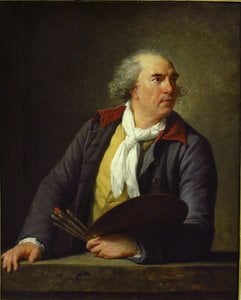
Hubert Robert : Peintre des Ruines et Visionnaire
- Né: 22 mai 1733, Paris, France
- Décédé: 15 avril 1808, Paris, France
Hubert Robert fut un peintre français célébré pour ses paysages évocateurs et ses peintures de *capriccio* – des représentations pittoresques semi-fictives de ruines en Italie et en France. Il est considéré comme une figure essentielle reliant les périodes rococo et néoclassique, anticipant des aspects du romantisme avec sa fascination pour la décomposition, l'histoire et les reconstructions imaginatives.
Jeunesse et Formation Artistique
Nicolas Robert, le père de Hubert, était au service de François-Joseph de Choiseul, marquis de Stainville. Robert reçut une éducation jésuite au Collège de Navarre en 1751. Il étudia ensuite la sculpture avec Michel-Ange Slodtz, qui l'encouragea à se consacrer à la peinture. Cette formation précoce lui inculqua une solide base en dessin et en perspective, des éléments cruciaux qui définiraient plus tard son style artistique.
Les Années Romaines et Développement Artistique (1754-1765)
- Départ pour Rome: En 1754, Robert se rendit à Rome avec Étienne-François de Choiseul, fils de l'employeur de son père.
- Onze Ans en Italie: Il passa onze ans à Rome, une période formatrice pour son développement artistique.
- Soutien et Patronage: Il se maintint en créant des œuvres pour les connaisseurs visitant la ville, comme l'abbé de Saint-Non.
- Influence de Giovanni Paolo Panini: Robert travailla aux côtés de Giovanni Paolo Panini, dont l’influence est visible dans ses premières compositions de *capriccio*.
- Croquis et Observations: Il esquissa méticuleusement les ruines romaines et les paysages, documentant des sites tels que la Villa d'Este et Caprarola, démontrant un sens aigu du détail et de la perspective atmosphérique.
Son séjour à Rome façonna profondément sa vision artistique. La juxtaposition des ruines antiques romaines avec la vie contemporaine suscita son intérêt pour représenter la décomposition aux côtés de la vitalité, un thème récurrent tout au long de sa carrière.
Retour à Paris et Reconnaissance (1765-1790)
- Succès Rapide: À son retour à Paris en 1765, Robert gagna rapidement une reconnaissance.
- Admission à l'Académie Royale de Peinture et de Sculpture: Il fut admis à l'Académie Royale de Peinture et de Sculpture avec un *capriccio* romain, "Le Port de Rome, Orné de Différents Monuments d'Architecture, Anciens et Modernes".
- Expositions au Salon: Ses expositions au Salon (à partir de 1767) attirèrent une attention considérable. Denis Diderot remarqua notamment la grandeur évoquée par ses représentations de ruines.
- Œuvres Notables: Parmi les œuvres clés de cette période figurent "Paysage avec les Ruines du Temple Rond, avec une Statue de Vénus et un Monument à Marc Aurèle", témoignant de sa maîtrise de la peinture de *capriccio*.
Le succès parisien de Robert provenait de sa capacité à capturer à la fois la grandeur de l'Antiquité classique et la vitalité de la vie contemporaine. Ses œuvres résonnaient auprès d’un public fasciné par l’histoire, l’archéologie et le pittoresque.
Les Dernières Années, la Révolution et l'Héritage (1790-1808)
- Révolution Française: Robert fut témoin et documenta la Révolution française, y compris la démolition de monuments historiques.
- Conservateur du Muséum Central des Arts: Il servit de conservateur du Muséum Central des Arts nouvellement établi (plus tard le Louvre), démontrant son engagement à préserver le patrimoine culturel.
- Production Artistique Continue: Malgré le climat politique tumultueux, Robert continua à peindre et à dessiner avec une grande productivité.
- Reproduction et Influence: Ses œuvres furent fréquemment reproduites par des artistes tels que l'abbé de Saint-Non, Châtelain, Linard et Le Veau, témoignant de son influence généralisée.
L’héritage de Hubert Robert réside dans sa capacité unique à mélanger la rigueur historique avec une vision imaginative. Il a ouvert un genre de peinture qui célébrait à la fois la beauté de la décomposition et le pouvoir durable de la créativité humaine. Son œuvre continue d'inspirer les artistes et de captiver le public, consolidant ainsi sa place en tant que figure significative dans l’art du XVIIIe siècle.



 Aperçu en situation
 Acheter la peinture faite à la main
 Partager
 Partager
 Détails

 Télécharger
 Articles similaires
 Radiographie
 Voir le diaporama
 Statistiques


 Afficher la suite






































 L'option verre n'est disponible que pour les dimensions inférieures à 110 cm.