early life and career
Hryhorii Havrylenko (1927-1984) was born in Hluhiv, Ukraine, a region steeped in folklore and artistic tradition. From a young age, he demonstrated an exceptional talent for drawing and painting, nurtured by his family’s encouragement and the vibrant cultural landscape of his hometown.
He pursued formal education at Kyiv State Institute, where he honed his skills in graphic design and illustration—disciplines that would profoundly shape his artistic vision. His formative years were marked by exposure to avant-garde movements circulating throughout Europe, notably Surrealism and Expressionism, which instilled in him a rebellious spirit and a fascination with exploring unconventional techniques.
artistic contributions
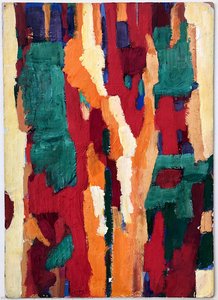
Havrylenko’s distinctive style is characterized by bold experimentation with color palettes and compositional arrangements. He rejected academic conventions, favoring instead abstract forms that conveyed emotion and psychological depth—a hallmark of Ukrainian avant-garde art during the 1960s and 70s.
His prolific output encompassed paintings, prints, and book illustrations, demonstrating his versatility as an artist. Recurring motifs included female figures rendered in stylized poses, reflecting a preoccupation with themes of femininity and vulnerability—a stylistic choice that aligns with the broader artistic currents of his time.
notable works and exhibitions
Havrylenko’s artwork gained recognition through exhibitions at the Kharkiv Regional Art Museum, where curators showcased his innovative approach to visual storytelling. Among his most celebrated pieces are “Nude,” a masterful depiction of human anatomy executed with meticulous detail, and “Composition,” an abstract exploration of geometric shapes that embodies the spirit of Surrealist aesthetics.
His book illustrations—particularly those commissioned for publications by M. Bazhan—stand out as exemplary instances of his artistic prowess. These works demonstrate his ability to capture complex narratives through evocative imagery and symbolic representations.
influences
Havrylenko’s artistic trajectory was undeniably shaped by the legacy of European masters such as Pablo Picasso and Franz Kafka, whose groundbreaking innovations challenged established artistic paradigms. He absorbed inspiration from Surrealist artists like René Magritte and Salvador Dalí, embracing their penchant for dreamlike imagery and paradoxical juxtapositions.
historical significance
Hryhorii Havrylenko’s contribution to Ukrainian art history is undeniable. As a pioneer of the avant-garde movement, he championed artistic freedom and pushed boundaries—a stance that resonated with intellectuals and artists across Ukraine during his lifetime. His enduring influence continues to inspire contemporary artists who strive to forge new paths in visual expression.



 Aperçu en situation
 Commander la reproduction peinte à la main
 Envoyer
 Partager
 Détails de l'œuvre

 Télécharger
 Articles similaires
 Radiographie
 Diaporama
 Statistiques

 Lire la suite






































 L'option verre n'est disponible que pour les dimensions inférieures à 110 cm.