


 Huile sur toileArt muralNorthern Renaissance
 65.0 x 53.0 cm
Impressions giclées ou sur toile de qualité musée, avec une production rapide et des finitions au choix. ( Commander la reproduction peinte à la main Acheter l'image haute résolution)





























Choisissez parmi nos formats prédéfinis qui respectent les proportions originales de l’œuvre.

Vous pouvez saisir vos propres dimensions pour vous adapter à un cadre ou à un espace spécifique. Si la taille sélectionnée ne correspond pas aux proportions de l'image originale, nous recadrerons l'œuvre ou étendrons l'image avec une bordure en miroir ou une couleur unie. Une maquette numérique vous sera envoyée pour approbation avant le début de la production.
Veuillez noter que l'aperçu à l'écran ne reflète pas le recadrage ou l'extension réelle. Seule la maquette montrera avec précision la composition finale.
Bien que des tailles personnalisées soient disponibles, nous vous recommandons de choisir une dimension dans la liste prédéfinie afin de préserver les proportions originales.
Livraison dans le monde entier () en 2 semaines au lieu des 4/5 semaines habituelles. (7 septembre)


The Conjuror
Format de la reproduction
Hieronymus Bosch remains one of art history's most perplexing figures, an artist whose unsettling visions continue to captivate audiences centuries after his death in 1516. Born around 1450 in ’s-Hertogenbosch, Brabant—a region grappling with religious anxieties and burgeoning societal change—Bosch’s oeuvre defies easy categorization, presenting a landscape of grotesque figures, fantastical creatures, and meticulously rendered details that simultaneously repel and intrigue.
“The Conjurer,” painted circa 1502, exemplifies Bosch's distinctive style. Executed in oil on wood, the painting depicts a man dressed in scarlet robes standing beside a table laden with symbolic objects: a tennis racket, a bowl containing fruit, a wine glass, and two clocks—one positioned prominently near the upper left corner, the other lower right.
The symbolism embedded within “The Conjurer” is multilayered and profoundly disturbing. The tennis racket represents manipulation and deceit—a tool wielded by the conjurer to control his audience. The fruit symbolizes temptation and decay, mirroring Bosch’s preoccupation with themes of mortality and corruption. Crucially, the clocks serve as potent reminders of time's relentless passage and the inevitability of judgment.
More than just a visual spectacle, “The Conjurer” operates on an emotional level, provoking feelings of unease and apprehension. Bosch’s masterful use of color—particularly scarlet—intensifies the painting’s unsettling atmosphere, drawing viewers into a realm where rationality yields to irrationality and beauty is subsumed by grotesquery. It's a work that compels contemplation, prompting us to confront uncomfortable truths about human nature and the perils of spiritual complacency.
Ultimately, Bosch’s “The Conjurer” transcends its historical context, resonating with viewers across generations due to its enduring exploration of fundamental anxieties concerning faith, morality, and the human condition. It stands as a cornerstone of Northern Renaissance art—a chilling reminder that beauty can coexist with terror and that true understanding requires venturing beyond the confines of conventional perception.


1450 - 1516 , Pays-Bas
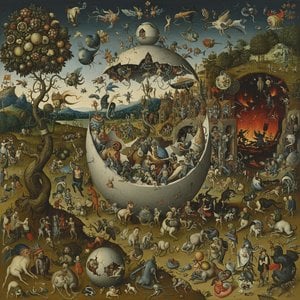
Plongez dans l'univers fascinant de Hieronymus Bosch ! Découvrez les 25 œuvres maîtresses du peintre flamand, symbolisme religieux et visions fantastiques. Reproductions d'art de qualité muséale sur WahooArt.com.

Explorez l'univers fascinant de Jérôme Bosch avec notre analyse approfondie. Découvrez le symbolisme caché de ses œuvres, des Primitifs Flamands au célèbre Jardin des Délices. Un voyage artistique incontournable.

Explorez le réalisme magique latino-américain : origines, artistes clés (Carpentier, García Márquez), symbolisme et influence culturelle. Découvrez un univers onirique fascinant avec WahooArt.

Plongez au cœur du Musée du Prado avec notre sélection des 25 œuvres incontournables : Velázquez, Goya, El Greco… Découvrez l'histoire et la beauté de ces chefs-d'œuvre baroques. Trouvez l'inspiration déco & achetez des reproductions haute qualité sur WahooArt.com !
Plongez au cœur de la peinture flamande ! Découvrez les 10 chefs-d'œuvre de Jan van Eyck, Campin & Memling. Histoire, symbolisme et réalisme : trouvez l'inspiration déco et achetez des reproductions d'art exceptionnelles sur WahooArt.com.

 Aperçu en situation
 Envoyer
 Partager
 Détails de l'œuvre

 Télécharger
 Articles similaires
 Radiographie
 Diaporama
 Lire la suite







 L'option verre n'est disponible que pour les dimensions inférieures à 110 cm.


