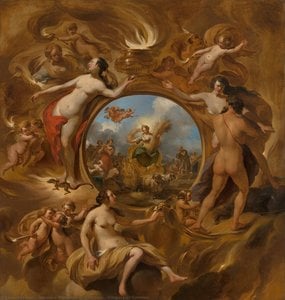
1905
1905 89.0 x 109.0 cm
Huile sur toile peinte à la main, avec cadre et dimensions personnalisés, réalisée sur commande par nos artistes. ( Commander l'impression Acheter l'image haute résolution)
Choisissez parmi nos formats prédéfinis qui respectent les proportions originales de l’œuvre.

Vous pouvez saisir vos propres dimensions pour l'adapter à un cadre ou à un espace spécifique. Si la taille sélectionnée ne correspond pas aux proportions de l'image d'origine, nous recadrerons l'œuvre ou prolongerons la peinture avec des éléments peints à la main supplémentaires. Une maquette numérique vous sera envoyée pour approbation avant le début de la production.
Veuillez noter que l'aperçu à l'écran ne reflète pas le recadrage ou l'extension réels. Seule la maquette montrera fidèlement la composition finale.
Bien que des tailles personnalisées soient disponibles, nous vous recommandons de sélectionner une dimension dans la liste prédéfinie afin de préserver les proportions d'origine.
Livraison dans le monde entier () en 3 à 4 semaines au lieu des 5 semaines habituelles. (7 septembre). Aucun compromis sur la qualité.


The Dodo and Given
Format de la reproduction

In the grand tapestry of late nineteenth-century art, few figures possess the dual mastery of scientific precision and poetic sensibility found in Henrik Grø.nvold. Born in Præstø, Denmark, in 1858, Grønvold was a man whose soul was inextricably bound to the rhythms of the natural world. While many of his contemporaries sought the abstract or the purely emotive, Grønvold found his muse in the delicate plumage of a songbird and the shifting light over a Nordic fjord. His life was a continuous dialogue with nature, a pursuit that saw him transition from a student of machine drawing in Copenhagen to one of the most respected natural history illustrators of his era.
Grønvold’s artistic journey was shaped by a rigorous academic foundation and an insatiable curiosity. After honing his technical skills at the Copenhagen Technical College, he sought further refinement at the Königliche Kunstakademie Düsseldorf. It was here, under the guidance of the master Wilhelm Leibl, that Grønvold encountered the nuances of German Impressionism. This pivotal influence infused his work with a luminous quality, teaching him to use color not merely as a descriptive tool, but as a means to capture the very atmosphere of the Scandinavian landscape. His technique became a sophisticated blend of meticulous anatomical accuracy and a loose, expressive brushwork that breathed life into every subject he touched.
What truly distinguishes Grønvold from the traditional landscape painters of his time was his profound ornithological obsession. He did not merely observe birds; he studied them with the intensity of a scientist and the reverence of a devotee. This passion led him on extensive expeditions across Denmark, Norway, and Sweden, where he painstakingly documented avian life in its most authentic habitats. His work as an illustrator for the Biological Research Station of Copenhagen and his later tenure at the Natural History Museum in London allowed him to merge the worlds of taxidermy, anatomy, and fine art. He was among the final generation of natural history illustrators to master the delicate art of lithography, ensuring that his scientific contributions were as visually breathtaking as they were biologically accurate.
His oeuvre is a testament to this duality, ranging from sweeping oil paintings to intimate watercolor studies:
As the twentieth century dawned, Grønvold’s work stood at a unique crossroads between the era of classical naturalism and the rising tide of modernism. While his commitment to scientific truth remained steadfast, his ability to embrace the light-filled aesthetics of Post-Impressionism allowed his art to remain relevant in a changing artistic landscape. He lived through a period of immense transition, yet he remained anchored by his devotion to the organic world. Even when his travels took him far from his Danish roots—including a significant period in London where he worked alongside renowned naturalists—his heart remained tethered to the landscapes of Scandinavia.
Today, the legacy of Henrik Grønvold resides in the quiet beauty of his subjects and the enduring accuracy of his observations. He remains a singular figure who proved that the line between the scientist’s ledger and the artist’s canvas is beautifully thin. To look upon a Grønvold painting is to experience a moment of profound stillness, an invitation to witness the intricate, often overlooked wonders of the natural world through the eyes of a true master of light and life.

1858 - 1940

 Aperçu en situation
 Envoyer
 Partager
 Détails de l'œuvre

 Télécharger
 Articles similaires
 Radiographie
 Diaporama
 Lire la suite




































 L'option verre n'est disponible que pour les dimensions inférieures à 110 cm.