A Portrait of Authority: Unveiling Hans Holbein’s “Untitled (975)”
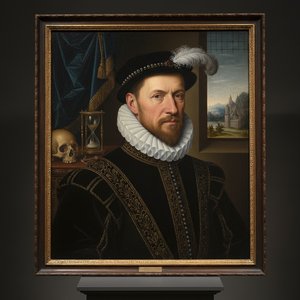
Hans Holbein the Younger's "Untitled (975)" presents a compelling and enigmatic portrait, a quintessential example of the Northern Renaissance master’s unparalleled ability to capture not just physical appearance but also the very soul of his subjects. The painting depicts a man – identified only by this designation – rendered with an almost unnerving realism, immediately drawing the viewer into a direct confrontation. His stern gaze, fixed upon us across the centuries, speaks of authority, perhaps religious or secular, yet simultaneously hints at a profound inner contemplation. The meticulous detail evident in every fold of his robe and the glint of the gold chain surrounding his neck underscores Holbein’s dedication to precise observation and masterful technique – hallmarks that defined his artistic legacy.
The Precision of Detail: Holbein's Technique
Holbein was renowned for his painstaking approach, a direct inheritance from his father, Hans Holbein the Elder. This wasn't simply about replicating what he saw; it was about dissecting reality and reconstructing it on canvas with an almost scientific precision. The use of oil paint allowed him to build up layers of color – glazes – achieving luminous effects and subtle gradations that were revolutionary for his time. Notice the way light catches the folds of the robe, creating a sense of volume and texture. Similarly, the rendering of the man’s face is remarkable for its psychological depth; the slight furrow in his brow, the set of his jaw, all contribute to an impression of quiet intensity. The inclusion of two secondary figures – one at the upper left and another near the bottom right – adds a layer of complexity, suggesting a scene of observation or perhaps even judgment, further enriching the narrative potential of the portrait.
Symbolism and Context: A Tudor Portrait
Created during Holbein’s time in England (approximately 1532-1536), this work reflects the artistic currents of the Tudor court. The subject's attire – a robe with a gold chain – strongly suggests a figure of high status, likely a religious dignitary or an important member of the court. Such portraits were not merely decorative; they served as powerful statements of identity and authority within a hierarchical society. Holbein’s commissions for Henry VIII and other prominent figures demonstrate his ability to navigate the complex political landscape of the era while simultaneously producing works of enduring artistic merit. The painting's ambiguity – the lack of a clear title or identifying details – adds to its mystique, inviting viewers to project their own interpretations onto the subject.
Emotional Impact and Legacy
"Untitled (975)" continues to captivate audiences with its arresting realism and psychological depth. Holbein’s ability to convey not just appearance but also character and mood is a testament to his genius. This portrait exemplifies the Northern Renaissance's focus on humanism, exploring the complexities of individual identity within a broader historical context. A hand-painted reproduction offers an unparalleled opportunity to experience the power and beauty of this iconic work firsthand, bringing Holbein’s masterful technique and profound insights into your own space.



 Aperçu en situation
 Acheter la peinture faite à la main
 Partager
 Partager
 Détails
 Guide
Guide

 Télécharger
 Articles similaires
 Radiographie
 Voir le diaporama
 Statistiques

 Afficher la suite






































 L'option verre n'est disponible que pour les dimensions inférieures à 110 cm.





![Portrait double de Jean de Dinteville et Georges de Selve (alias Les Ambassadeurs) [détail]](/media/artworks/images-thumb/bb/ab/bbab7ce77b7dd15d23d21114a63b51a4.jpg)


