Aperçu en situation Aperçu en RA Passer au format impression Passer au format image numérique Partager
Détails Guide imprimable Ajouter aux favoris Télécharger Articles similaires Radiographie Voir le diaporama Statistiques

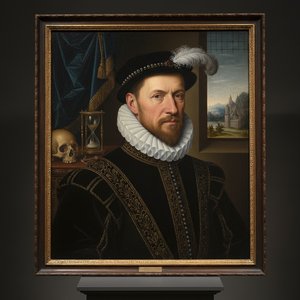
Le Comte Philippe

Découvrez le riche portrait de la Renaissance nordique du Comte Philippe par Hans Baldung, avec un clair-obscur magistral et des détails vibrants ; acquérez ce chef-d'œuvre dès aujourd'hui.

Découvrez Hans Baldung Grien (1485-1545), peintre allemand majeur ! Portraitisme expressif, gravures saisissantes et une fascination pour la sorcellerie : un artiste unique au cœur de la Renaissance.

Reproduction à l'huile faite à la main

Huile sur toile peinte à la main, avec cadre et dimensions personnalisés, réalisée sur commande par nos artistes. ( Passer au format impression Passer au format image numérique)

Corner sample of the P118B picture frame: polystyrène moulé, 5 cm wide and 3 cm thick
P118B €10
Corner sample of the P118H picture frame: polystyrène moulé, 5 cm wide and 3 cm thick
P118H €10
Corner sample of the P118W picture frame: polystyrène moulé, 5 cm wide and 3 cm thick
P118W €10
Corner sample of the P438Z picture frame: polystyrène moulé, 5.5 cm wide and 3.5 cm thick
P438Z €10
Corner sample of the P508JH picture frame: polystyrène moulé, 7 cm wide and 3.5 cm thick
P508JH €12
Corner sample of the P508YH picture frame: polystyrène moulé, 7 cm wide and 3.5 cm thick
P508YH €12
Corner sample of the P805H picture frame: polystyrène moulé, 5 cm wide and 3.5 cm thick
P805H €10
Corner sample of the P805Z picture frame: polystyrène moulé, 5 cm wide and 3.5 cm thick
P805Z €10
Corner sample of the P919BZ picture frame: polystyrène moulé, 7 cm wide and 3.5 cm thick
P919BZ €10
Corner sample of the P919G picture frame: polystyrène moulé, 7 cm wide and 3.5 cm thick
P919G €10
Corner sample of the P919XJ picture frame: polystyrène moulé, 7 cm wide and 3.5 cm thick
P919XJ €10
Corner sample of the P959ZH picture frame: polystyrène moulé, 5 cm wide and 3 cm thick
P959ZH €10
Corner sample of the P968JZ picture frame: polystyrène moulé, 6 cm wide and 4 cm thick
P968JZ €12
Corner sample of the W106C picture frame: bois massif, 5 cm wide and 3 cm thick
W106C €8
Corner sample of the W218G picture frame: bois massif, 5 cm wide and 3 cm thick
W218G €10
Corner sample of the W218JH picture frame: bois massif, 5 cm wide and 3 cm thick
W218JH €8
Corner sample of the W218Y picture frame: bois massif, 5 cm wide and 3 cm thick
W218Y €10
Corner sample of the W307PJ picture frame: bois massif, 6 cm wide and 3 cm thick
W307PJ €10
Corner sample of the W316G picture frame: bois massif, 6 cm wide and 3 cm thick
W316G €10
Corner sample of the W316PJ picture frame: bois massif, 6 cm wide and 3 cm thick
W316PJ €8
Corner sample of the W316Y picture frame: bois massif, 6 cm wide and 3 cm thick
W316Y €10
Corner sample of the W398PJ picture frame: bois massif, 5 cm wide and 3 cm thick
W398PJ €8
Corner sample of the W4111J picture frame: bois massif, 6.5 cm wide and 3.5 cm thick
W4111J €10
Corner sample of the W500HY picture frame: bois massif, 7 cm wide and 5 cm thick
W500HY €15
Corner sample of the W500JH picture frame: bois massif, 7 cm wide and 5 cm thick
W500JH €15
Corner sample of the W692G picture frame: bois massif, 8 cm wide and 4 cm thick
W692G €12
Corner sample of the W849H picture frame: bois massif, 5 cm wide and 3 cm thick
W849H €8
Corner sample of the W940BG picture frame: bois massif, 7.5 cm wide and 4.5 cm thick
W940BG €15
Corner sample of the W953PJ picture frame: bois massif, 6 cm wide and 3.5 cm thick
W953PJ €8

Format standard
personnalisé
CM
INCH

Choisissez parmi nos formats prédéfinis qui respectent les proportions originales de l’œuvre.

largeur
hauteur

Saisissez la largeur et la hauteur souhaitées, pour s'adapter à votre cadre ou à votre mur. Cette œuvre est peinte à la main ; ainsi, pour un format de forme différente, l'artiste peut peindre un peu plus autour du tableau ou réduire légèrement les bords — c'est vous qui choisissez. Nous vous envoyons une maquette numérique pour approbation avant que la peinture ne commence. L'image présentée sur cette page ne reflète pas le résultat réel — seule la maquette le fait.

Exemples de personnalisation possibles : remplacer un visage par la photo du client ; ajouter un animal de compagnie (par exemple, remplacer un chat par un chien) ; inclure un message caché en arrière-plan ; modifier le paysage ou les éléments de l'arrière-plan.
Après la commande, l’équipe WahooArt.com contactera le client par e-mail pour recueillir ses instructions et lui fournira une maquette d’aperçu

Livraison dans le monde entier () en 3 à 4 semaines au lieu des 5 semaines habituelles. (23 octobre). Aucun compromis sur la qualité.

Livraison express gratuite dans le monde entier
Toile de lin de haute qualité
Assurance transport complète
Garantie de remboursement des droits de douane
Garantie de fidélité des couleurs
Garantie de retour de 100 jours (uniquement en cas de défaut)
Garantie de remboursement à 100%
Tarifs dégressifs sur quantité

Prix total

€ 239

Le Comte Philippe

Technique de reproduction

Format de la reproduction

-

Prix total final

€ 239

L'essentiel de l'œuvre

  • Year: 1517
  • Medium: Huile sur bois
  • Artist: Hans Baldung
  • Notable elements or techniques: Clair-obscur, couleurs riches
  • Title: Comte Philippe

Quiz d'art

Chaque question ne comporte qu'une seule bonne réponse.

Question 1:
Quel est le titre de l'œuvre décrite ?
Question 2:
En quelle année le tableau 'Le Comte Philippe' de Hans Baldung a-t-il été créé ?
Question 3:
À quelle période artistique appartient le tableau 'Le Comte Philippe' ?
Question 4:
Avec quelle technique le tableau 'Le Comte Philippe' a-t-il été exécuté ?
Question 5:
Une technique artistique clé visible dans la peinture, utilisée pour créer de la profondeur par la lumière et l'ombre, est connue sous le nom de :

Le Regard Royal du Comte Philippe

Se tenir devant la représentation du Comte Philippe par Hans Baldung, c'est faire la rencontre non pas d'un simple portrait, mais d'un instant de pouvoir aristocratique soigneusement construit et figé dans le temps. Cette huile sur bois, datant de 1517, impose immédiatement l'attention par sa riche matérialité et ce sentiment palpable d'autorité qui émane du sujet. L'homme, paré de tissus somptueux — notamment la doublure de fourrure luxueuse de son manteau — fixe le spectateur avec une franchise troublante. Sa main soutient délicatement son menton, un geste qui en dit long sur la contemplation, le statut social, et peut-être une subtile et complaisante amusement suggéré par la légère courbe de sa bouche. C'est un chef-d'œuvre imprégné de la gravité de la Renaissance septentrionale.

Maîtrise de l'Ombre et de la Lumière

Le génie technique de Baldung brille à travers chaque coup de pinceau visible. Il emploie le clair-obscur avec une compétence époustouflante ; la lumière ne se contente pas d'éclairer le Comte Philippe, elle le sculpte. Des ombres profondes s'accumulent dans les plis de son magnifique manteau rouge et sous la texture pesante de son chapeau, conférant un volume presque tridimensionnel à la composition. Cette gestion magistrale de l'illumination sert à élever le sujet au-delà d'une simple ressemblance, le transformant en une icône de la noblesse de la Renaissance. Le jeu vibrant entre les bleus profonds, les rouges riches et les reflets lumineux sur sa barbe témoigne d'un artiste profondément versé tant dans l'usage des pigments que dans la profondeur psychologique.

Une Fenêtre sur la Vie de l'Élite

Au-delà de son attrait esthétique, le Comte Philippe sert de document historique essentiel. En tant que portrait du Comte Palatin Philippe le Belliqueux, il offre un aperçu inestimable des hiérarchies sociales rigides et des goûts opulents de l'Europe de la Renaissance. La tenue elle-même — la coupe du manteau, la qualité de la fourrure, l'allure même de l'homme — sont autant de marqueurs d'une richesse immense et d'un pouvoir ancré au sein de la puissante dynastie palatine. Posséder une reproduction de cette œuvre permet de se connecter intimement à la culture matérielle et aux préoccupations élevées de l'élite européenne durant cette ère transformatrice.

Échos de l'Esprit de la Renaissance Septentrionale

Hans Baldung lui-même était une figure énigmatique, jetant un pont entre les quêtes érudites et une profonde expression artistique. Son style incarne le ferment intellectuel de la Renaissance allemande — une période caractérisée par un renouveau des idéaux classiques tempéré par un profond caractère régional. La peinture capture cette tension : la formalité du portrait rencontrant l'intensité expressive caractéristique de l'art d'Europe du Nord. C'est une œuvre qui semble à la fois méticuleusement contrôlée et chargée d'émotion, invitant le spectateur moderne à méditer sur le poids du statut social et la nature durable de l'ambition humaine.

Inspirer la Grandeur de la Renaissance chez Soi

Pour ceux qui chercheent à infuser un espace de la profondeur de l'histoire et de la richesse de la peinture des Maîtres Anciens, cette reproduction offre une opportunité inégalée. La combinaison de sa composition frappante, de la texture palpable suggérée par la technique de Baldung et de sa présence narrative captivante garantit qu'elle deviendra un point focal — un sujet de conversation qui murmure les récits des cours du XVIe siècle et du génie artistique.

Questions et réponses

Que représente "Le Comte Philippe" et quelle atmosphère s'en dégage ?

«Le Comte Philippe» de Hans Baldung Grien allie portrait, renaissance, noblesse, peinture à l'huile, homme barbu, manteau rouge, tenue de luxe à une atmosphère Opulence dorée.

«Le Comte Philippe» de Hans Baldung Grien fait-il partie des œuvres Renaissance nordique les plus recherchées ?

« Le Comte Philippe » est répertorié comme étant Iconique parmi les œuvres du Renaissance nordique dans le catalogue.

À quelle étape de la carrière de Hans Baldung Grien s'inscrit « Le Comte Philippe », compte tenu de sa date ?

La date de 1517 inscrit « Le Comte Philippe » dans la période Première période du développement de Hans Baldung Grien.


Biographie de l'artiste

A Swabian Enigma: The Life and Early Influences of Hans Baldung Grien

Hans Baldung—forever distinguished as Hans Baldung Grien due to his predilection for wearing green attire—emerged from an unexpectedly scholarly lineage. Born around 1485 in the Free Imperial City of Schwäbisch Gmünd, nestled within the rolling hills of Bavaria, Germany, he was the son of Johann Baldung, a university-educated jurist who held the office of legal adviser to the Bishopric of Strasbourg, Albert of Bavaria, from 1492, and Margarethe Herlin, daughter of Arbogast Herlin. His uncle, Hieronymus Baldung, was a doctor in medicine, with a son, Pius Hieronymus, cousin of Hans, who taught law at Freiburgand became chancellor of Tyrol in 1527. The family resided in Strasbourg. He was the first male in his family to not attend university, but he was one of the earliest German artists to come from an academic family. His formative years were marked by exposure to humanist ideals and intellectual currents that shaped his worldview—a characteristic that permeated his entire oeuvre. He received his initial artistic training around 1500 in the Upper Rhineland with an artist from Strasbourg, laying the groundwork for his technical skills before he sought out more prominent masters to hone his craft. This early period instilled within him a foundation of draftsmanship and composition, preparing him for the rigorous artistic environment that awaited him in Nuremberg.

Under Dürer’s Wing and Forging an Individual Style

The pivotal moment in Baldung’s development arrived in 1503 when he became an assistant in Albrecht Dürer’s workshop in Nürnberg, where he perfected his art between 1503 and 1507. This period proved profoundly formative, exposing him to the meticulous detail, intellectual rigor, and innovative printmaking techniques that defined Dürer’s style. The two artists developed a close relationship; Baldung even managed Dürer’s workshop during his master’s sojourn to Venice. However, while deeply influenced by Dürer—evident in early works showcasing precise draftsmanship and Northern realism—Baldung quickly began to forge his own artistic identity. He absorbed the lessons of the Renaissance masters but infused them with a uniquely German sensibility, characterized by expressive color, imaginative compositions, and an increasingly unsettling psychological depth. This divergence from Dürer’s more classical approach would become a hallmark of Baldung’s mature style. His time in Venice, overseeing Dürer’s affairs, also exposed him to the burgeoning Italian Renaissance art scene, broadening his artistic horizons and subtly influencing his palette and compositional choices. He returned from Italy with a heightened sense of color and a willingness to experiment with spatial arrangements that set him apart from his contemporaries.

A Master of Many Mediums: Themes and Techniques

Hans Baldung Grien was an artist of remarkable versatility, proficient in painting, printmaking—particularly woodcuts and engravings—drawing, tapestry design, and even stained glass work. His paintings often feature small-scale works brimming with puzzling allegories and mythological narratives, rendered with a vibrant palette and a distinctive sense of spatial ambiguity. He excelled at portraiture, capturing the likenesses of his patrons with both realism and psychological insight. However, it is perhaps for his woodcuts that Baldung is most widely recognized today. These prints are characterized by their dramatic compositions, intricate detail, and often macabre subject matter. A recurring theme throughout his work is a fascination with witchcraft, death, and the supernatural—a reflection of the anxieties and beliefs prevalent in 16th-century Germany. His depictions of witches are particularly striking, portraying them not as stereotypical hags but as complex, even alluring figures, embodying both fear and fascination. He exploited the medium’s capacity for stark contrasts and intricate detail to create images that were both visually arresting and psychologically unsettling. ## Reformation Currents and Lasting Legacy Baldung’s career unfolded during a period of immense religious and political upheaval, marked by the rise of the Protestant Reformation. While not overtly aligned with any particular faction, his work often reflects the changing spiritual landscape of Germany. His monumental high altar for the city of Münster, completed in 1531, is a testament to this engagement, showcasing support for the reformation movement through its iconography and stylistic choices. He died in Strasbourg in September 1545, leaving behind a body of work that continues to captivate and intrigue viewers today. His influence can be seen in the works of later German artists, and his unique blend of Renaissance technique, Northern expressionism, and allegorical complexity secures his place as a significant figure in art history. He remains an artist whose work invites contemplation, challenging us to confront the darker aspects of human nature and the mysteries of the unseen world.

Hans Baldung Grien

Hans Baldung Grien

1485 - 1545 , Allemagne

En bref

  • Artistic Movement Or Style: Renaissance, Mannerism
  • Artists Who Influenced This Artist: ['Albrecht Dürer']
  • Date Of Birth: c. 1485
  • Full Name: Hans Baldung Grien
  • Nationality: German
  • Notable Artworks:
    • Bewitched Groom
    • Allegory of Death & Beauty
  • Place Of Birth: Schwäbisch Gmünd, Germany
Explorez des œuvres d'art classées par thèmes, styles et caractéristiques.