Aperçu en situation Aperçu en RA Acheter la peinture faite à la main Passer au format image numérique Partager
Détails Guide imprimable Ajouter aux favoris Télécharger Articles similaires Radiographie Voir le diaporama Statistiques

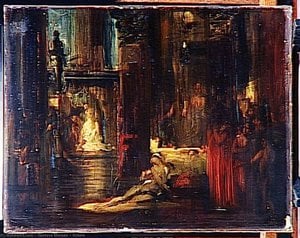
La Mort de Sapho

La Mort de Sapho depicts a woman lying on her side before a rocky landscape with a castle-like structure, symbolizing death and introspection through vibrant colors and intricate figures—a masterpiece by Gustave Moreau.

Explorez l'art symboliste captivant de Gustave Moreau (1826-1898). Découvrez ses peintures allégoriques, scènes mythologiques et son influence sur Matisse & Rouault. Visitez le Musée Gustave Moreau à Paris pour découvrir l'héritage de cette figure majeure.

Giclées et impressions d'art

Impressions giclées ou sur toile de qualité musée, avec une production rapide et des finitions au choix. ( Acheter la peinture faite à la main Passer au format image numérique)

P118B $10
P118H $10
P118W $10
P438Z $10
P508JH $12
P508YH $12
P805H $10
P805Z $10
P919BZ $10
P919G $10
P919XJ $10
P959ZH $10
P968JZ $12
W106C $8
W218G $10
W218JH $8
W218Y $10
W307PJ $10
W316G $10
W316PJ $8
W316Y $10
W398PJ $8
W4111J $10
W500HY $15
W500JH $15
W692G $12
W849H $8
W940BG $15
W953PJ $8

Format standard
personnalisé
CM
INCH

Choisissez parmi nos formats prédéfinis qui respectent les proportions originales de l’œuvre.

largeur
hauteur

Vous pouvez saisir vos propres dimensions pour vous adapter à un cadre ou à un espace spécifique. Si la taille sélectionnée ne correspond pas aux proportions de l'image originale, nous recadrerons l'œuvre ou étendrons l'image avec une bordure en miroir ou une couleur unie. Une maquette numérique vous sera envoyée pour approbation avant le début de la production.
Veuillez noter que l'aperçu à l'écran ne reflète pas le recadrage ou l'extension réelle. Seule la maquette montrera avec précision la composition finale.
Bien que des tailles personnalisées soient disponibles, nous vous recommandons de choisir une dimension dans la liste prédéfinie afin de préserver les proportions originales.

Livraison dans le monde entier () en 2 semaines au lieu des 4/5 semaines habituelles. (26 septembre)

why_choose_icon
Livraison express gratuite dans le monde entier
why_choose_icon
Toile de lin de haute qualité
why_choose_icon
Assurance transport complète
why_choose_icon
Garantie de remboursement des droits de douane
why_choose_icon
Garantie de fidélité des couleurs
why_choose_icon
Garantie de retour de 100 jours (uniquement en cas de défaut)
why_choose_icon
Garantie de remboursement à 100%
why_choose_icon
Tarifs dégressifs sur quantité

Prix total

$ 68

reproduction

La Mort de Sapho

Giclées et impressions d'art

Format de la reproduction

-

Prix total final

$ 68

L'essentiel de l'œuvre

  • Artist: Gustave Moreau
  • Title: The Painting
  • Artistic style: Romantic Surrealism
  • Subject or theme: Mythology, Spirituality
  • Location: Private Collection
  • Medium: Oil on Canvas

Quiz d'art

Chaque question ne comporte qu'une seule bonne réponse.

Question 1:
What artistic movement is Gustave Moreau associated with?
Question 2:
The painting depicts a woman lying on her side in front of what type of landscape?
Question 3:
What architectural element is prominently featured in the background of “La Mort de Sapho”?
Question 4:
Moreau’s artistic style prioritizes conveying what?
Question 5:
What is the overall atmosphere created by Moreau’s use of color in “La Mort de Sapho”?

A Dream Weaver of Symbolism: The Life and Art of Gustave Moreau

Gustave Moreau—a name that conjures images of opulent interiors bathed in muted hues, populated by fantastical figures drawn from mythology and folklore—stands apart as a titan among the Symbolist painters who dominated the artistic landscape of late 19th-century Paris. Unlike his Impressionist contemporaries obsessed with capturing sunlight’s ephemeral dance across landscapes, Moreau wrestled with profound questions about consciousness, spirituality, and the subconscious mind, translating these intellectual explorations into breathtaking visual narratives. His life itself was marked by an unusual blend of scholarly pursuits and artistic obsession—a testament to his unwavering commitment to forging a singular path toward aesthetic truth. Moreau’s formative years were spent immersed in the intellectual ferment of Parisian salons, where he encountered thinkers like Nietzsche and Wagner—figures who profoundly influenced his worldview and fueled his fascination with esoteric traditions. This exposure instilled within him a conviction that art possessed the capacity to transcend mere representation, achieving instead a communion with deeper realities beyond sensory perception. He rejected the prevailing scientific materialism of the era, arguing passionately for the importance of intuition and imagination as instruments of artistic creation. His distinctive style—characterized by meticulous detail, flattened perspectives, and an arresting use of color—was born from this intellectual crucible. Moreau eschewed the naturalistic conventions championed by Realism, opting instead for a deliberately stylized approach that prioritized symbolic resonance over photographic accuracy. He employed techniques honed through years of painstaking observation and experimentation, layering translucent glazes upon thickly impastoed surfaces to achieve luminous effects and imbue his canvases with an otherworldly glow. This masterful manipulation of pigment—often incorporating iridescent hues—created textures that seemed to pulsate with inner life, mirroring the artist’s own preoccupation with psychological depth. Moreau's artistic output spanned decades, producing a prolific body of work encompassing paintings, sculptures, decorative arts, and prints. However, it is his monumental canvases—particularly those depicting biblical scenes and mythological figures—that cemented his reputation as one of Symbolism’s foremost masters. Consider “The Tower of Babel,” for instance—a sprawling composition dominated by towering stone structures and populated by grotesque humanoids engaged in futile attempts to ascend toward the heavens. The painting's symbolism is multilayered, reflecting Moreau’s anxieties about societal fragmentation and humanity’s inability to grasp transcendent truths. Similarly, his depiction of “Saint George and the Dragon”—a dramatic tableau imbued with palpable tension—employs flattened perspectives and stylized figures to convey a visceral sense of struggle between good and evil. Beyond its technical brilliance, Moreau's art possesses an undeniable emotional impact. His canvases evoke feelings of melancholy, wonder, and apprehension—reflecting his profound engagement with existential concerns. He sought not merely to depict events but to communicate inner states of mind, inviting viewers into a realm of psychological contemplation. By confronting the viewer with unsettling imagery and ambiguous narratives, Moreau compelled them to grapple with questions about faith, morality, and the human condition—a legacy that continues to inspire artists and collectors alike. Ultimately, Gustave Moreau’s enduring influence stems from his unwavering conviction that art could serve as a conduit for accessing realms beyond the visible world. He remains an exemplar of artistic integrity and visionary imagination—a testament to the transformative power of pursuing beauty and truth with uncompromising passion. His paintings endure not simply as aesthetically pleasing objects but as profound meditations on the mysteries of human experience, securing his place among the most significant figures in Symbolist art history.

Biographie de l'artiste

**Jeunesse et Éducation**

Gustave Moreau, artiste français, est né le 6 avril 1826 à Paris. Il a reçu une formation académique traditionnelle en peinture à l’École des Beaux-Arts, démontrant un talent pour le dessin dès son plus jeune âge.

**Le Mouvement Symboliste**

L'œuvre de Moreau, caractérisée par des sujets allégoriques et mythologiques, l'a positionné comme un peintre symboliste de premier plan, en particulier dans les années 1890. Son art (et le symbolisme en général) a connu une période de déclin mais a été réévalué depuis les années 1960, Moreau étant désormais considéré comme l’un des peintres symbolistes les plus importants.

**Œuvres Notables et Expositions**

* Salomé dans la prison (peinture de 'Gustave Moreau') est un exemple notable de son œuvre, mettant en valeur sa maîtrise du symbolisme. * Autoportrait (peinture de 'Gustave Moreau') est une autre représentation puissante de l’artiste lui-même.

**Musée Gustave Moreau**

Le Musée National Gustave-Moreau (Musée Gustave Moreau Paris, France) à Paris est dédié à l’œuvre de Moreau, abritant plus de 1 200 peintures, aquarelles et dessins. Le musée témoigne de son héritage artistique.

**Héritage et Influence**

L'influence de Moreau sur le mouvement symboliste est indéniable. Il a enseigné à l’École des Beaux-Arts, influençant des artistes notables tels que Henri Matisse et Georges Rouault. Sa nature recluse n'a pas diminué son impact sur le monde de l’art. **En conclusion, l’héritage de Gustave Moreau en tant que figure emblématique du mouvement symboliste perdure, son œuvre inspirant et influençant les artistes encore aujourd'hui.**
Gustave Moreau

Gustave Moreau

1826 - 1898 , France

En bref

  • Artistes Influents:
    • Eugène Delacroix
    • Michelangelo
    • Leonard de Vinci
  • Date De Décès: 1898
  • Date De Naissance: 6 avril 1826
  • Influence Sur Les Artistes:
    • Henri Matisse
    • Georges Rouault
  • Lieu De Naissance: Paris, France
  • Mouvement Artistique: Symbolisme
  • Nationalité: Française
  • Nom Complet: Gustave Moreau
  • Oeuvres Notables:
    • Salomé dans la prison
    • Autoportrait
    • Jupiter et Sémélé
    • Orphée
    • L'Apparition
Explorez des œuvres d'art classées par thèmes, styles et caractéristiques.