Aperçu en situation Aperçu en RA Passer au format impression Passer au format image numérique Partager
Détails Guide imprimable Ajouter aux favoris Télécharger Articles similaires Radiographie Voir le diaporama Statistiques

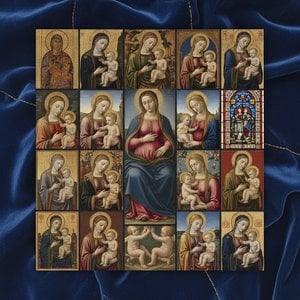
Madonna and Child

A stunning Renaissance painting by Giulio Romano depicting the Virgin Mary and Child with St. John the Baptist. Admire its intricate details & serene beauty at The Walters Art Museum.

Découvrez Giulio Romano (1499-1546), élève de Raphaël & maître du maniérisme ! Admirez ses fresques au Palazzo Te, ses designs architecturaux et son influence sur l'art de la Renaissance.

Reproduction à l'huile faite à la main

Huile sur toile peinte à la main, avec cadre et dimensions personnalisés, réalisée sur commande par nos artistes. ( Passer au format impression Passer au format image numérique)

P118B $10
P118H $10
P118W $10
P438Z $10
P508JH $12
P508YH $12
P805H $10
P805Z $10
P919BZ $10
P919G $10
P919XJ $10
P959ZH $10
P968JZ $12
W106C $8
W218G $10
W218JH $8
W218Y $10
W307PJ $10
W316G $10
W316PJ $8
W316Y $10
W398PJ $8
W4111J $10
W500HY $15
W500JH $15
W692G $12
W849H $8
W940BG $15
W953PJ $8

Format standard
personnalisé
CM
INCH

Choisissez parmi nos formats prédéfinis qui respectent les proportions originales de l’œuvre.

largeur
hauteur

Vous pouvez saisir vos propres dimensions pour l'adapter à un cadre ou à un espace spécifique. Si la taille sélectionnée ne correspond pas aux proportions de l'image d'origine, nous recadrerons l'œuvre ou prolongerons la peinture avec des éléments peints à la main supplémentaires. Une maquette numérique vous sera envoyée pour approbation avant le début de la production.
Veuillez noter que l'aperçu à l'écran ne reflète pas le recadrage ou l'extension réels. Seule la maquette montrera fidèlement la composition finale.
Bien que des tailles personnalisées soient disponibles, nous vous recommandons de sélectionner une dimension dans la liste prédéfinie afin de préserver les proportions d'origine.

Exemples de personnalisation possibles : remplacer un visage par la photo du client ; ajouter un animal de compagnie (par exemple, remplacer un chat par un chien) ; inclure un message caché en arrière-plan ; modifier le paysage ou les éléments de l'arrière-plan.
Après la commande, l’équipe WahooArt.com contactera le client par e-mail pour recueillir ses instructions et lui fournira une maquette d’aperçu

Livraison dans le monde entier () en 3 à 4 semaines au lieu des 5 semaines habituelles. (25 septembre). Aucun compromis sur la qualité.

why_choose_icon
Livraison express gratuite dans le monde entier
why_choose_icon
Toile de lin de haute qualité
why_choose_icon
Assurance transport complète
why_choose_icon
Garantie de remboursement des droits de douane
why_choose_icon
Garantie de fidélité des couleurs
why_choose_icon
Garantie de retour de 100 jours (uniquement en cas de défaut)
why_choose_icon
Garantie de remboursement à 100%
why_choose_icon
Tarifs dégressifs sur quantité

Prix total

$ 272

reproduction

Madonna and Child

Technique de reproduction

Format de la reproduction

-

Prix total final

$ 272

L'essentiel de l'œuvre

  • Influences:
    • Raphael
    • Bramante
  • Title: Madonna and Child
  • Notable elements: Foreshortening, interior scene
  • Subject or theme: Virgin and Child
  • Year: 1522-1524
  • Location: The Walters Art Museum
  • Movement: Mannerism

Quiz d'art

Chaque question ne comporte qu'une seule bonne réponse.

Question 1:
What artistic movement is most closely associated with the style of Giulio Romano, as evidenced by this painting?
Question 2:
The depiction of the interior in this painting, with its foreshortening and domestic setting, is a characteristic feature of which artist's work?
Question 3:
Based on the image description, what is the likely identity of the figure wearing a veiled robe?
Question 4:
What historical event significantly influenced Giulio Romano's career and artistic style, leading him to establish a studio in Mantua?
Question 5:
The use of the term 'Madonna' in art historical contexts primarily refers to:

Giulio Romano’s Madonna and Child: A Roman Masterpiece of Grace and Mystery

Giulio Romano's Madonna and Child, a captivating work housed within the esteemed collection of The Walters Art Museum in Baltimore, offers a profound glimpse into the heart of the Italian Renaissance. More than simply a depiction of the Virgin Mary cradling her infant son, this painting is a testament to Romano’s evolving artistic vision – a synthesis of Raphael's influence and his own burgeoning Mannerist style, reflecting a pivotal moment in art history. Completed around 1522-23 during his time in Mantua, it embodies a delicate balance between idealized beauty and subtly unsettling psychological depth.

The painting’s composition immediately draws the eye to the central figures: Mary, rendered with an exquisite blend of serenity and vulnerability, holds her child close. The infant Jesus, depicted not as a fully grown figure but as a miniature adult, gazes directly at the viewer – a deliberate choice that fosters a powerful sense of intimacy and connection. His pose, reminiscent of classical sculptures, subtly hints at his future role as the Lamb of God, foreshadowing his sacrifice. The surrounding architectural setting, a simplified yet evocative interior space, is not merely decorative; it serves to frame the scene and imbue it with a quiet dignity. The parapet at the bottom of the painting, a feature uncommon in earlier Italian works, creates an illusion of depth, drawing the viewer into the intimate world of the Madonna and Child.

The Shadow of Raphael and the Rise of Mannerism

Giulio Romano’s artistic journey is inextricably linked to that of his master, Raphael. He apprenticed under the great painter in Rome, absorbing not only technical skills but also a deep appreciation for classical ideals and harmonious composition. However, Romano quickly began to diverge from Raphael's High Renaissance style, embracing the principles of Mannerism – a movement characterized by elongated figures, distorted perspective, and an emphasis on emotional expression over strict realism. This shift is particularly evident in Madonna and Child, where the figures possess a heightened sense of elegance and dynamism compared to the more balanced compositions favored by Raphael.

The influence of Leonardo da Vinci is also palpable. Romano’s use of sfumato – a technique involving subtle gradations of tone to create a hazy, atmospheric effect – contributes to the painting's ethereal quality. Furthermore, the careful attention to detail in rendering fabrics and textures, combined with the delicate modeling of the figures, demonstrates Romano’s mastery of oil paint—a medium he skillfully employed to achieve remarkable luminosity and depth.

Symbolism and Spiritual Resonance

Beyond its aesthetic beauty, Madonna and Child is rich in symbolic meaning. The presence of St. John the Baptist, depicted as a young boy gazing at Christ with reverence, underscores the narrative arc of salvation – from innocence to sacrifice. The Lamb, held by Jesus, is a potent symbol of his future role as the sacrificial lamb, offering redemption for humanity. The muted color palette—primarily blues and browns—evokes a sense of solemnity and contemplation, inviting viewers to reflect on themes of faith, love, and mortality.

The choice of a domestic setting, rather than a grand landscape, further enhances the painting’s emotional impact. It suggests that the Madonna and Child are not distant figures but intimately connected members of a family—a powerful reminder of the nurturing role of Mary in the Christian faith. The overall effect is one of profound tenderness and spiritual resonance, inviting viewers to connect with the timeless themes explored within this masterpiece.

A Legacy of Artistic Innovation

Giulio Romano’s Madonna and Child stands as a pivotal work in the transition from High Renaissance to Mannerism. It showcases his evolving artistic style—a synthesis of Raphael's influence and his own innovative approach to composition, form, and color. The painting’s enduring appeal lies not only in its technical brilliance but also in its profound emotional depth and symbolic richness. It remains a testament to Romano’s genius and a captivating example of the transformative power of art.


Biographie de l'artiste

Première Vie et Formation

  • Né: Rome, Italie (c. 1492 ou 1499)
  • Décédé: 1er novembre 1546
  • Les détails de sa vie précoce sont rares, mais il a commencé sa carrière artistique à Rome.
  • Il fut l'élève de Raphaël, devenant un peintre et un architecte talentueux.
  • Après la mort de Raphaël en 1520, Giulio Romano prit en charge de nombreux projets inachevés, notamment la décoration de la Villa Madama pour le cardinal Giuliano de' Medici.

Développement du Style Maniériste

  • Giulio Romano est surtout connu pour ses contributions au style maniériste.
  • Son style s'est écarté du classicisme de la Haute Renaissance.
  • Les peintures et les fresques présentent souvent une asymétrie, une tension et une instabilité plutôt que l'équilibre et l'harmonie.
  • Influencé par Michelangelo et d’autres artistes de son époque.
  • Il est devenu de plus en plus indispensable à Raphaël, modifiant les plans et créant la première déclaration du maniérisme à grande échelle à Rome.

Œuvres Majeures et Réalisations

  • L'Incendie du Borgo: Une fresque peinte pour les Stanze Vaticane de Raphaël.
  • Plafond en Voûte (Détail): Une fresque au Palazzo Te.
  • Palazzo del Tè (Mantoue): Conçu et décoré de fresques illusionnistes, mettant en valeur ses compétences architecturales et artistiques. C'est son œuvre la plus importante.
  • Villa Madama: A décoré cette villa de la Renaissance pour le cardinal Giuliano de' Medici.
  • Il devint peintre et architecte à la cour de Federigo Gonzaga en 1524, dirigeant virtuellement toute l’activité artistique à Mantoue.

Influences et Importance Historique

  • Raphaël: La formation précoce de Giulio Romano sous Raphaël a considérablement façonné ses bases artistiques.
  • Michelangelo: L'influence du travail de Michelangelo a contribué au développement de son style maniériste.
  • Il est considéré comme une figure clé dans la transition de la Haute Renaissance au maniérisme.
  • Ses dessins étaient très prisés, et les gravures contemporaines gravées par Marcantonio Raimondi ont aidé à diffuser les styles artistiques italiens dans toute l'Europe.
  • L’héritage de Giulio Romano peut être vu chez les artistes ultérieurs qui ont adopté son style et ses techniques.

Vie Tardive et Héritage

  • Après la mort de Raphaël, Giulio a hérité de la direction de l'atelier du maître et a achevé de nombreux projets de ce dernier.
  • Il était si célèbre après sa mort qu’il est le seul artiste "moderne" mentionné par Shakespeare dans une pièce de théâtre.
  • Son travail démontre un changement s'éloignant des idéaux de la Renaissance vers des formes plus dynamiques et expressives.
  • Les contributions de Giulio Romano au maniérisme ont consolidé sa place en tant que figure influente dans l’histoire de l’art.
Giulio Romano

Giulio Romano

1499 - 1546 , Italie

En bref

  • Artistes Influencés: ['Artistes maniéristes']
  • Artistes Influents:
    • Raphaël
    • Michel-Ange
  • Date De Décès: 1er novembre 1546
  • Date De Naissance: Vers 1492 ou 1499
  • Lieu De Naissance: Rome, Italie
  • Mouvement Artistique: Manierisme
  • Nationalité: Italienne
  • Nom Complet: Giulio Romano
  • Oeuvres Notables:
    • L'Incendie du Borgo
    • Plafond en arc boutant
    • Palazzo del Tè
Explorez des œuvres d'art classées par thèmes, styles et caractéristiques.