x
Aperçu en situationAperçu en situation Visualiser en RAVisualiser en RA Commander l'impression Commander l'impressionAcheter l'image haute résolution Acheter l'image haute résolution EnvoyerEnvoyer
Détails de l'œuvreDétails de l'œuvre Ajouter aux favoris Ajouter aux favoris TéléchargerTélécharger Articles similairesArticles similaires RadiographieRadiographie DiaporamaDiaporama

Perspective View (Stage design)

Discover Canaletto's 'Perspective View (Stage design)': A captivating capriccio depicting a fantastical Roman Capitol stage set, showcasing intricate details and masterful perspective.

Découvrez "Le Grand Canal & la Salute" de Canaletto – un chef-d'œuvre vénitien de 1730 à couper le souffle ! Admirez les détails complexes, les couleurs chaudes et le charme historique. Parfait pour les amateurs d'art et les collectionneurs.

Reproduction à l'huile faite à la main

Huile sur toile peinte à la main, avec cadre et dimensions personnalisés, réalisée sur commande par nos artistes. (Commander l'impression Commander l'impressionAcheter l'image haute résolution Acheter l'image haute résolution)

P118B $10
P118H $10
P118W $10
P438Z $10
P508JH $12
P508YH $12
P805H $10
P805Z $10
P919BZ $10
P919G $10
P919XJ $10
P959ZH $10
P968JZ $12
W106C $8
W218G $10
W218JH $8
W218Y $10
W307PJ $10
W316G $10
W316PJ $8
W316Y $10
W398PJ $8
W4111J $10
W500HY $15
W500JH $15
W692G $12
W849H $8
W940BG $15
W953PJ $8

Format standard
sur mesure
CM
INCH

Choisissez parmi nos formats prédéfinis qui respectent les proportions originales de l’œuvre.

largeur
hauteur

Vous pouvez saisir vos propres dimensions pour l'adapter à un cadre ou à un espace spécifique. Si la taille sélectionnée ne correspond pas aux proportions de l'image d'origine, nous recadrerons l'œuvre ou prolongerons la peinture avec des éléments peints à la main supplémentaires. Une maquette numérique vous sera envoyée pour approbation avant le début de la production.
Veuillez noter que l'aperçu à l'écran ne reflète pas le recadrage ou l'extension réels. Seule la maquette montrera fidèlement la composition finale.
Bien que des tailles personnalisées soient disponibles, nous vous recommandons de sélectionner une dimension dans la liste prédéfinie afin de préserver les proportions d'origine.

Exemples de personnalisation possibles : remplacer un visage par la photo du client ; ajouter un animal de compagnie (par exemple, remplacer un chat par un chien) ; inclure un message caché en arrière-plan ; modifier le paysage ou les éléments de l'arrière-plan.
Après la commande, l’équipe WahooArt.com contactera le client par e-mail pour recueillir ses instructions et lui fournira une maquette d’aperçu

Livraison dans le monde entier () en 3 à 4 semaines au lieu des 5 semaines habituelles. (5 septembre). Aucun compromis sur la qualité.

why_choose_icon
Livraison express gratuite dans le monde entier

why_choose_icon
Toile de lin de qualité supérieure
why_choose_icon
Assurance transport complète
why_choose_icon
Garantie de remboursement des droits de douane
why_choose_icon
Garantie de fidélité des couleurs
why_choose_icon
Politique de retour de 60 jours (uniquement en cas de défaut)
why_choose_icon
Garantie de remboursement à 100%
why_choose_icon
Offre de tarifs dégressifs

Prix total

$ 272

reproduction

Perspective View (Stage design)

Technique de reproduction

Format de la reproduction

-

Prix total

$ 272

Informations clés

  • Movement: Venetian School
  • Title: Perspective View (Stage design)
  • Medium: Oil on canvas
  • Notable elements or techniques: Perspective, foreshortening
  • Artistic style: Veduta, Capriccio
  • Artist: giovanni antonio canal

Quiz d'art

Chaque question ne comporte qu'une seule bonne réponse.

Question 1:
What is the primary subject depicted in ‘Perspective View (Stage design)’?
Question 2:
The description mentions that the painting may have been created shortly after Canaletto’s stay in Rome. What does this suggest about its style?
Question 3:
The painting features a prominent equestrian monument. What historical figure does it resemble?
Question 4:
According to the description, what is a key characteristic of Canaletto’s style that has been debated by scholars?
Question 5:
What type of perspective is prominently featured in ‘Perspective View (Stage design)’?

A Captivating Vision of Venetian Theatre

Canaletto’s “Perspective View (Stage Design)” is more than just a depiction of a bustling scene; it's a window into the vibrant theatrical culture of 18th-century Venice. Painted likely in the early 1720s, this capriccio – a term Canaletto himself employed for imaginary or idealized views – transports us to a fantastical Capitol, glimpsed through a grand loggia adorned with Corinthian columns and shimmering with golden ornamentation. The composition is anchored by an equestrian monument, reminiscent of Marcus Aurelius, rising majestically from the steps of a triumphal arch, creating a powerful sense of grandeur and historical resonance.

The painting’s genius lies not merely in its technical precision but also in its evocative atmosphere. Canaletto masterfully employs linear perspective to draw the viewer into this meticulously rendered space. The receding lines of the loggia, the diminishing scale of the statues, and the subtle shifts in light create a convincing illusion of depth, inviting us to step through the painted world and become part of the scene. Notice how he uses atmospheric perspective – distant elements are paler and less defined, contributing to the overall sense of vastness and theatrical spectacle.

The Artist’s Context: Canaletto and Venetian Topography

Giovanni Antonio Canal, known as Canaletto, was a pivotal figure in the development of topographical painting. Born in Venice in 1697, he initially trained under his father, Bernardo Canal, a stage designer for theatrical productions. This early experience instilled in him a deep understanding of perspective and spatial relationships – skills that would later define his remarkable career. Canaletto’s work was profoundly shaped by the bustling commercial activity of Venice, a city renowned for its trade and artistic patronage. He meticulously documented the city's canals, palaces, markets, and everyday life, creating a vast archive of visual records.

His approach differed significantly from earlier Venetian painters who focused primarily on religious or mythological subjects. Canaletto’s interest lay in capturing the tangible reality of Venice – its architecture, its people, and its atmosphere. This shift towards secular subject matter reflected a broader cultural trend during the 18th century, as artists increasingly sought to depict the world around them with greater accuracy and detail. The painting's attribution has been debated by scholars, but Stefano Susinno recognized it as a unique example in Canaletto’s oeuvre due to its drawing, points of light, and similarities to other capricci.

Symbolism and Theatrical Allusion

Beyond its technical brilliance, “Perspective View (Stage Design)” is rich in symbolic meaning. The equestrian monument, a reference to Roman emperors, suggests an ideal of leadership and power. The triumphal arch evokes the grandeur of ancient Rome, while the golden ornaments symbolize wealth and prestige. The inclusion of figures engaged in various activities – musicians, spectators, and performers – underscores the importance of theatre as a central element of Venetian society. It’s a scene brimming with life, energy, and the allure of entertainment.

Interestingly, scholars believe this painting may have been created shortly after Canaletto's stay in Rome (1718-1720), possibly inspired by the city’s ancient ruins and theatrical traditions. The presence of numerous architectural elements reminiscent of Roman antiquity suggests a deliberate attempt to evoke the spirit of the classical world.

A Legacy of Precision and Vision

“Perspective View (Stage Design)” stands as a testament to Canaletto's exceptional skill and artistic vision. It’s a captivating blend of realism, imagination, and theatricality – a painting that continues to delight and intrigue viewers centuries after its creation. Reproductions of this work offer a remarkable opportunity to experience the beauty and detail of Canaletto’s artistry in your own home or office, bringing a touch of Venetian elegance and historical grandeur to any space.


Biographie de l'artiste

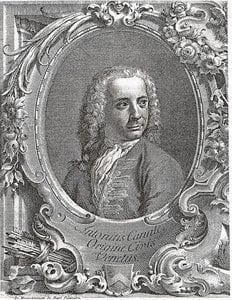
Giovanni Antonio Canal

Giovanni Antonio Canal, commonly known as canaletto, was born in Venice on October 18, 1697, to Bernardo Canal, a painter of theatrical scene settings, and Artemisia Barbieri. He was the son of a noble family steeped in artistic tradition—Bernardo Canal himself had been a respected artist, establishing a lineage dedicated to visual representation. Canaletto’s early training commenced with his father, who instilled within him the fundamental principles of painting, shaping his formative years into an immersion in artistic craftsmanship. This familial influence would prove pivotal in nurturing his innate talent and guiding his subsequent artistic pursuits.

The Making of a Master

In 1718, Canaletto embarked on a transformative journey to Rome—a city renowned for its artistic fervor and intellectual dynamism. During this period, he actively participated in the production of scenery for two operas by Alessandro Scarlatti, immersing himself in the theatrical world and honing his skills in designing immersive environments. This experience profoundly impacted his artistic development, exposing him to innovative techniques and fostering a keen understanding of visual storytelling—a cornerstone of his distinctive style. The collaboration with Scarlatti wasn’t merely professional; it was an encounter with the very essence of Baroque aesthetics. Upon returning to Venice, Canaletto swiftly established himself as a leading figure in Venetian landscape painting, adopting a technique that would soon earn him international acclaim: *veduta*. He meticulously crafted detailed depictions of the city's architectural grandeur and bustling public life—capturing not just what was seen but conveying an emotional resonance. His preparatory drawings were remarkably precise, reflecting his unwavering commitment to accuracy while simultaneously allowing for artistic interpretation. Canaletto’s method mirrored that of Giovanni Paolo Pannini, a Venetian artist who pioneered topographical art, emphasizing observation and meticulous documentation.

Notable Works and Collaborations

Canaletto's oeuvre comprises numerous masterpieces that exemplify the zenith of Venetian landscape painting—a genre characterized by its luminous palette and masterful perspective. Among his most celebrated works are “The Stonemason’s Yard” (c. 1725), a captivating portrayal of Venetian craftsmanship, and “Regatta on the Grand Canal” (c. 1730), which vividly captures the splendor of Venice's ceremonial processions—a testament to Canaletto’s ability to convey both visual accuracy and emotional depth. His depiction of Eton College (1746-1756) stands as a poignant reminder of his influence in England, where he collaborated closely with Bernardo Bellotto, who became an equally accomplished artist. Together, they produced breathtaking panoramas of Dresden and Vienna—works that continue to inspire admiration for their compositional elegance and technical virtuosity.

Artistic Style and Technique

Canaletto’s distinctive artistic style is inextricably linked to his pioneering use of the camera obscura—a darkened room equipped with a lens that projects an inverted image of the outside world onto a surface illuminated by candlelight. This ingenious device allowed him to achieve unparalleled topographical accuracy, ensuring that his paintings faithfully reproduced the contours and textures of Venice and London. However, Canaletto’s artistic vision extended beyond mere replication; he skillfully manipulated perspective and employed subtle tonal variations to create atmospheric effects—transforming ordinary scenes into emotionally evocative landscapes. His meticulous attention to detail—from the reflections in windows to the folds of drapery—elevated his paintings to levels of artistic sophistication rarely achieved by his contemporaries. Canaletto’s legacy resides not only in his technical prowess but also in his ability to imbue his works with a palpable sense of place and time—capturing the spirit of an era with remarkable sensitivity and artistry.
Giovanni Antonio Canal

Giovanni Antonio Canal

1697 - 1768 , Italie

L'essentiel de l'artiste

  • Artistic Movement Or Style: Vedute Venice
  • Artists Or Movements Influenced By This Artist: ['Tintoretto']
  • Artists Who Influenced This Artist: ['Giovanni Paolo Pannini']
  • Date Of Birth: October 18, 1697
  • Date Of Death: April 19, 1768
  • Full Name: Giovanni Antonio Canal
  • Nationality: Italian
  • Notable Artworks:
    • The Stonemason's Yard
    • Regatta on the Grand Canal
    • Eton College
  • Place Of Birth: Venice, Italy
Explorez des œuvres d'art classées par thèmes, styles et caractéristiques.