The Formative Years of a Flemish Visionary
In the vibrant, intellectually charged atmosphere of seventeenth-century Brussels, the foundations of Gillis van Tilborgh’s artistry were laid. Born around 1625, most likely in Brussels, he grew up within a family of artists. He is believed to have first learned the nuances of the brush from his father, Gillis van Tilborgh the Elder, before continuing his training with David Teniers the Younger, who had moved from Antwerp to Brussels around 1650 as court painter to Archduke Leopold Wilhelm, governor of the Habsburg Netherlands. From Teniers he took both a repertoire of subjects, from lively tavern and village scenes to meticulous views of princely picture galleries, and a keen eye for everyday life. This pedigree provided him with more than just technical skill; it instilled a deep reverence for the dramatic interplay of light and shadow, known as
chiaroscuro, and a meticulous devotion to the anatomical precision that would become his hallmark. He became a master in the Brussels Guild of Saint Luke in 1654 and its dean in 1663, and in 1666 he was appointed keeper of the painting collection of the court and of Tervuren castle, the governor’s residence: the same post his presumed master Teniers had held for Archduke Leopold Wilhelm.
Capturing the Pulse of Flemish Life
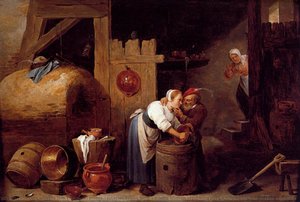
Van Tilborgh’s true genius lay in his ability to transform the mundane into the monumental. He moved effortlessly between the worlds of elegant portraiture and the gritty, evocative "low-life" genre scenes that captured the social heartbeat of the Low Countries. In works such as
“Village Inn,” completed in 1657, he offers viewers a meticulously crafted window into a vanished era. Within these canvases, one finds a bustling microcosm of society:
- Men engaged in spirited conversation over hearty meals and flowing drinks.
- The quiet, solitary scholar lost in the pages of a book amidst the tavern's revelry.
- The rustic textures of wooden beams and stone fireplaces that ground the scene in a tangible reality.
Whether depicting the high-society prestige of a
“Family Portrait” or the tense, atmospheric intrigue of
“The Card Players,” his work resonates with a psychological depth that transcends mere likeness. He did not simply paint figures; he painted the very essence of human connection and social tension. His dated works span the years 1650 to 1671 and are usually signed with the monogram “TB”; besides portraits and group portraits, they include tavern scenes, village feasts, guardroom interiors and picture galleries. Around 1670 he travelled to England, where he painted group portraits: his view of Tichborne House with the Tichborne family distributing alms, the so-called
“Tichborne Dole,” documents the journey.
A Legacy of Light and Realism
The enduring significance of Gillis van Tilborgh resides in his masterful command of atmosphere and texture. His brushwork possessed a remarkable fluidity, capable of rendering the glint of fine silk or the rough grain of a tavern table with equal precision. By skillfully employing
chiaroscuro, he created luminous interiors where light seems to breathe, casting evocative shadows that lend volume and immediacy to his subjects. Working in Brussels at the height of the Flemish Baroque, he helped define an era of unprecedented realism in genre painting and portraiture. His ability to capture both the grandeur of aristocratic life and the humble dignity of everyday existence ensures that his oeuvre remains a captivating testament to the dramatic beauty of the Baroque period.



 Aperçu en situation
 Passer au format impression
 Envoyer
 Partager
 Détails de l'œuvre
 Guide
Guide

 Télécharger l'image
 Articles similaires
 Radiographie
 Diaporama
 Q&A
Q&A Statistiques
 Lire la suite