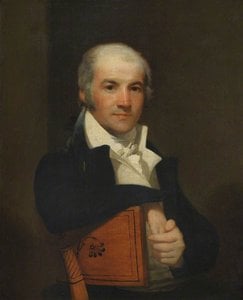
A Portrait of Power and Promise: John Jay by Gilbert Stuart
Gilbert Charles Stuart’s 1794 portrait of John Jay is more than just a likeness; it's a carefully constructed embodiment of the nascent American republic. Housed within the National Gallery of Art in Washington, D.C., this oil on canvas painting transcends mere representation, offering a profound glimpse into the character and ambitions of one of America’s founding fathers. Stuart, already establishing himself as a leading portraitist, masterfully captures Jay's commanding presence – a man simultaneously radiating authority and hinting at the weighty responsibilities he bore in shaping the nation’s future.
The painting immediately draws the eye to Jay’s posture: seated with an air of deliberate composure, his gaze directed downward, seemingly lost in contemplation. This subtle shift in focus – away from direct engagement – speaks volumes about the man himself. Jay was a meticulous and often reserved individual, known for his strategic thinking and cautious approach to governance. Stuart cleverly utilizes this characteristic, suggesting a mind deeply engaged with complex matters of state, yet maintaining an outward sense of dignified restraint. The rich crimson robe, adorned with gold trim, is not merely decorative; it’s a visual declaration of Jay's high office as the first Chief Justice of the United States Supreme Court – a position he held with unwavering dedication for nearly two decades.
The Neoclassical Masterstroke: Technique and Detail
Stuart’s skill is evident in every brushstroke. The painting exemplifies the hallmarks of Neoclassicism, a style deeply rooted in the ideals of ancient Greece and Rome. Notice the meticulous attention to detail – the intricate folds of the robe, the texture of Jay's clothing, the subtle shading that defines his face. Stuart’s use of light is particularly effective, creating a sense of depth and dimensionality that brings the portrait to life. The chiaroscuro technique—the dramatic contrast between light and shadow—highlights Jay’s features, emphasizing his intelligence and gravitas. The artist skillfully employs atmospheric perspective in the background, subtly blurring the details to draw attention to the central figure.
Furthermore, observe how Stuart captures the nuances of Jay's expression. It isn’t a boisterous or overtly enthusiastic portrayal; rather, it’s a quiet confidence, a hint of melancholy, and an underlying sense of duty. This restrained emotionality is characteristic of Neoclassical portraiture, which sought to capture not just physical likeness but also the inner character of the subject.
A Founding Father in Context: John Jay and the American Experiment
To fully appreciate “John Jay,” it’s crucial to understand the historical context in which it was created. The late 1790s were a turbulent period in American history, marked by political divisions between Federalists and Republicans. Jay played a pivotal role as a diplomat during the Revolutionary War and later served as Governor of New York, navigating complex international relations and shaping domestic policy. As Chief Justice, he established many precedents for the Supreme Court, solidifying its authority within the new government.
The portrait itself was commissioned at a time when Jay’s role in securing peace with Great Britain after the war was still fresh in the public's mind. His Treaty of Paris, signed in 1795, averted a potentially devastating conflict and established crucial trade relations between the United States and Great Britain. The painting thus serves as a visual reminder of Jay’s contributions to the nation’s founding and his commitment to preserving its stability.
Symbolism and Enduring Legacy
Beyond its technical brilliance, “John Jay” is rich in symbolism. The seated pose itself conveys authority and wisdom – qualities highly valued in a leader of the new republic. The red robe, signifying judicial office, underscores Jay’s role as a guardian of justice. And the downward gaze suggests a man deeply engaged with the weighty responsibilities of his position. This portrait is not merely a representation of a historical figure; it's an embodiment of the ideals and aspirations of early America – a nation striving to establish itself as a beacon of liberty, justice, and self-governance. Today, reproductions of this iconic work continue to inspire admiration for Jay’s legacy and Stuart’s enduring artistic talent.
Questions et réponses
Où puis-je voir un aperçu de « John Jay » ?
Pour prévisualiser une reproduction de «John Jay» de Gilbert Stuart, ouvrez la page Aperçu de l'œuvre.
Quelle est l'orientation de «John Jay» de Gilbert Stuart ?
Le format de « John Jay » est Format portrait. Cela est utile lors de la planification de l'emplacement d'une reproduction.
Comment le médium et le mouvement se conjuguent-ils dans « John Jay » ?
Dans « John Jay », la technique du Huile sur toile rencontre le mouvement Neoclassical Portraiture.
Quelle est la date de création de «John Jay» de Gilbert Stuart ?
«John Jay» date de 1794. Cette date inscrit l'œuvre dans la carrière de Gilbert Stuart ainsi que dans son époque.
Quel âge avait Gilbert Stuart lors de la création de « John Jay » en 1794 ?
Gilbert Stuart a réalisé « John Jay » à l'âge de 39. L'artiste est né en 1755 et l'œuvre date de 1794.
À quel artiste est attribuée l'œuvre "John Jay" ?
« John Jay » a été créé par Gilbert Stuart. Les informations présentes sur cette page décrivent l'œuvre originale de Gilbert Stuart.
L'image de «John Jay» de Gilbert Stuart peut-elle être librement reproduite ?
Le statut des droits d'auteur pour «John Jay» de Gilbert Stuart : l'œuvre est dans le dans le domaine public - ses droits d'auteur ont expiré. Cela détermine si les reproductions de l'image peuvent être réalisées librement.



 Aperçu en situation
 Passer au format impression
 Partager
 Partager
 Détails
 Guide imprimable

 Télécharger
 Articles similaires
 Radiographie
 Voir le diaporama
 Statistiques


 Afficher la suite






































 L'option verre n'est disponible que pour les dimensions inférieures à 110 cm.