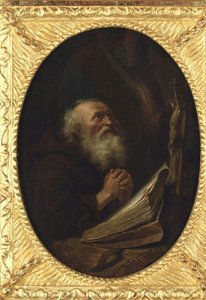
A Glimpse into the Creative Soul: Gerrit Dou's Painter in His Studio
To stand before this depiction of a painter at work is to step directly across the threshold and into the very sanctum of creation. This painting, dating from 1647, offers us an intimate, almost conspiratorial view into the life of an artist during the Dutch Golden Age. It is more than just a portrait; it is a meticulously constructed tableau vivant, a celebration of intellect, craft, and the quiet moments that precede genius. The scene unfolds around a seated figure, absorbed in his work at a desk, surrounded by the tangible evidence of a rich, cultivated mind.
Mastery in Miniature: Technique and Detail
Gerrit Dou, the hand behind this exquisite piece, was renowned for a level of detail that bordered on the microscopic. His technique is characterized by an almost obsessive polish, allowing every object within the frame to contribute to the narrative whole. Observe the scattering of books—each spine suggesting untold stories or volumes of study—and the placement of various implements upon the desk. Dou’s mastery of light, particularly evident in how it catches on the open book before the artist, speaks to his profound understanding of optics and texture. The inclusion of objects like the violin adds a layer of sensory richness; perhaps the painter was not only skilled with pigment but also with melody. This attention to minute detail elevates the work from mere genre scene to a profound study in material culture.
Symbolism of the Workshop
Every element within this studio setting whispers a story of dedication. The scattered books are potent symbols of accumulated knowledge, suggesting that true artistry is built upon a foundation of deep learning. The presence of multiple clocks—one high on the wall and another closer to the center—serves as a subtle memento mori, reminding the viewer that time, while essential for creation, is also fleeting. These objects anchor the scene in a specific moment, yet their accumulation suggests a life lived perpetually between moments of intense focus. The bowl near the corner, likely holding pigments or tools, acts as a quiet promise: the work continues.
Historical Resonance and Emotional Connection
This painting captures the spirit of the fijnschilders, those specialized painters who thrived in the relative intimacy of Dutch life. It speaks to an era that valued bourgeois accomplishment and intellectual pursuits alongside religious devotion. For the modern collector or designer, this piece offers more than mere decoration; it is a conduit to a bygone atmosphere of focused contemplation. To own a reproduction of this work is to invite a sense of ordered creativity into your space—a visual reminder to slow down, to study the details around you, and to honor the quiet labor that underpins all great achievements.



 Aperçu en situation
 Acheter la peinture faite à la main
 Partager
 Partager
 Détails
 Guide imprimable

 Télécharger
 Articles similaires
 Radiographie
 Voir le diaporama
 Statistiques


 Afficher la suite






































 L'option verre n'est disponible que pour les dimensions inférieures à 110 cm.