CONSEIL EN ART GRATUIT

x
Commander la reproduction Commander la reproductionAcheter l'image haute résolution Acheter l'image haute résolution PartagerPartager
DétailsDétails Ajouter aux favoris Ajouter aux favoris TéléchargerTélécharger Articles similairesArticles similaires RadiographieRadiographie DiaporamaDiaporama

Self-portrait

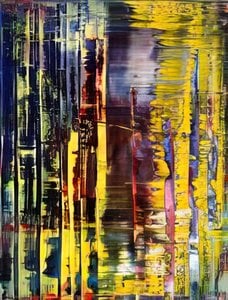
Explore Gerhard Richter's haunting 1996 self-portrait – a blurred, introspective study of identity and uncertainty. This oil on canvas captures the artist’s quiet contemplation, reflecting his complex life and artistic legacy.

Explorez l'art novateur de Gerhard Richter (né en 1932), un artiste allemand de premier plan, connu pour ses peintures abstraites et photorréalistes, 'Réalisme capitaliste', et ses tableaux aux couleurs à grande échelle. Découvrez ses records d'enchères et son influence sur l'art contemporain.

Giclée / Impression d'art

Impression giclée ou sur toile de qualité musée, avec une production rapide et des finitions au choix.

P118B $10
P118H $10
P118W $10
P438Z $10
P508JH $12
P508YH $12
P805H $10
P805Z $10
P919BZ $10
P919G $10
P919XJ $10
P959ZH $10
P968JZ $12
W106C $8
W218G $10
W218JH $8
W218Y $10
W307PJ $10
W316G $10
W316PJ $8
W316Y $10
W398PJ $8
W4111J $10
W500HY $15
W500JH $15
W692G $12
W849H $8
W940BG $15
W953PJ $8

Standard
custom
CM
INCH

Choisissez parmi nos formats prédéfinis qui respectent les proportions originales de l’œuvre.

largeur
hauteur

Vous pouvez saisir vos propres dimensions pour vous adapter à un cadre ou à un espace spécifique. Si la taille sélectionnée ne correspond pas aux proportions de l'image originale, nous recadrerons l'œuvre ou étendrons l'image avec une bordure en miroir ou une couleur unie. Une maquette numérique vous sera envoyée pour approbation avant le début de la production.
Veuillez noter que l'aperçu à l'écran ne reflète pas le recadrage ou l'extension réelle. Seule la maquette montrera avec précision la composition finale.
Bien que des tailles personnalisées soient disponibles, nous vous recommandons de choisir une dimension dans la liste prédéfinie afin de préserver les proportions originales.

Livraison dans le monde entier () en 2 semaines au lieu des 4/5 semaines habituelles. (2 juillet)

why_choose_icon
Livraison express gratuite dans le monde entier
why_choose_icon
Toile de lin de haute qualité
why_choose_icon
Assurance transport complète
why_choose_icon
Garantie de remboursement des frais de douane
why_choose_icon
Garantie de fidélité des couleurs
why_choose_icon
Politique de retour de 60 jours (uniquement en cas de défaut)
why_choose_icon
Garantie de remboursement à 100%
why_choose_icon
Réduction sur les achats groupés

Prix total

-

reproduction

Self-portrait

Giclée / Impression d'art

Format de reproduction

-

Prix total final

-

En bref

  • Dimensions: 51 x 46 cm
  • Artist: Gerhard Richter
  • Subject or theme: Self-reflection
  • Influences: Photography
  • Notable elements: Blurry image
  • Location: MoMA, New York
  • Artistic style: Photorealism/Abstraction

Quiz d'art

Chaque question ne comporte qu'une seule bonne réponse.

Question 1:
What is the primary visual focus of the image depicting Gerhard Richter’s ‘Self-Portrait’?
Question 2:
Based on the description, what is the overall artistic quality conveyed by the image?
Question 3:
Gerhard Richter is known for his work in which of the following styles?
Question 4:
Considering Richter’s biography, which of the following best describes a significant influence on his artistic development?

Description de l'œuvre

Gerhard Richter’s ‘Self-Portrait’: A Study in Uncertainty and Reflection

Gerhard Richter's 1996 self-portrait is not merely a depiction of a man; it’s an embodiment of the anxieties and ambiguities that defined much of his oeuvre. This particular work, rendered in oil on linen and measuring a modest 51 x 46 cm, feels both intensely personal and profoundly detached, mirroring the artist's own complex relationship with representation and memory. The photograph itself – blurry, almost indistinct – immediately establishes an atmosphere of uncertainty. Richter deliberately obscures sharp detail, employing a technique he would later famously refine into his ‘photo-paintings,’ where he layers photographic images onto canvas, manipulating their source material to create works that are simultaneously familiar and unsettling. The subject, a man in a white shirt and tie, appears almost lost within the haze, his eyes holding a serious, contemplative gaze – a gaze that seems to question not just the viewer, but perhaps also himself.

A Life Shaped by Division: Contextualizing Richter’s Early Years

To fully appreciate this self-portrait, it's crucial to understand the formative experiences that shaped Gerhard Richter’s artistic vision. Born in Dresden in 1932, his childhood unfolded during a period of immense upheaval – the rise of Nazism and subsequent displacement. His family moved repeatedly throughout the war years, an experience that instilled within him a deep-seated sense of instability and a questioning spirit. This early exposure to political turmoil and social disruption profoundly influenced his later work, often characterized by a deliberate ambiguity and a refusal to offer definitive answers. Richter’s father, a schoolteacher navigating the complexities of life under authoritarian rule, and his mother, fostering a love for literature and music within their home, created a duality – a pragmatic acceptance of circumstance alongside a yearning for cultural expression—a tension that would become a recurring theme in his art. The landscapes of Reichenau and Waltersdorf, initially idyllic, were irrevocably altered by conflict, leaving an indelible mark on his psyche.

Technique and the Illusion of Reality: Richter’s ‘Photo-Paintings’

Richter's approach to painting is notoriously complex. He doesn’t simply replicate what he sees; instead, he engages in a process of layering and manipulation. This self-portrait exemplifies his signature technique – the ‘photo-painting.’ He begins with photographic images, often sourced from newspapers or magazines, which he then applies to canvas using thin layers of oil paint. The resulting surface is not smooth and polished but rather textured and fragmented, creating an illusion of reality that is simultaneously present and absent. The blur in this particular portrait isn’t a flaw; it's a deliberate choice, intensifying the sense of detachment and inviting the viewer to actively participate in constructing meaning. The subtle shifts in color and tone suggest movement and change, mirroring the instability inherent in memory and experience.

Symbolism and Emotional Resonance: A Portrait of Contemplation

While Richter’s work often resists straightforward interpretation, this self-portrait offers a glimpse into the artist's internal landscape. The man’s serious expression suggests introspection and perhaps even melancholy. The blurred features contribute to a sense of anonymity, transforming the portrait from a simple likeness into a meditation on identity and perception. It’s not a triumphant declaration of self but rather a quiet acknowledgment of one’s place within the world – a recognition of uncertainty and the difficulty of capturing a definitive truth. The photograph's lack of background further emphasizes this feeling of isolation, drawing all attention to the subject himself. Ultimately, Richter’s ‘Self-Portrait’ is a powerful reminder that art can be more than just representation; it can be an exploration of the complexities of human experience and the elusive nature of reality.

Further Information: Explore Gerhard Richter's work at The Metropolitan Museum of Art or delve deeper into his artistic journey on Wikipedia.

Œuvres apparentées


Biographie de l'artiste

**Jeunesse et Éducation**

Gerhard Richter, artiste visuel allemand renommé, est né le 9 février 1932 à l'hôpital de Dresde-Neustadt, à Dresde, en Saxe. Il a grandi à Reichenau, Basse Silésie (aujourd’hui Bogatynia, Pologne), et à Waltersdorf (Zittauer Gebirge), dans la campagne supérieure de Lusace. Le père de Richter, Horst Richter, était étudiant en mathématiques et en physique à l'Technische Hochschule de Dresde.

**Carrière artistique**

Richter a commencé son parcours artistique comme apprenti peintre décorateur et a ensuite étudié à l’Académie des Beaux-Arts de Dresde. Ses premières œuvres ont été influencées par les styles de Picasso et Jean Arp, ce qui est évident dans ses peintures abstraites et photoréalistes. En 1957, Richter a travaillé comme stagiaire maître à l'académie, réalisant des commandes pour l'époque de la République Démocratique allemande de l’Est.

**Œuvres notables et réalisations**

* Abstrait (2012) a établi un prix de vente aux enchères record pour une peinture d'un artiste vivant à 34 millions de dollars (£21 million). * Domplatz, Mailand (Place de la cathédrale, Milan) (1968) a été vendu pour 37,1 millions de dollars (£24,4 million) à New York. * Abstrait (2015) a été vendu pour 44,52 millions de dollars (£30,4 million) lors de la vente aux enchères contemporaine de Sotheby's.

**Style et mouvement artistique**

Le travail de Richter est caractérisé par son éclectisme, combinant des styles abstraits et photoréalistes. Avec Sigmar Polke, il a introduit le terme Kapitalistischer Realismus (Réalisme capitaliste), un anti-style d'art qui s'approprie le langage pictural de la publicité.

**Vie personnelle**

Richter a épousé Marianne Eufinger en 1957 et a eu une fille. Il a plus tard épousé Isa Genzken en 1982 et Sabine Moritz en 1995, avec qui il a eu deux fils et une fille. **Note :** Cet article est basé sur les informations fournies et peut ne pas être une biographie complète. Pour plus d’informations détaillées, veuillez consulter les sources liées.
Gerhard Richter

Gerhard Richter

1932 - , Allemagne

En bref

  • Artistes Influents:
    • Picasso
    • Jean Arp
  • Date De Naissance: 9 février 1932
  • Lieu De Naissance: Dresde, Allemagne
  • Mouvement Artistique:
    • Abstraction
    • Photoréalisme
  • Nationalité: Allemand
  • Nom Complet: Gerhard Richter
  • Oeuvres Notables:
    • Abstraktes Bild (2012)
    • Domplatz, Milan (1968)
    • Nuages
    • S. avec enfant
  • Style Artistique: Réalisme capitaliste
Explorez des œuvres d'art classées par thèmes, styles et caractéristiques.