A Symphony of Shadow and Light
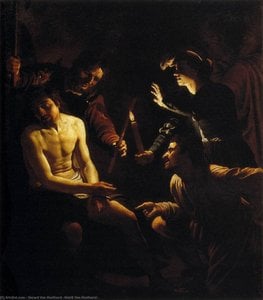
In the quiet, amber-hued depths of the Dutch Golden Age, few works capture the visceral tension between intimacy and drama as profoundly as Gerard van Honthorst’s “The Concert.” This masterpiece serves as a breathtaking window into a world where music is not merely heard, but felt through the very texture of light. As one of the most celebrated practitioners of the Utrecht Caravaggisti style, Honthorst earned the evocative moniker “Gherardo delle Notti”—Gerard of the Nights—a title that perfectly encapsulates his ability to conjure life from the impenetrable darkness. In this particular scene, the artist invites us into a dimly lit chamber, where the soft glow of unseen candlelight dances across scarlet drapery and illuminates a gathering of musicians caught in a moment of profound musical engagement.
The composition is a masterclass in tenebrism, a technique borrowed from the revolutionary Caravaggio. By juxtaposing intense, concentrated light against deep, swallowing shadows, Honthorost creates a sense of three-dimensional weight that pulls the viewer directly into the room. The eye is immediately drawn to the central figures: a woman seated gracefully on a bench, her hands poised with a violin, accompanied by companions whose faces emerge from the gloom like memories surfacing from sleep. There is a palpable sense of movement and rhythm in the way the light catches the curve of an instrument or the fold of a sleeve, transforming a static portrait into a living, breathing performance.
The Soul of the Dutch Golden Age
Beyond its technical brilliance, “The Concert” is steeped in the historical anxieties and cultural richness of the 17th-century Netherlands. Unlike the idealized, polished portraits common in other eras, Honthorst embraced a gritty, tactile realism. He eschewed perfection in favor of truth, capturing the textures of fabric, the sheen of wood, and the subtle expressions of human emotion. This dedication to realism allowed him to mirror the complexities of his era—a time of great prosperity but also profound uncertainty. The presence of the scarlet curtains adds a layer of theatrical grandeur, suggesting that this musical gathering is both a private sanctuary and a staged spectacle of high culture.
For the discerning collector or interior designer, this painting offers more than just aesthetic beauty; it provides an emotional anchor for a space. The interplay of warm tones and deep shadows makes it an ideal centerpiece for rooms designed to evoke intimacy, sophistication, and contemplation. Whether placed in a contemporary gallery setting or a classic study, the artwork commands attention through its silent narrative. It is a piece that does not merely decorate a wall but transforms an environment, inviting guests to linger in the glow of its historical mystery and to find their own rhythm within its beautifully orchestrated shadows.



 Aperçu en situation
 Acheter la peinture faite à la main
 Partager
 Partager
 Détails
 Guide
Guide

 Télécharger
 Articles similaires
 Radiographie
 Voir le diaporama
 Statistiques

 Afficher la suite






































 L'option verre n'est disponible que pour les dimensions inférieures à 110 cm.