Aperçu en situation Aperçu en RA Acheter la peinture faite à la main Passer au format image numérique Partager
Détails Guide Ajouter aux favoris Télécharger Articles similaires Radiographie Voir le diaporama Statistiques

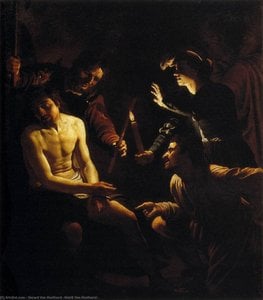
Christ Crowned with Thorns, Gerard van Honthorst, c. 1622

Discover Gerard van Honthorst’s dramatic ‘Christ Crowned with Thorns,’ a Baroque masterpiece showcasing intense light & emotion. Explore its Caravaggist style & historical significance.

Découvrez Gerard van Honthorst (1590-1656), maître de l'âge d'or néerlandais & figure clé du caravagisme utrechtien ! Portraits, scènes bibliques & son influence baroque.

Giclées et impressions d'art

Impressions giclées ou sur toile de qualité musée, avec une production rapide et des finitions au choix. ( Acheter la peinture faite à la main Passer au format image numérique)

P118B $10
P118H $10
P118W $10
P438Z $10
P508JH $12
P508YH $12
P805H $10
P805Z $10
P919BZ $10
P919G $10
P919XJ $10
P959ZH $10
P968JZ $12
W106C $8
W218G $10
W218JH $8
W218Y $10
W307PJ $10
W316G $10
W316PJ $8
W316Y $10
W398PJ $8
W4111J $10
W500HY $15
W500JH $15
W692G $12
W849H $8
W940BG $15
W953PJ $8

Format standard
personnalisé
CM
INCH

Choisissez parmi nos formats prédéfinis qui respectent les proportions originales de l’œuvre.

largeur
hauteur

Vous pouvez saisir vos propres dimensions pour vous adapter à un cadre ou à un espace spécifique. Si la taille sélectionnée ne correspond pas aux proportions de l'image originale, nous recadrerons l'œuvre ou étendrons l'image avec une bordure en miroir ou une couleur unie. Une maquette numérique vous sera envoyée pour approbation avant le début de la production.
Veuillez noter que l'aperçu à l'écran ne reflète pas le recadrage ou l'extension réelle. Seule la maquette montrera avec précision la composition finale.
Bien que des tailles personnalisées soient disponibles, nous vous recommandons de choisir une dimension dans la liste prédéfinie afin de préserver les proportions originales.

Livraison dans le monde entier () en 2 semaines au lieu des 4/5 semaines habituelles. (22 septembre)

why_choose_icon
Livraison express gratuite dans le monde entier
why_choose_icon
Toile de lin de haute qualité
why_choose_icon
Assurance transport complète
why_choose_icon
Garantie de remboursement des droits de douane
why_choose_icon
Garantie de fidélité des couleurs
why_choose_icon
Garantie de retour de 100 jours (uniquement en cas de défaut)
why_choose_icon
Garantie de remboursement à 100%
why_choose_icon
Tarifs dégressifs sur quantité

Prix total

$ 68

reproduction

Christ Crowned with Thorns, Gerard van Honthorst, c. 1622

Giclées et impressions d'art

Format de la reproduction

-

Prix total final

$ 68

L'essentiel de l'œuvre

  • Title: The Starry Night
  • Medium: Oil on Canvas
  • Influences: Japanese prints
  • Year: 1889
  • Dimensions: 73.7 × 54.6 cm
  • Artistic style: Expressionist
  • Notable elements or techniques: Impasto technique; Use of complementary colors (yellow and blue)

Quiz d'art

Chaque question ne comporte qu'une seule bonne réponse.

Question 1:
What is the title of this painting?
Question 2:
Which artist created this masterpiece?
Question 3:
Approximately when was this painting executed?
Question 4:
What artistic technique is prominently used in this artwork?
Question 5:
The painting depicts a scene related to which religious tradition?

A Symphony in Crimson and Gold: Exploring “The Astronomer” by Johannes Vermeer

Johannes Vermeer’s “The Astronomer,” completed around 1668, transcends mere portraiture; it's a masterful distillation of Baroque aesthetics and intellectual curiosity. Painted during the Dutch Golden Age, this captivating artwork captures a moment frozen in time – a scholar engrossed in observing the celestial heavens through a meticulously crafted brass telescope.

Composition and Technique: Vermeer’s Baroque Brilliance

Vermeer's genius lies in his ability to create an illusion of depth within a relatively confined space. The painting employs a pyramidal composition, anchoring the gaze on the astronomer’s head and subtly guiding it downwards towards the telescope and its surroundings. Light plays a crucial role, emanating from a window positioned high on the left wall, illuminating the astronomer's face and casting dramatic shadows across the room.

Vermeer’s technique is characterized by meticulous layering of thin glazes – a hallmark of Baroque painting – allowing for unparalleled luminosity and tonal subtlety. He skillfully captures the textures of fabric (the astronomer’s robe), brass, and wood, demonstrating an astonishing level of realism. Vermeer's masterful use of chiaroscuro enhances the drama and emphasizes the contemplative mood of the scene.

Historical Context: Scientific Inquiry Meets Artistic Expression

“The Astronomer” reflects the burgeoning interest in scientific observation during the seventeenth century. The telescope, a relatively new invention at the time, represented a significant advancement in understanding the cosmos. Vermeer’s depiction wasn't merely aesthetically pleasing; it served as a commentary on the intellectual pursuits of his era.

However, Vermeer skillfully avoids didacticism, prioritizing artistic beauty over explicit instruction. The astronomer’s gaze is directed outwards, symbolizing contemplation and wonder—a reflection of the humanist values prevalent in Dutch society during this period.

Symbolism: Light, Knowledge, and Inner Reflection

The prominent window and its radiant light symbolize enlightenment and divine illumination – concepts central to Baroque spirituality. The telescope itself represents intellectual curiosity and the pursuit of knowledge. Furthermore, the astronomer’s posture conveys a sense of introspection and inner reflection, inviting viewers to contemplate their own place in relation to the universe.

The muted colors—primarily browns, golds, and reds—contribute to the painting's solemn atmosphere. Vermeer’s careful attention to detail underscores the importance of observation and contemplation – themes that resonate powerfully with audiences today.

Emotional Impact: Capturing a Moment of Serenity

"The Astronomer" evokes a profound sense of tranquility and intellectual engagement. It invites viewers to pause and consider the beauty of simplicity, mirroring Vermeer’s own artistic philosophy. The painting's enduring appeal lies in its ability to capture a fleeting moment of contemplative serenity—a testament to Vermeer’s unparalleled skill as an artist and his contribution to the legacy of Baroque art.


Biographie de l'artiste

Première jeunesse et formation

Gérard van Honthorst, peintre néerlandais important de l'âge d'or néerlandais, est né le 4 novembre 1590 à Utrecht. Il était le fils d’un peintre décorateur et a initialement été formé sous la direction de son père. Plus tard, il a poursuivi sa formation artistique sous Abraham Bloemaert.

Carrière et influences

La carrière précoce de van Honthorst a impliqué une visite à Rome, où il a été fortement influencé par le style de Caravage. Cette influence se manifeste dans ses œuvres ultérieures, en particulier dans son utilisation de scènes éclairées artificiellement, ce qui lui a valu le surnom de « Gherardo delle Notti » ou « Gérard des nuits ». À son retour aux Pays-Bas, van Honthorst est devenu un peintre portraitiste de premier plan.

Commandes notables et mécénat

Le travail de van Honthorst était très demandé, avec des mécènes notables tels que Vincenzo Giustiniani, qui l’a chargé de peindre « Christ devant le grand prêtre », exposé à la National Gallery de Londres. Il a également travaillé pour Cosme II de Médicis, grand-duc de Toscane, et était un favori auprès de la République néerlandaise et à l’étranger.

Héritage et vie ultérieure

En 1620, van Honthorst est retourné à Utrecht, où il a bâti une réputation considérable. En 1623, année de son mariage, il était devenu président de la guilde Saint-Luc d’Utrecht. Son succès a conduit à des recommandations par Sir Dudley Carleton pour l'Earl of Arundel et Lord Dorchester.

Œuvres clés et collaborations

  • La prise du Christ, une œuvre collaborative initialement attribuée à van Honthorst, aujourd'hui reconnue comme l’œuvre d’un autre artiste.
  • Christ devant le grand prêtre, commandée par Vincenzo Giustiniani, met en valeur la capacité de van Honthorst à capturer des scènes éclairées artificiellement.
  • Des collaborations avec d’autres artistes, tels que Peter Paul Rubens, démontrent son influence sur le style baroque flamand.

Mouvement artistique et style

Van Honthorst faisait partie du mouvement des Utrecht Caravaggistes, caractérisé par l’utilisation d’un éclairage dramatique et d’une profondeur émotionnelle intense. Son travail reflète l’influence de la baroque italienne, tout en contribuant au développement de l'âge d'or néerlandais. Principaux liens :
Gérard van Honthorst

Gérard van Honthorst

1590 - 1656 , Pays-Bas

En bref

  • Artistic Movement Or Style: Caravagisme d'Utrecht, Baroque
  • Artists Or Movements Influenced By This Artist:
    • Rembrandt van Rijn
    • Georges de la Tour
  • Artists Who Influenced This Artist:
    • Caravage
    • Abraham Bloemaert
  • Date Of Birth: 4 novembre 1590
  • Date Of Death: 27 avril 1656
  • Full Name: Gérard van Honthorst
  • Nationality: Néerlandais
  • Notable Artworks:
    • Christ avant le grand prêtre
    • La Prise du Christ
  • Place Of Birth (City And Country): Utrecht, Pays-Bas
Explorez des œuvres d'art classées par thèmes, styles et caractéristiques.