Aperçu en situationAperçu en situation Visualiser en RAVisualiser en RA Passer au format impression Passer au format impressionPasser à l'image numérique Passer à l'image numérique EnvoyerEnvoyer
Détails de l'œuvreDétails de l'œuvre Ajouter aux favoris Ajouter aux favoris TéléchargerTélécharger Articles similairesArticles similaires RadiographieRadiographie DiaporamaDiaporama StatistiquesStatistiques

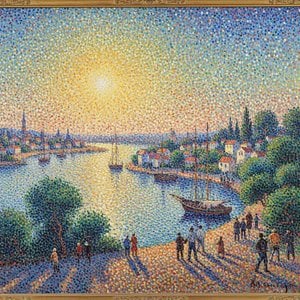
untitled (4615)

Witness Georges Seurat's revolutionary Pointillism in 'Bathers at Asnières'! This iconic Neo-Impressionist masterpiece, meticulously crafted with tiny dots of color, captures a Parisian afternoon with unparalleled precision and light. A must-see for art lovers!

Découvrez Georges Seurat (1859-1891), pionnier du Pointillisme ! Explorez 'Un dimanche à La Grande Jatte' et sa théorie révolutionnaire des couleurs. Achetez des reproductions peintes à la main !

Reproduction à l'huile faite à la main

Huile sur toile peinte à la main, avec cadre et dimensions personnalisés, réalisée sur commande par nos artistes. (Passer au format impression Passer au format impressionPasser à l'image numérique Passer à l'image numérique)

P118B $10
P118H $10
P118W $10
P438Z $10
P508JH $12
P508YH $12
P805H $10
P805Z $10
P919BZ $10
P919G $10
P919XJ $10
P959ZH $10
P968JZ $12
W106C $8
W218G $10
W218JH $8
W218Y $10
W307PJ $10
W316G $10
W316PJ $8
W316Y $10
W398PJ $8
W4111J $10
W500HY $15
W500JH $15
W692G $12
W849H $8
W940BG $15
W953PJ $8

Format standard
sur mesure
CM
INCH

Choisissez parmi nos formats prédéfinis qui respectent les proportions originales de l’œuvre.

largeur
hauteur

Vous pouvez saisir vos propres dimensions pour l'adapter à un cadre ou à un espace spécifique. Si la taille sélectionnée ne correspond pas aux proportions de l'image d'origine, nous recadrerons l'œuvre ou prolongerons la peinture avec des éléments peints à la main supplémentaires. Une maquette numérique vous sera envoyée pour approbation avant le début de la production.
Veuillez noter que l'aperçu à l'écran ne reflète pas le recadrage ou l'extension réels. Seule la maquette montrera fidèlement la composition finale.
Bien que des tailles personnalisées soient disponibles, nous vous recommandons de sélectionner une dimension dans la liste prédéfinie afin de préserver les proportions d'origine.

Exemples de personnalisation possibles : remplacer un visage par la photo du client ; ajouter un animal de compagnie (par exemple, remplacer un chat par un chien) ; inclure un message caché en arrière-plan ; modifier le paysage ou les éléments de l'arrière-plan.
Après la commande, l’équipe WahooArt.com contactera le client par e-mail pour recueillir ses instructions et lui fournira une maquette d’aperçu

Livraison dans le monde entier () en 3 à 4 semaines au lieu des 5 semaines habituelles. (9 septembre). Aucun compromis sur la qualité.

why_choose_icon
Livraison express gratuite dans le monde entier
why_choose_icon
Toile de lin de qualité supérieure
why_choose_icon
Assurance transport complète
why_choose_icon
Garantie de remboursement des droits de douane
why_choose_icon
Garantie de fidélité des couleurs
why_choose_icon
Politique de retour de 100 jours (uniquement en cas de défaut)
why_choose_icon
Garantie de remboursement à 100%
why_choose_icon
Offre de tarifs dégressifs

Prix total

$ 272

reproduction

untitled (4615)

Technique de reproduction

Format de la reproduction

-

Prix total

$ 272

Informations clés

  • Artist: Georges Seurat
  • Subject or theme: Modern life, leisure
  • Medium: Oil on canvas
  • Influences:
    • Impressionism
    • Delacroix
  • Artistic style: Neo-Impressionism
  • Notable elements or techniques: Pointillism
  • Year: 1884–1886

Quiz d'art

Chaque question ne comporte qu'une seule bonne réponse.

Question 1:
What artistic technique is most prominently displayed in the painting "untitled (4615)"?
Question 2:
The description mentions the painting utilizes a ‘post-impressionist style’. What does this generally indicate about its approach?
Question 3:
According to the description, what is a key characteristic of the painting’s visual effect?
Question 4:
Georges Seurat is best known for his pioneering work in which artistic movement?
Question 5:
The description highlights the meticulous detail of the painting. What does this suggest about Seurat’s artistic process?

Georges Seurat’s *A Sunday Afternoon on the Island of La Grande Jatte* – A Symphony of Light and Modernity

Georges Pierre Seurat's *A Sunday Afternoon on the Island of La Grande Jatte*, completed between 1884 and 1886, stands as a monumental achievement not just within Impressionism, but as a foundational work of modern art. More than simply a depiction of a Parisian leisure scene, it’s a meticulously constructed meditation on time, modernity, and the evolving relationship between humanity and its environment – a theme that continues to resonate powerfully today. The painting's scale alone—a colossal 17 feet by 25 feet—immediately commands attention, drawing the viewer into a world of carefully orchestrated observation and scientific precision.

  • The Technique: Pointillism Seurat’s revolutionary technique, known as Pointillism or Divisionism, is the very heart of this masterpiece. Rather than blending colors directly on the canvas, he applied tiny dots of pure color – meticulously calculated to create optical mixtures when viewed from a distance. This method, inspired by scientific theories of optics and championed by Seurat himself, aimed to capture the fleeting effects of light and atmosphere with unprecedented accuracy.
  • Color Theory The painting’s palette is remarkably restrained, dominated by blues, greens, ochres, and browns – colors that evoke the hazy summer afternoon and the industrial landscape surrounding La Grande Jatte. Seurat's understanding of color theory was exceptional; he used complementary colors strategically to heighten visual impact and create a sense of shimmering light.
  • Composition The composition is carefully balanced, with figures arranged in shallow depth planes, creating an illusion of space that’s both realistic and stylized. The diagonal lines of the boats and the receding shoreline draw the viewer's eye into the scene, while the central grouping of figures anchors the composition.

A Reflection on Modern Life

Painted during a period of rapid industrialization and social change in Paris, *A Sunday Afternoon* offers a complex commentary on the burgeoning modern world. The island itself was a popular leisure spot for Parisians escaping the city’s bustle, but Seurat presents a scene that feels strangely detached from everyday life. The figures are posed awkwardly, seemingly unaware of each other, and their activities – boating, sunbathing, picnicking – feel almost ritualistic. This detachment reflects the growing alienation and anonymity experienced by individuals in an increasingly urbanized society.

Symbolism: Some scholars interpret the painting as a critique of bourgeois leisure, suggesting that the figures’ detached behavior represents a superficial enjoyment of wealth and status. The industrial backdrop – the factory chimneys and the boats powered by steam – subtly underscores the impact of technology on human life. The painting's stillness is also significant; it captures a moment frozen in time, reflecting the anxieties surrounding the relentless march of progress.

Historical Context & Seurat’s Vision

Seurat was deeply influenced by scientific advancements of the late 19th century, particularly those related to optics and color theory. He studied the work of Eugène Delacroix, but rejected his expressive brushwork in favor of a more objective approach. His ambition was not simply to paint what he saw, but to capture the *impression* of light and atmosphere with scientific rigor. This pursuit led him to develop Pointillism as a revolutionary technique that would transform the course of modern art.

Neo-Impressionism: Seurat’s work is considered a cornerstone of Neo-Impressionism, an artistic movement that emerged in response to Impressionism. While Impressionists focused on capturing fleeting moments of light and color, Neo-Impressionists, led by Seurat and Paul Signac, employed scientific principles to create works with a more structured and systematic approach. *A Sunday Afternoon* is arguably the most significant example of this movement.

Emotional Impact & Legacy

Despite its intellectual rigor, *A Sunday Afternoon on the Island of La Grande Jatte* possesses a profound emotional impact. The painting’s scale, combined with Seurat's masterful use of color and light, creates a sense of immersive beauty that draws the viewer into the scene. It is a work that invites contemplation – about time, modernity, human connection, and the enduring power of art to capture the essence of our experience.


Biographie de l'artiste

Georges Seurat : Pionnier du Néo-Impressionnisme

Jeunesse et Formation

  • Né le: 2 décembre 1859 à Paris, en France.
  • La famille de Seurat s'est installée sur le Boulevard de Magenta peu après sa naissance.
  • Son père, Antoine Chrysostome Seurat, était un ancien fonctionnaire juridique devenu riche grâce à la spéculation immobilière.
  • Il a commencé ses études artistiques à l’École Municipale de Sculpture et Dessin, près de chez lui, sous la direction du sculpteur Justin Lequien.
  • En 1878, il s'est inscrit à l’illustre École des Beaux-Arts, où il a étudié auprès d'Henri Lehmann.

Développement Artistique et Influences

  • La personnalité artistique de Seurat était un mélange unique de sensibilité et d’abstraction logique. Il combinait une délicate sensibilité avec une précision mathématique.
  • Influences: Bien que les influences spécifiques soient débattues, il a étudié les théories des couleurs de scientifiques tels que Michel Eugène Chevreul et Ogden Rood.
  • Il a initialement expérimenté avec des techniques de dessin traditionnelles avant de développer son style caractéristique.
  • Ses premières œuvres montrent un intérêt pour la peinture académique, mais se sont progressivement orientées vers une approche plus innovante.

Chromoluminarisme et Pointillisme

  • Seurat a inventé les techniques du chromoluminarisme (la science de la couleur) et du pointillisme, appliquant de petites touches distinctes de couleurs pures à une toile.
  • Il utilisait le crayon Conté pour des dessins détaillés sur papier à surface rugueuse dans le cadre de son processus.
  • Objectif du Pointillisme: L'idée était que l’œil du spectateur mélangerait ces couleurs optiquement, créant un effet vibrant et lumineux.

Réalisations Majeures et Œuvres Notables

  • Un Dimanche après-midi à l’Île de la Grande Jatte (1884-1886): Son œuvre la plus célèbre, marquant le début du Néo-Impressionnisme. Elle illustre sa technique pointilliste et son approche méticuleuse.
  • Alfalfa, Saint-Denis (1886-1887): Démontre son application de la théorie des couleurs à un paysage rural.
  • Paysage à Saint-Ouen (1882-1883): Un exemple précoce montrant son style évolutif et son intérêt pour la lumière et l’atmosphère.
  • La Tour Eiffel (1889): Une représentation du célèbre monument parisien, réalisée à l'aide de techniques pointillistes.
  • Les Baigneurs d’Asnières (1884): Une autre œuvre significative explorant le loisir et la vie moderne avec son style distinctif.

Signification Historique et Héritage

  • Le travail de Seurat a profondément influencé le développement de l’art moderne, en particulier par son accent sur l’expression subjective et l’exploration de nouvelles techniques.
  • A ouvert la voie: Il a ouvert la voie aux mouvements tels que le Fauvisme, le Cubisme et l’Expressionnisme abstrait.
  • Son approche scientifique de la peinture a défié les conventions artistiques traditionnelles.
  • Malgré sa courte vie (il est décédé à l'âge de 31 ans), Seurat a laissé une marque indélébile sur l’histoire de l’art, inspirant des générations d'artistes avec sa vision novatrice.
Georges Pierre Seurat

Georges Pierre Seurat

1859 - 1891 , France

L'essentiel de l'artiste

  • Artistic Movement Or Style: Néo-impressionnisme, Pointillisme
  • Artists Or Movements Influenced By This Artist:
    • Fauvisme
    • Cubisme
    • Expressionnisme abstrait
  • Artists Who Influenced This Artist:
    • Michel Eugène Chevreul
    • Ogden Rood
  • Date Of Birth: 2 décembre 1859
  • Full Name: Georges Pierre Seurat
  • Nationality: Français
  • Notable Artworks:
    • Un dimanche à La Grande Jatte
    • Baigneurs d'Asnières
    • La Tour Eiffel
  • Place Of Birth (City And Country): Paris, France
Explorez des œuvres d'art classées par thèmes, styles et caractéristiques.