Georges Pierre Seurat’s “Trees, Winter”: A Symphony of Light and Precision
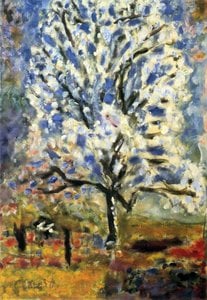
“Trees, Winter,” painted in 1883 by Georges Pierre Seurat stands as a cornerstone of Post-Impressionism—a movement that irrevocably altered the course of artistic expression. More than just a depiction of a snowy forest landscape, this artwork embodies Seurat’s groundbreaking approach to painting: Pointillism, a method rooted in scientific observation and driven by an unwavering desire to capture the essence of visual perception.
Seurat's journey toward artistic innovation began amidst the intellectual ferment of Parisian life. Born in 1859, he benefited from a privileged upbringing fostered by his father’s legal profession and subsequent foray into property speculation—allowing him access to formative art education. Early influences included Impressionism, particularly Monet and Renoir, yet Seurat swiftly recognized limitations within Impressionistic techniques, prioritizing instead the pursuit of optical accuracy.
The Science Behind Brilliance: Pointillist Technique
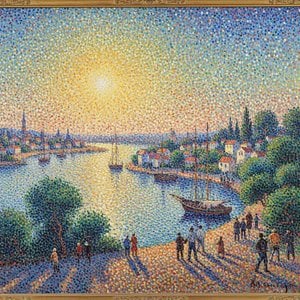
Unlike Impressionists who blended colors on canvas to create an illusion of luminosity, Seurat meticulously applied tiny dots of pure pigment—primarily complementary hues—onto the surface. This seemingly simple technique demanded exhaustive mathematical calculations and a profound understanding of color theory. Seurat’s meticulous process aimed to stimulate retinal cells, triggering a phenomenon known as chromoluminarism – essentially recreating the way light interacts with surfaces to produce color perception.
- Mathematical Precision: Seurat employed hexagonal grids overlaid on his canvas to ensure consistent spacing and distribution of pigment dots.
- Complementary Color Harmony: The artist skillfully utilized complementary colors—such as yellow and violet—to maximize visual impact and create a vibrant, balanced composition.
- Optical Mixing: Rather than blending pigments physically, Seurat relied on the eye’s ability to fuse adjacent dots of color, resulting in an astonishingly luminous effect.
A Landscape Steeped in Symbolism
"Trees, Winter" transcends mere topographical representation; it speaks to themes of solitude and contemplation amidst the austere beauty of nature. The stark white snow serves as a canvas for Seurat’s masterful rendering of bare branches—a visual metaphor for resilience and enduring strength during periods of dormancy. Furthermore, the muted earth tones contribute to an atmosphere of quiet introspection, inviting viewers to pause and appreciate the subtle nuances of winter light.
Emotional Resonance: Capturing Atmosphere
Despite its seemingly objective depiction, “Trees, Winter” possesses a palpable emotional depth. Seurat’s unwavering dedication to scientific rigor—combined with his sensitivity to color and texture—creates an artwork that resonates with viewers on a visceral level. It's a testament to the artist’s ability to transform observation into profound artistic expression, securing its place as a timeless masterpiece of Post-Impressionism.



 Aperçu en situation
 Commander la reproduction peinte à la main
 Envoyer
 Partager
 Détails de l'œuvre

 Télécharger
 Articles similaires
 Radiographie
 Diaporama
 Stats
Stats


 Lire la suite






































 L'option verre n'est disponible que pour les dimensions inférieures à 110 cm.