Aperçu en situationAperçu en situation Aperçu en RAAperçu en RA Passer au format impression Passer au format impressionPasser au format image numérique Passer au format image numérique PartagerPartager
DétailsDétails Ajouter aux favoris Ajouter aux favoris TéléchargerTélécharger Articles similairesArticles similaires RadiographieRadiographie Voir le diaporamaVoir le diaporama StatistiquesStatistiques

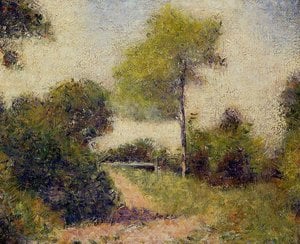
Barbizon Forest

A Pioneer of Luminous Precision: The Life and Art of Georges Seurat Georges Pierre Seurat (1859-1891) revolutionized painting with his pioneering use of Pointillism, influenced by scientific theories on color perception. His artistic vision sought to capture the fleeting effects of light and atmosphere—a legacy that continues to inspire artists today.

Découvrez Georges Seurat (1859-1891), pionnier du Pointillisme ! Explorez 'Un dimanche à La Grande Jatte' et sa théorie révolutionnaire des couleurs. Achetez des reproductions peintes à la main !

Reproduction à l'huile faite à la main

Huile sur toile peinte à la main, avec cadre et dimensions personnalisés, réalisée sur commande par nos artistes. (Passer au format impression Passer au format impressionPasser au format image numérique Passer au format image numérique)

P118B $10
P118H $10
P118W $10
P438Z $10
P508JH $12
P508YH $12
P805H $10
P805Z $10
P919BZ $10
P919G $10
P919XJ $10
P959ZH $10
P968JZ $12
W106C $8
W218G $10
W218JH $8
W218Y $10
W307PJ $10
W316G $10
W316PJ $8
W316Y $10
W398PJ $8
W4111J $10
W500HY $15
W500JH $15
W692G $12
W849H $8
W940BG $15
W953PJ $8

Format standard
personnalisé
CM
INCH

Choisissez parmi nos formats prédéfinis qui respectent les proportions originales de l’œuvre.

largeur
hauteur

Vous pouvez saisir vos propres dimensions pour l'adapter à un cadre ou à un espace spécifique. Si la taille sélectionnée ne correspond pas aux proportions de l'image d'origine, nous recadrerons l'œuvre ou prolongerons la peinture avec des éléments peints à la main supplémentaires. Une maquette numérique vous sera envoyée pour approbation avant le début de la production.
Veuillez noter que l'aperçu à l'écran ne reflète pas le recadrage ou l'extension réels. Seule la maquette montrera fidèlement la composition finale.
Bien que des tailles personnalisées soient disponibles, nous vous recommandons de sélectionner une dimension dans la liste prédéfinie afin de préserver les proportions d'origine.

Exemples de personnalisation possibles : remplacer un visage par la photo du client ; ajouter un animal de compagnie (par exemple, remplacer un chat par un chien) ; inclure un message caché en arrière-plan ; modifier le paysage ou les éléments de l'arrière-plan.
Après la commande, l’équipe WahooArt.com contactera le client par e-mail pour recueillir ses instructions et lui fournira une maquette d’aperçu

Livraison dans le monde entier () en 3 à 4 semaines au lieu des 5 semaines habituelles. (14 septembre). Aucun compromis sur la qualité.

why_choose_icon
Livraison express gratuite dans le monde entier
why_choose_icon
Toile de lin de haute qualité
why_choose_icon
Assurance transport complète
why_choose_icon
Garantie de remboursement des droits de douane
why_choose_icon
Garantie de fidélité des couleurs
why_choose_icon
Garantie de retour de 100 jours (uniquement en cas de défaut)
why_choose_icon
Garantie de remboursement à 100%
why_choose_icon
Tarifs dégressifs sur quantité

Prix total

$ 272

reproduction

Barbizon Forest

Technique de reproduction

Format de la reproduction

-

Prix total final

$ 272

L'essentiel de l'œuvre

  • Artist: Georges Pierre Seurat
  • Notable elements or techniques: Pointillist technique
  • Movement: Neo-Impressionism
  • Year: 1883
  • Location: Private Collection
  • Medium: Oil on canvas
  • Title: Forest of Barbizon

Quiz d'art

Chaque question ne comporte qu'une seule bonne réponse.

Question 1:
What artistic movement is Georges Seurat’s ‘Forest of Barbizon’ primarily associated with?
Question 2:
The painting utilizes a technique known as Pointillism. What is the core principle behind this method?
Question 3:
According to the description, what prominent element contributes to the overall atmosphere of ‘Forest of Barbizon’?
Question 4:
What influenced Seurat's approach to color and light, shaping his artistic vision?
Question 5:
The painting depicts a scene from the Barbizon School. What is characteristic of this artistic movement?

A Symphony of Light and Color: The Luminous World of Seurat

To stand before Georges Seurat’s Forest of Barbizon is to witness a profound moment in the evolution of modern art, where the fleeting magic of Impressionism meets the rigorous precision of science. Completed in 1883, this masterpiece serves as a breathtaking gateway into the world of Neo-Impressionism. The painting captures a tranquil woodland scene, yet it transcends mere landscape; it is a meticulously constructed meditation on how we perceive the very essence of light. Through his revolutionary approach, Seurat invites the viewer to step away from the chaotic energy of the urbanizing 19th century and find solace in a structured, idealized version of nature that feels both deeply organic and mathematically sublime.

The subject matter—a serene corner of the French forest—represents a deliberate departure from the dramatic, emotional landscapes favored by the Romantic movement. Instead, Seurat seeks a harmonious blend of observation and intellectual contemplation. In this lush composition, a majestic central tree anchors the scene, surrounded by a delicate arrangement of smaller trees and verdant bushes that create a sense of depth and enclosure. High above the canopy, two birds soar through the sky, their presence adding a subtle layer of life and movement to an otherwise still and contemplative atmosphere. For the collector or interior designer, this piece offers a sense of profound peace, making it an ideal focal point for spaces designed for reflection and quiet elegance.

The Science of Beauty: Decoding Pointillist Precision

What truly distinguishes this work is Seurat’s groundbreaking technique, known as Pointillism or Chromoluminarism. Rejecting the traditional method of blending pigments on a palette, Seurat applied tiny, individual dots of pure, unmixed color directly onto the canvas. This was not merely an aesthetic choice but a scientific one. He relied on the principle of optical mixture, trusting that the viewer’s eye, when viewing the canvas from a distance, would synthesize these myriad dots into a vibrant, shimmering whole. This technique allows the air itself to seem to vibrate with light, creating a luminous quality that traditional brushstrokes simply cannot achieve.

The emotional impact of this method is nothing short of transformative. As one moves closer to the painting, the structured geometry of the dots becomes apparent, revealing the artist's intense intellectual rigor and passion for logical abstraction. Yet, as one retreats, the precision dissolves into a soft, atmospheric glow where colors dance and merge. This duality—the tension between scientific order and natural beauty—is what gives the Forest of Barbizon its enduring power. It is a work that rewards deep study and provides a captivating visual experience that changes with every glance, offering an unparalleled sense of sophistication to any curated art collection.


Biographie de l'artiste

Georges Seurat : Pionnier du Néo-Impressionnisme

Jeunesse et Formation

  • Né le: 2 décembre 1859 à Paris, en France.
  • La famille de Seurat s'est installée sur le Boulevard de Magenta peu après sa naissance.
  • Son père, Antoine Chrysostome Seurat, était un ancien fonctionnaire juridique devenu riche grâce à la spéculation immobilière.
  • Il a commencé ses études artistiques à l’École Municipale de Sculpture et Dessin, près de chez lui, sous la direction du sculpteur Justin Lequien.
  • En 1878, il s'est inscrit à l’illustre École des Beaux-Arts, où il a étudié auprès d'Henri Lehmann.

Développement Artistique et Influences

  • La personnalité artistique de Seurat était un mélange unique de sensibilité et d’abstraction logique. Il combinait une délicate sensibilité avec une précision mathématique.
  • Influences: Bien que les influences spécifiques soient débattues, il a étudié les théories des couleurs de scientifiques tels que Michel Eugène Chevreul et Ogden Rood.
  • Il a initialement expérimenté avec des techniques de dessin traditionnelles avant de développer son style caractéristique.
  • Ses premières œuvres montrent un intérêt pour la peinture académique, mais se sont progressivement orientées vers une approche plus innovante.

Chromoluminarisme et Pointillisme

  • Seurat a inventé les techniques du chromoluminarisme (la science de la couleur) et du pointillisme, appliquant de petites touches distinctes de couleurs pures à une toile.
  • Il utilisait le crayon Conté pour des dessins détaillés sur papier à surface rugueuse dans le cadre de son processus.
  • Objectif du Pointillisme: L'idée était que l’œil du spectateur mélangerait ces couleurs optiquement, créant un effet vibrant et lumineux.

Réalisations Majeures et Œuvres Notables

  • Un Dimanche après-midi à l’Île de la Grande Jatte (1884-1886): Son œuvre la plus célèbre, marquant le début du Néo-Impressionnisme. Elle illustre sa technique pointilliste et son approche méticuleuse.
  • Alfalfa, Saint-Denis (1886-1887): Démontre son application de la théorie des couleurs à un paysage rural.
  • Paysage à Saint-Ouen (1882-1883): Un exemple précoce montrant son style évolutif et son intérêt pour la lumière et l’atmosphère.
  • La Tour Eiffel (1889): Une représentation du célèbre monument parisien, réalisée à l'aide de techniques pointillistes.
  • Les Baigneurs d’Asnières (1884): Une autre œuvre significative explorant le loisir et la vie moderne avec son style distinctif.

Signification Historique et Héritage

  • Le travail de Seurat a profondément influencé le développement de l’art moderne, en particulier par son accent sur l’expression subjective et l’exploration de nouvelles techniques.
  • A ouvert la voie: Il a ouvert la voie aux mouvements tels que le Fauvisme, le Cubisme et l’Expressionnisme abstrait.
  • Son approche scientifique de la peinture a défié les conventions artistiques traditionnelles.
  • Malgré sa courte vie (il est décédé à l'âge de 31 ans), Seurat a laissé une marque indélébile sur l’histoire de l’art, inspirant des générations d'artistes avec sa vision novatrice.
Georges Pierre Seurat

Georges Pierre Seurat

1859 - 1891 , France

En bref

  • Artistic Movement Or Style: Néo-impressionnisme, Pointillisme
  • Artists Or Movements Influenced By This Artist:
    • Fauvisme
    • Cubisme
    • Expressionnisme abstrait
  • Artists Who Influenced This Artist:
    • Michel Eugène Chevreul
    • Ogden Rood
  • Date Of Birth: 2 décembre 1859
  • Full Name: Georges Pierre Seurat
  • Nationality: Français
  • Notable Artworks:
    • Un dimanche à La Grande Jatte
    • Baigneurs d'Asnières
    • La Tour Eiffel
  • Place Of Birth (City And Country): Paris, France
Explorez des œuvres d'art classées par thèmes, styles et caractéristiques.