x
Aperçu en situationAperçu en situation Visualiser en RAVisualiser en RA Commander l'impression Commander l'impressionAcheter l'image haute résolution Acheter l'image haute résolution EnvoyerEnvoyer
Détails de l'œuvreDétails de l'œuvre Ajouter aux favoris Ajouter aux favoris TéléchargerTélécharger Articles similairesArticles similaires RadiographieRadiographie DiaporamaDiaporama

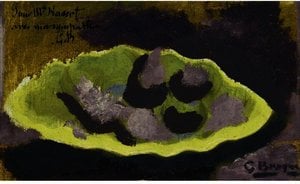
The Green Apples

Georges Braque’s masterful Cubist still life captures the essence of form and texture—green apples arranged in a dynamic circle alongside a lemon—reflecting the groundbreaking artistic innovations of the early 20th century. Explore this iconic piece and bring its timeless beauty into your home.

Explorez la vie et l'art de Georges Braque (1882-1963), une figure clé de la peinture du 20e siècle. Pionnier du cubisme aux côtés de Picasso, connu pour le fauvisme, les collages et les formes géométriques innovantes. Découvrez son héritage chez WahooArt!

Reproduction à l'huile faite à la main

Huile sur toile peinte à la main, avec cadre et dimensions personnalisés, réalisée sur commande par nos artistes. (Commander l'impression Commander l'impressionAcheter l'image haute résolution Acheter l'image haute résolution)

P118B $10
P118H $10
P118W $10
P438Z $10
P508JH $12
P508YH $12
P805H $10
P805Z $10
P919BZ $10
P919G $10
P919XJ $10
P959ZH $10
P968JZ $12
W106C $8
W218G $10
W218JH $8
W218Y $10
W307PJ $10
W316G $10
W316PJ $8
W316Y $10
W398PJ $8
W4111J $10
W500HY $15
W500JH $15
W692G $12
W849H $8
W940BG $15
W953PJ $8

Format standard
sur mesure
CM
INCH

Choisissez parmi nos formats prédéfinis qui respectent les proportions originales de l’œuvre.

largeur
hauteur

Vous pouvez saisir vos propres dimensions pour l'adapter à un cadre ou à un espace spécifique. Si la taille sélectionnée ne correspond pas aux proportions de l'image d'origine, nous recadrerons l'œuvre ou prolongerons la peinture avec des éléments peints à la main supplémentaires. Une maquette numérique vous sera envoyée pour approbation avant le début de la production.
Veuillez noter que l'aperçu à l'écran ne reflète pas le recadrage ou l'extension réels. Seule la maquette montrera fidèlement la composition finale.
Bien que des tailles personnalisées soient disponibles, nous vous recommandons de sélectionner une dimension dans la liste prédéfinie afin de préserver les proportions d'origine.

Exemples de personnalisation possibles : remplacer un visage par la photo du client ; ajouter un animal de compagnie (par exemple, remplacer un chat par un chien) ; inclure un message caché en arrière-plan ; modifier le paysage ou les éléments de l'arrière-plan.
Après la commande, l’équipe WahooArt.com contactera le client par e-mail pour recueillir ses instructions et lui fournira une maquette d’aperçu

Livraison dans le monde entier () en 3 à 4 semaines au lieu des 5 semaines habituelles. (4 septembre). Aucun compromis sur la qualité.

why_choose_icon
Livraison express gratuite dans le monde entier

why_choose_icon
Toile de lin de qualité supérieure
why_choose_icon
Assurance transport complète
why_choose_icon
Garantie de remboursement des droits de douane
why_choose_icon
Garantie de fidélité des couleurs
why_choose_icon
Politique de retour de 60 jours (uniquement en cas de défaut)
why_choose_icon
Garantie de remboursement à 100%
why_choose_icon
Offre de tarifs dégressifs

Prix total

$ 272

reproduction

The Green Apples

Technique de reproduction

Format de la reproduction

-

Prix total

$ 272

Informations clés

  • Artistic style: Analytical Cubism
  • Artist: Georges Braque
  • Location: Private Collection
  • Medium: Oil on canvas
  • Notable elements or techniques: Geometric abstraction
  • Movement: Cubism

Quiz d'art

Chaque question ne comporte qu'une seule bonne réponse.

Question 1:
Georges Braque is best known for his contribution to which artistic movement?
Question 2:
The painting depicts a still life featuring what prominent objects?
Question 3:
What artistic technique is primarily employed in 'The Green Apples' to create a sense of fractured perspective?
Question 4:
The painting's muted color palette contributes to what overall mood or atmosphere?

A Quiet Revolution in Form: Decoding Braque’s The Green Apples

In the quietude of Georges Braque’s 1912 masterpiece, The Green Apples, one finds far more than a simple arrangement of fruit upon a table. At first glance, the viewer is met with a deceptively humble tableau: a collection of verdant apples resting on a plate, accompanied by a bowl and a subtle hint of a lemon. Yet, to look closer is to enter the very heart of the Cubist revolution. This work serves as a profound exploration of visual perception, where the boundaries between object and space begin to dissolve. Braque does not merely present a still life; he invites us into a meditative study of how light, mass, and geometry intersect to create a new reality.

The technique employed here is a masterclass in the analytical approach that defined Braque’s pivotal period. Moving away from the vibrant, emotive outbursts of his Fauvist beginnings, Braque adopts a muted, sophisticated palette dominated by earthy greens, deep browns, and soft ochres. This deliberate restraint prioritizes tonal harmony over mere spectacle, allowing the viewer to focus on the structural rhythm of the composition. Through the use of fragmentation and multiple simultaneous viewpoints, the artist deconstructs the traditional illusion of depth. The apples are not merely painted; they are reconstructed through geometric abstraction, challenging the eye to piece together a fragmented world that exists beyond a single, static perspective.

Historical Resonance and Symbolic Depth

To understand The Green Apples, one must consider the turbulent era from which it emerged. Painted during the height of the Cubist movement alongside his legendary collaborator Pablo Picasso, this work reflects a broader intellectual shift in early 20th-century Europe. As the world faced the complexities of rapid industrialization and the looming shadows of global conflict, artists like Braque sought to dismantle conventional notions of perspective. The painting acts as a blueprint for modern vision, stripping away the superficiality of representation to find the structural truth beneath. It is an era where the mirror of art was shattered, and Braque was one of the primary architects of its reconstruction.

Beyond its formal brilliance, the composition is rich with subtle symbolic resonance. The circular arrangement of the apples serves as a recurring motif for Braque, suggesting themes of wholeness, continuity, and the cyclical nature of time. This sense of stability is punctuated by the sharp, acidic brightness of the lemon on the left, a small but vital disruption that prevents the tonal balance from becoming too static. Even the partially obscured chair in the background provides an anchor of domesticity, grounding the abstract experimentation in a recognizable, human space. For the collector or designer, this piece offers a sophisticated balance of intellectual rigor and domestic warmth.

An Essential Addition to the Modern Interior

For those seeking to curate a space defined by elegance and contemplation, The Green Apples offers an unparalleled emotional impact. It evokes a mood of quiet meditation—a sanctuary of thought in an increasingly loud world. The painting’s ability to command attention through subtlety rather than volume makes it an ideal centerpiece for high-end interiors, whether placed in a minimalist gallery setting or a richly textured study. Its muted tones and organic forms harmonize effortlessly with contemporary decor, providing a sense of historical depth and artistic prestige.

Owning a high-quality reproduction of this work is more than an aesthetic choice; it is an invitation to engage with the very foundations of modern art. It allows the presence of Braque’s revolutionary spirit to inhabit a room, offering daily inspiration through its complex interplay of light and form. Whether you are an art historian captivated by its Cubist lineage or an interior designer looking for a piece that embodies timeless sophistication, The Green Apples remains a profound testament to the power of seeing the world anew.


Biographie de l'artiste

**Jeunesse et formation**

Georges Braque, peintre français renommé, collagiste, dessinateur, graveur et sculpteur, est né le 13 mai 1882 à Argenteuil, dans les Val-d'Oise. Il a grandi à Le Havre et a initialement été formé pour devenir peigneur et décorateur comme son père et son grand-père. Cependant, les inclinations artistiques de Braque l’ont conduit à étudier la peinture à l’École des Beaux-Arts de Le Havre de 1897 à 1899.

**Évolution artistique et fauvisme**

En 1902, après avoir terminé son apprentissage auprès d'un décorateur à Paris, Braque a fréquenté l’Académie Humbert jusqu’en 1904. Cette période a marqué son introduction au fauvisme, un style caractérisé par des couleurs vives et des réponses émotionnelles. Influencé par les œuvres de Henri Matisse et André Derain, Braque a adopté une approche fauviste, comme en témoigne son tableau La Patience (fauvisme, huile sur toile).

**Contribution au cubisme**

La collaboration de Braque avec Pablo Picasso de 1908 à 1912 a conduit au développement du cubisme. Leurs œuvres cubistes analytiques, telles que Georges Braque: La Patience et Pablo Picasso: Le Clarinette(cubisme analytique, huile sur toile), sont aujourd’hui considérées comme des jalons de l'histoire de l'art.

**Héritage et œuvres notables**

* Maisons à l’Estaque : Témoignage de l'utilisation innovante de la géométrie et de la perspective simultanée par Braque. * La Patience(fauvisme, huile sur toile) : démontre le style fauve de Braque. * Le Clarinette(cubisme analytique, huile sur toile) : œuvre cubiste collaborative avec Picasso.

**Musées et collections**

* Musée d'Orsay : présente une vaste collection d'art impressionniste et post-impressionniste, incluant des œuvres de Braque. * Musée de l'Orangerie : expose une large gamme d'œuvres d'art, incluant celles de Braque et d'autres artistes notables.
  • Découvrez-en davantage sur la vie et l’œuvre de Georges Braque sur WahooArt.com
  • Explorez la collection du Musée d'Orsay, présentant des œuvres de Braque et d'autres artistes, sur Musée d'Orsay - Wikipédia
  • Apprenez-en davantage sur le fauvisme et son influence sur le développement du cubisme avec le mouvement artistique fauviste sur WahooArt.com
**Le style innovant de Georges Braque et sa collaboration avec Pablo Picasso continuent d'inspirer les artistes et les amateurs d'art.**
Georges Braque

Georges Braque

1882 - 1963 , France

L'essentiel de l'artiste

  • Artistes Influents:
    • Henri Matisse
    • André Derain
    • Paul Cézanne
  • Date De Décès: 1963
  • Date De Naissance: 13 mai 1882
  • Influence Sur Les Artistes: ['Pablo Picasso']
  • Lieu De Naissance: Argenteuil, France
  • Mouvement Artistique: Cubisme, Fauvisme
  • Nationalité: Française
  • Nom Complet: Georges Braque
  • Oeuvres Notables:
    • Maisons à L'Estaque
    • La Patience
    • Le Clarinette
    • Nature morte avec cruets
Explorez des œuvres d'art classées par thèmes, styles et caractéristiques.