The Genesis of a Fragmented World
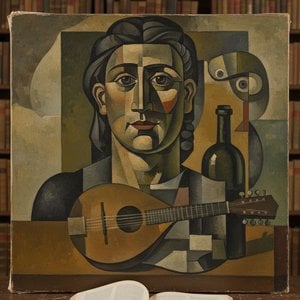
Georges Braque’s “Still Life With Fish,” though its exact dimensions remain elusive, offers a captivating glimpse into the heart of early 20th-century artistic revolution. Born in Argenteuil, France, in 1882, Braque's formative years were steeped in the practicalities of his family’s trade as house painters and decorators – an experience that instilled within him not merely technical skill but a profound understanding of form, structure, and material. This grounding, combined with his rigorous training at the École des Beaux-Arts, provided a crucial foundation for his later radical experimentation. The painting itself is a testament to this duality: a seemingly simple depiction of a fish in a bowl, yet brimming with the intellectual energy of a man grappling with the very nature of representation.
Created during a pivotal period – roughly 1910-12 – “Still Life With Fish” firmly anchors itself within the realm of Analytical Cubism. This movement, spearheaded by Braque and Pablo Picasso, sought to dismantle traditional notions of perspective and spatial illusion. Rather than presenting a single, fixed viewpoint, artists like Braque fractured objects into geometric components, reassembling them on the canvas in a way that challenged the viewer’s perception of reality. The bowl itself isn't rendered as a solid volume; instead, it is dissected into planes, suggesting multiple perspectives simultaneously. This fragmentation isn’t merely stylistic—it reflects a deeper interrogation of how we understand and experience the world around us.
A Symphony of Color and Texture
The painting’s palette is deliberately restrained – dominated by earthy hues of brown, ochre, and muted blues – a characteristic of Analytical Cubism. These colors aren't applied with broad strokes; instead, Braque employs a meticulous layering technique, building up the surface through countless thin glazes. This creates a remarkable sense of texture, inviting close inspection and revealing the intricate process of construction. The blue of the bowl provides a striking contrast to the fish’s skin tone, drawing the eye and emphasizing the object's presence within its contained space. The inclusion of the spoon and cup adds further layers of visual interest, grounding the composition in familiar domestic objects while simultaneously contributing to the overall sense of disorientation.
Beyond mere representation, Braque masterfully utilizes light and shadow to enhance the painting’s spatial ambiguity. The bowl casts a subtle shadow on the surrounding surfaces, suggesting depth and volume without relying on traditional shading techniques. The way the light interacts with the fragmented forms creates an almost sculptural quality, as if the objects themselves are emerging from the canvas.
Symbolism and the Poetics of Observation
While Analytical Cubism often prioritized formal experimentation over overt symbolism, “Still Life With Fish” subtly hints at deeper meanings. The fish itself can be interpreted as a symbol of abundance, fertility, or even mortality – themes frequently explored in still-life paintings of the period. The bowl, representing containment and observation, invites us to contemplate the object within—to consider its origins, its purpose, and its relationship to the wider world. Braque’s meticulous attention to detail suggests a quiet reverence for the ordinary, elevating these commonplace objects into subjects worthy of artistic contemplation.
Furthermore, the painting's fragmented composition mirrors the fragmentation of modern experience – a theme that resonated deeply with artists at the turn of the 20th century. Braque’s work reflects a shift away from romantic idealism and towards a more objective, analytical approach to reality. “Still Life With Fish” is not simply a depiction of objects; it's an exploration of perception, representation, and the very nature of seeing.
Bringing Braque Home: High-Quality Reproductions
WahooArt offers meticulously crafted hand-painted reproductions of Georges Braque’s “Still Life With Fish,” allowing you to bring this iconic work into your home or office. Our skilled artists replicate the painting's intricate details, nuanced color palette, and textural qualities with exceptional precision. Whether you are an art enthusiast, a collector, or simply seeking a unique piece of décor, our reproductions provide an authentic and affordable way to experience the power and beauty of Braque’s vision. Explore our selection today and discover the timeless appeal of this groundbreaking masterpiece.



 Aperçu en situation
 Commander la reproduction peinte à la main
 Envoyer
 Partager
 Détails de l'œuvre

 Télécharger
 Articles similaires
 Radiographie
 Diaporama
 Statistiques
 Lire la suite






































 L'option verre n'est disponible que pour les dimensions inférieures à 110 cm.