


L’œuvre d'art présentée sur cette page est protégée par le droit d'auteur, ce qui signifie que nous ne pouvons légalement créer ou vendre de reproduction identique. Cette protection est appliquée en vertu d'accords internationaux tels que la Convention de Berne et par les lois nationales, notamment celles énoncées par le Loi américaine sur le droit d'auteur - Titre 17.
Cette méthode est pleinement conforme aux réglementations sur le droit d'auteur car elle ne repose pas sur la copie ou la duplication de l'œuvre protégée. Il s'agit plutôt d'une réinterprétation créative — une nouvelle peinture qui s'inspire de l'original sans pour autant lui être identique.
Impressions giclées ou sur toile de qualité musée, avec une production rapide et des finitions au choix. ( Commander la reproduction peinte à la main Passer au format numérique)





























Choisissez parmi nos formats prédéfinis qui respectent les proportions originales de l’œuvre.

Saisissez la largeur et la hauteur souhaitées pour qu'elles s'adaptent à votre cadre ou à votre mur. Une impression peut être recadrée, mais jamais agrandie au-delà de l'image originale ; ainsi, un format de forme différente entraînera la perte d'une partie de l'image. Nous vous envoyons une maquette numérique pour approbation avant toute impression. L'image présentée sur cette page ne montre pas le recadrage réel — seule la maquette le permet.
Livraison dans le monde entier () en 2 semaines au lieu des 4/5 semaines habituelles. (8 novembre)
Fruit Dish
Format de la reproduction
Georges Braque's Fruit Dish, painted in 1908-09, isn’t merely a depiction of apples, oranges, and bananas arranged within a bowl; it’s a pivotal moment in the birth of Cubism – an artistic revolution that fundamentally altered how we perceive and represent reality. Born in Argenteuil, France, Braque's early training as a house painter instilled a deep understanding of materials and structure, a foundation he skillfully combined with his burgeoning artistic vision. This work represents a deliberate departure from traditional still life conventions, moving beyond simple representation towards an exploration of form, space, and the very nature of visual perception. The painting emerged during a period of intense experimentation within the Parisian art scene, fueled by influences ranging from Paul Cézanne’s geometric explorations to the radical ideas circulating amongst Picasso and other avant-garde artists.
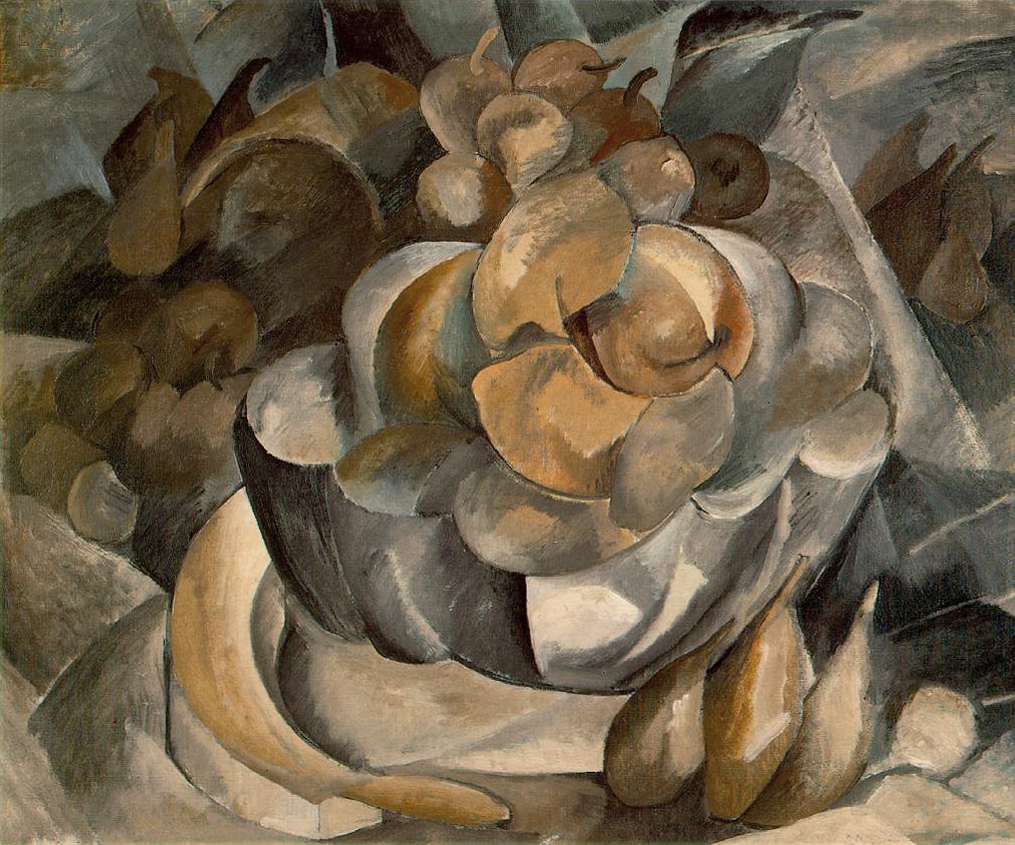
What truly distinguishes Fruit Dish is its innovative use of papier collé – a technique that would become inextricably linked to the development of Synthetic Cubism. Braque, while traveling with his friend Pablo Picasso, stumbled upon a roll of faux bois wallpaper depicting stylized oak panels at a shop in Avignon. Recognizing its potential, he meticulously cut and pasted fragments of this printed paper onto a canvas, layering it with charcoal lines and gouache. This seemingly simple addition dramatically transformed the painting, introducing an element of artificiality and challenging the illusion of depth traditionally achieved through perspective. The wallpaper’s inherent flatness – a deliberate contrast to the painted fruit – forces the viewer to reconsider their relationship with the image, questioning what is “real” and what is constructed.
Beyond its technical innovations, Fruit Dish is rich in symbolic meaning. The arrangement of the fruits – apples, oranges, and bananas – can be interpreted as representing abundance, nourishment, and perhaps even a subtle commentary on consumer culture. The bowl itself acts as a central organizing element, yet it’s fragmented and distorted, mirroring the fractured perspective characteristic of Cubism. Braque wasn't simply depicting objects; he was dissecting them, breaking them down into their essential geometric components and reassembling them in an entirely new way. The inclusion of the potted plant on the left side adds a touch of nature, grounding the still life within a broader context while simultaneously highlighting its artificiality.
Fruit Dish stands as a landmark work in the history of modern art. It’s not just a beautiful painting; it's a demonstration of Braque’s intellectual rigor and his willingness to push the boundaries of artistic convention. The techniques he pioneered – particularly the use of papier collé – would profoundly influence artists like Picasso, Matisse, and others, shaping the trajectory of 20th-century art. Reproductions of this iconic piece offer a remarkable opportunity to experience firsthand the genesis of Cubism and appreciate Braque’s groundbreaking contribution to our understanding of form, space, and perception. Its enduring appeal lies in its ability to simultaneously challenge and delight, inviting viewers to engage with the image on multiple levels.
Avec son atmosphère Sérénité, « Fruit Dish » est idéal pour une Salon.
«Fruit Dish» de Georges Braque est une œuvre réalisée en Huile sur toile, datant de 1908.
Visualisez «Fruit Dish» de Georges Braque sur votre propre mur grâce à la page Aperçu en RA de l'œuvre, en utilisant la réalité augmentée sur un appareil compatible.


1882 - 1963 , France

Explore the profound evolution of Cubist still life, from Cézanne's structural foundations to the fragmented brilliance of Braque and Léger. Discover how geometric abstraction redefined reality through a sophisticated lens of form, color, and modern artistic mastery.

Discover the profound legacy of Georges Braque. Our expert guide explores the evolution of Cubism, from Analytic deconstruction to Synthetic innovation, offering deep insights for discerning art collectors and connoisseurs of modern masterpieces.

Explore the profound beauty of fruit arrangement masterpieces. From Dutch Golden Age opulence to Baroque chiaroscuro, discover the art history, symbolism, and timeless elegance of classical still life paintings for the discerning collector.
 Aperçu en situation
 Envoyer
 Partager
 Détails de l'œuvre
 Guide
Guide

 Télécharger l'image
 Articles similaires
 Radiographie
 Diaporama
 Questions et réponses
 Statistiques

 Lire la suite









 L'option verre n'est disponible que pour les dimensions inférieures à 110 cm.


